
Simple tweak, brings big leap for electro-optics
A novel nano soft gold–liquid crystal hybrid material that is stable to high temperature fluctuations and has increased optical features can facilitate next generation optical technologies, energy-efficient electronics and advanced sensors.
Nano–soft hybrid materials mark an exciting frontier in materials science—where the precision of nanotechnology meets the versatility of soft matter. These materials have a significant demand in cutting-edge electro-optical materials.
A group of researchers from the Centre for Nano and Soft Matter Sciences (CeNS), Bengaluru, an autonomous institute of the Department of Science and Technology (DST), led by senior scientist Dr. B.L.V. Prasad and Ph.D. scholar Muskan Duggal with key contributions from Dr. S. Krishna Prasad, Dr. D. S. Shankar Rao, Dr. C.V. Yelamaggad, and Dr. Santosh Khatavi have used molecular engineering and minimal processing to bring about dramatic structural and functional transformations resulting in an gold liquid crystal (Au-LC) composite with high thermal stability and enhanced optical features.
Through molecular engineering and minimal processing, researchers brought about significant structural and functional transformations leading to extraordinary performance in the new material.
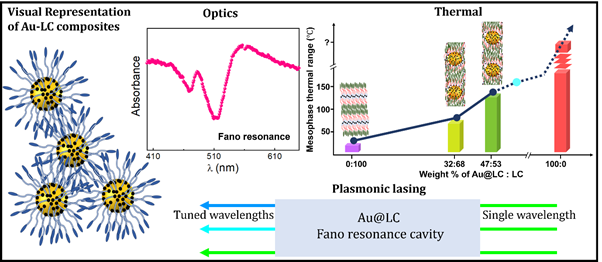
The work involved the synthesis of a molecule called an amine-functionalized liquid crystal (LC), that acted as a reducing agent, triggering formation of gold nanoparticles and also stabilized them in situ, obviating the need for additional reagents.
This smart molecular choice streamlined the synthesis and unlocked significant control over hybrid structure, demonstrating how simple ligand engineering can lead to versatile results in material design. The innovative design drastically enhanced thermal stability ranges from 27 ℃ for pure LC to 145 ℃ for the hybrid material (Au-LC composite), and unprecedented optical properties such as emergence of a rare and intriguing optical effect called Fano-like resonance that olds tremendous potential in advanced light-based technologies.
It is used in plasmonic lasers (spasers), which are extremely small yet powerful light sources, in ultra-sensitive sensors that can detect tiny amounts of chemicals, pollutants, or biological markers and in specially engineered materials that guide light in precise ways. This helps create high-performance filters and even invisibility cloaks. These breakthroughs are shaping future of optics, nano-photonics, and biomedical imaging.
The distinctive optical behavior that emerged from simple nano–soft hybrid material prepared by CeNS researchers suggests that we may now have a more accessible and efficient route to achieving effects that once required intricate and expensive systems.
The findings by the team published in ACS Applied Nano Materials highlight the potential of these hybrids to serve as practical platforms for real-world applications—enabling the development of smarter sensors, responsive coatings, and next-generation photonic devices with greater ease and scalability.
Publication link: 10.1021/acsanm.5c00923