
Trump Says There Will Be ‘No Deal’ as Israel Unleashes Wave of Attacks on Iran

President Trump repeated his call for the “unconditional surrender” of the Islamic Republic. Israel said it had struck a leadership bunker in Tehran, and sent thousands fleeing a bombardment in Lebanon.

President Trump on Friday demanded “unconditional surrender” by Iran, saying there would be no negotiated end to the war, while Israeli officials said their forces had destroyed a Tehran bunker that had been used by Iran’s supreme leader, in a fresh wave of heavy strikes on Tehran.
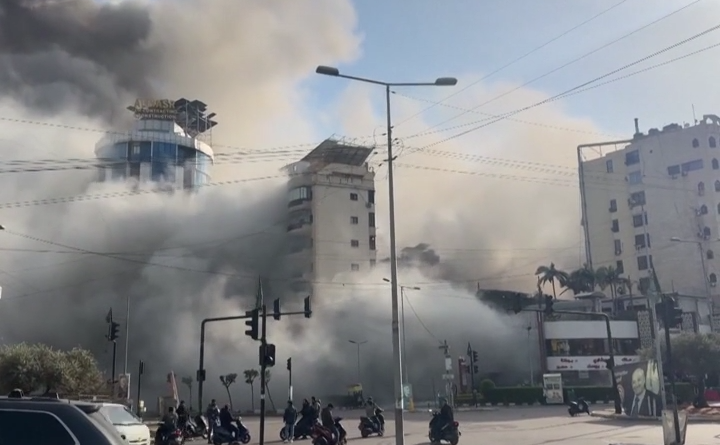
The Israeli military also pounded Beirut and issued more evacuation warnings in Lebanon as it intensified its campaign there against Iran-backed Hezbollah militants.
Mr. Trump wrote on Truth Social that there “will be no deal with Iran except UNCONDITIONAL SURRENDER!” He made the post after Masoud Pezeshkian, the Iranian president, said that some countries had begun what he called “mediation efforts,” without elaborating on who was involved.
The comments highlighted the shifting U.S. stances in the war that began with U.S.-Israeli strikes on Iran six days ago. Mr. Trump told The Atlantic on Sunday, “They want to talk, and I have agreed to talk, so I will be talking to them.” And Iran’s intelligence ministry has reached out to the C.I.A. through intermediaries to discuss terms for ending the war, according to officials briefed on the outreach.
Iran’s Islamic Revolutionary Guards Corps launched a wave of drones and missiles at Israel, according to a statement from the force reported by IRNA, the country’s state news agency. Air-raid sirens went off in Tel Aviv, and the Israeli military said that it had detected missile launches from Iran, though there were no immediate reports of major damage.
Iranian state television reported attacks on a compound in Tehran where the supreme leader, Ayatollah Ali Khamenei, lived until he was killed in the initial bombing on Saturday. Hours later, Israel published video showing a series of airstrikes in roughly the same area as the compound, saying that the military had destroyed an underground bunker that had been used by Ayatollah Khamenei and other senior officials, and also released graphics that it said showed the layout of the facility.
Two Israeli officials, speaking on condition of anonymity to discuss sensitive details, said the bunker was beneath Ayatollah Khamenei’s residence, which had already been bombed. It was unclear whether anyone was killed in the attack.
Israel’s air forces shifted their focus back to Iran late Friday after a day of heavy bombardment of Lebanon, which was fast becoming one of the hottest fronts in the spreading regional conflict. With smoke plumes rising from new strikes in and around Beirut, the capital, the Israeli military told more villagers in the Bekaa Valley, a Hezbollah bastion, to move north, indicating airstrikes were imminent.
Hezbollah claimed a string of attacks on Friday against Israeli forces in Lebanon, and the Israeli military said that five soldiers had been severely wounded by projectile fire.
Iran’s foreign minister, Abbas Araghchi, warned on Thursday that the conflict could become a “quagmire for whomever chooses to pursue it.” U.S. and Israeli officials offered a different assessment, saying their ongoing campaign had greatly degraded Tehran’s military capabilities.
Here’s what else we’re covering:
-
Gulf nations: As Iran’s retaliatory strikes hit U.S. allies in the Persian Gulf, Qatar’s foreign ministry said Tehran had carried out an attack on buildings in neighboring Bahrain where members of the Qatari Navy were, but reported no injuries. Saudi Arabia’s defense ministry said that it had intercepted and destroyed three ballistic missiles launched toward a military complex south of the capital, Riyadh, while the United Arab Emirates said it had intercepted nine ballistic missiles and more than 100 drones on Friday.
-
Oil and the economy: Stocks fell sharply as trading opened in New York as the surge in oil and gas prices driven by the conflict set off fears of resurgent inflation. A senior official in Qatar warned in a Financial Times interview of lengthy disruptions to energy production, and shipping through the Strait of Hormuz remained effectively closed because of attacks. Energy Secretary Chris Wright said in an interview on Fox News that the U.S. military would “escort ships through the straits and get the energy moving again” as soon as it was “reasonable” to do so.
-
Evacuations: The State Department is battling accusations from diplomats and travelers who say the Trump administration endangered U.S. citizens by beginning a war without adequate plans for helping Americans leave the Middle East.
-
Death toll: Hundreds of people have been killed in Iran since the start of the U.S.-Israeli attacks, according to the Red Crescent Society, Iran’s main humanitarian relief organization, including at least 175, many of them children, who died in the bombing of a girls’ elementary school. More than 200 people in Lebanon have been killed, according to the Lebanese health ministry. ( With courtsey from The New York Times)