
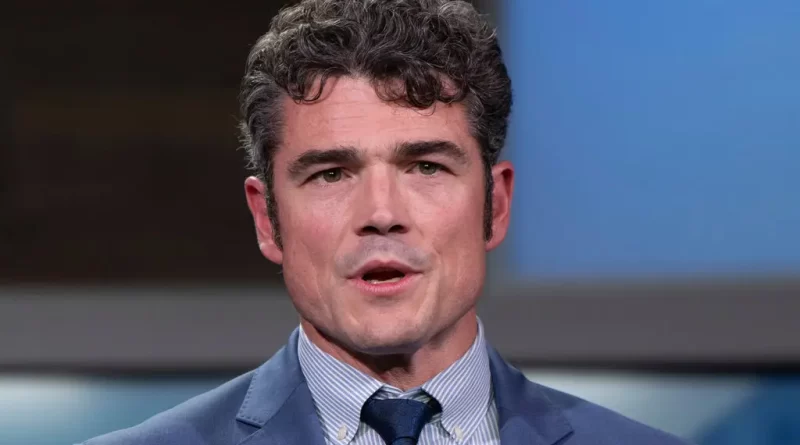
Joe Kent, a Top U.S. Counterterrorism Official, Resigns Over the Iran War
Mr. Kent is the highest-ranking Trump administration official to quit in opposition to the conflict. He said pressure from Israel had pushed the president into war against Iran.


Julian E. BarnesRobert Draper and Luke Broadwater
Reporting from Washington
One of the United States’ top counterterrorism officials resigned on Tuesday, citing his opposition to the war in Iran and what he said was Israel’s influence over the Trump administration’s policies, a sign of emerging divisions in the Republican coalition.
The official, Joe Kent, is the first senior member of the administration to quit over the war.
The seemingly open-ended nature of the U.S.-Israeli war in Iran has created strong divisions among Mr. Trump’s supporters. An anti-interventionist wing of the coalition, which supported President Trump because of his criticism of long overseas conflicts, has quickly become uneasy with the war, which has lasted 18 days with no immediate sign of ending.
“I cannot in good conscience support the ongoing war in Iran,” Mr. Kent, the director of the National Counterterrorism Center, wrote in a letter to Mr. Trump. “Iran posed no imminent threat to our nation, and it is clear that we started this war due to pressure from Israel and its powerful American lobby.”
Mr. Kent’s resignation came as a surprise. The top ranks of Mr. Trump’s administration have been remarkably stable, and no senior leader has quit while laying out a sharp policy difference with the president.
Unsurprisingly, Mr. Kent’s stance earned a sharp rebuke from Mr. Trump.
“I always thought he was a nice guy, but I always thought he was weak on security,” Mr. Trump told reporters in the Oval Office on Tuesday. “It’s a good thing that he’s out because he said Iran was not a threat.”
There are other senior administration officials who, like Mr. Kent, are skeptical of long overseas military engagements and often argue for a more restrained foreign policy, including Tulsi Gabbard, the director of national intelligence and Mr. Kent’s boss, and Vice President JD Vance. But the anti-interventionist wing has had a more muted influence in Mr. Trump’s government than some expected.
And it is unlikely Mr. Kent’s exit will lead to a parade of other resignations. Ms. Gabbard and Mr. Vance have taken care not to let themselves get too far out of step with Mr. Trump.
Still, others who have opposed foreign interventions praised Mr. Kent’s action. Mr. Kent is a close friend of Tucker Carlson, the Trump ally who has emerged as the sharpest critic of the war.
“Joe is the bravest man I know, and he can’t be dismissed as a nut,” Mr. Carlson said in a brief interview. “He’s leaving a job that gave him access to highest-level relevant intelligence. The neocons will now try to destroy him for that. He understands that and did it anyway.”
Mr. Kent has long had a penchant for conspiracy theories, claiming without evidence that intelligence officials had a hand in the violence around the Jan. 6, 2021, attack on the Capitol.
In the letter, Mr. Kent wrote about what he saw as a “misinformation campaign” by high-ranking Israeli officials and the news media, which he said had undermined Mr. Trump’s “America First platform and sowed pro-war sentiments to encourage a war with Iran.”
Some Republicans were quick to call out Mr. Kent for his remarks on Israel.
Representative Don Bacon, a former brigadier general in the Air Force who serves on the Armed Services Committee, reposted Mr. Kent’s letter with the comment “Good riddance.”
“Anti-Semitism is an evil I detest, and we surely don’t want it in our government,” Mr. Bacon wrote on social media.
Mr. Kent’s post included a resignation letter addressed to Mr. Trump, in which he argued that Israeli officials drew the United States into the conflict with Iran.
A veteran of the Iraq war, Mr. Kent said that the arguments in support of attacking Iran, and promises of a swift victory, echoed the debate over going to war against Iraq in 2003.
Mr. Kent also referred to his late wife, Shannon, a military cryptologist who was killed in a suicide attack in Syria in 2019.
“As a veteran who deployed to combat 11 times and as a Gold Star husband who lost my beloved wife Shannon in a war manufactured by Israel, I cannot support sending the next generation off to fight and die in a war that serves no benefit to the American people nor justifies the cost of American lives,” he wrote.
Senator Mark Warner of Virginia, the top Democrat on the Senate Intelligence Committee, has long criticized Mr. Kent, accusing him of politicizing intelligence. In a statement on Tuesday, he said Mr. Kent’s record was troubling and that he should never have been confirmed. But Mr. Warner added that he agreed with him, at least in part, on the Iran war.
“On this point, he is right: There was no credible evidence of an imminent threat from Iran that would justify rushing the United States into another war of choice in the Middle East,” Mr. Warner said.
As the varying responses to Mr. Kent’s resignation inside Republican circles showed, he has raised questions about how deep the war on Iran will crack the president’s Make America Great Again coalition, which has been positioned against wars of choice.
Mr. Vance has expressed some skepticism about the war, and Mr. Trump has said Mr. Vance was “less enthusiastic” about the mission than others in the administration.
Questioned in the Oval Office about his views on the war, Mr. Vance said Monday he would not allow the news media to drive a “wedge” between him and the president.
Still, while polling shows Americans are deeply divided about the war, most Republicans have lined up in support of Mr. Trump’s actions.
As for his Republican critics, Mr. Trump declared that they are no longer part of the MAGA movement.
“THEY ARE NOT MAGA, I AM,” he wrote this weekend on Truth Social, “and MAGA includes not allowing Iran, a Sick, Demented, and Violent Terrorist Regime, to have a Nuclear Weapon to blow up the United States of America, the Middle East and, ultimately, the rest of the World. MAGA is about stopping them cold, and that is exactly what we are doing.”
Senator Lindsey Graham, Republican of South Carolina, said Mr. Kent was “echoing the Democratic talking points.”
And Laura Loomer, a right-wing provocateur, has been a consistent critic of Mr. Kent and his family, despite their shared focus on the threat of Islamic terrorism and interest in conspiracy theories.
On Tuesday, Ms. Loomer called out Mr. Kent as an ally of Mr. Carlson and reiterated her criticism of his wife, Heather, as being anti-Israel.
Still, there is no question that Mr. Kent, despite his penchant for conspiracy theories and his deep skepticism of Israel, will be seen as a credible dissenter.
“Kent’s former experience as a seasoned combat veteran and with U.S. special operations and intelligence elements gave him a unique perspective on the risks and dangers associated with conflicts overseas,” Javed Ali, a former senior U.S. counterterrorism official who now teaches at the Gerald R. Ford School of Public Policy at the University of Michigan, wrote in an email.
Mr. Kent has been a critical adviser to Ms. Gabbard and has been advocating a more restrained foreign policy inside the administration.
Ms. Gabbard is set to appear before the Senate on Wednesday and the House on Thursday for annual hearings on threats to the United States. And Mr. Kent’s resignation is likely to be a focus of various lawmakers’ questions.
Mr. Kent did not respond to a request for comment. He is a twice failed congressional candidate in Washington State.
Mr. Kent is not the first official to publicly resign from the administration over the war. A lower-level Trump administration appointee, Sameerah Munshi, announced last week that she was resigning from the White House Religious Liberty Commission, citing the war with Iran as a major factor.
She wrote on social media that most Americans opposed the U.S.-Israel campaign, and said that “our tax dollars are funding the very violence that we oppose, both against innocent Palestinians and now Iranians.” Ms. Munshi, a Muslim woman, added that she had seen firsthand the “injustice” carried out by members of the commission, some of whom she accused of mocking her religion and treating her community “with hostility.”
Ms. Munshi said she was also resigning because the commission had revoked the membership last month of Carrie Prejean Boller, a Christian model accused by the chair of derailing a hearing on antisemitism.
=============================================================
Robert Jimison, Eric Schmitt and Edward Wong contributed reporting.
Julian E. Barnes covers the U.S. intelligence agencies and international security matters for The Times. He has written about security issues for more than two decades.
Robert Draper is based in Washington and writes about domestic politics. He is the author of several books and has been a journalist for three decades.
Luke Broadwater covers the White House for The Times.