
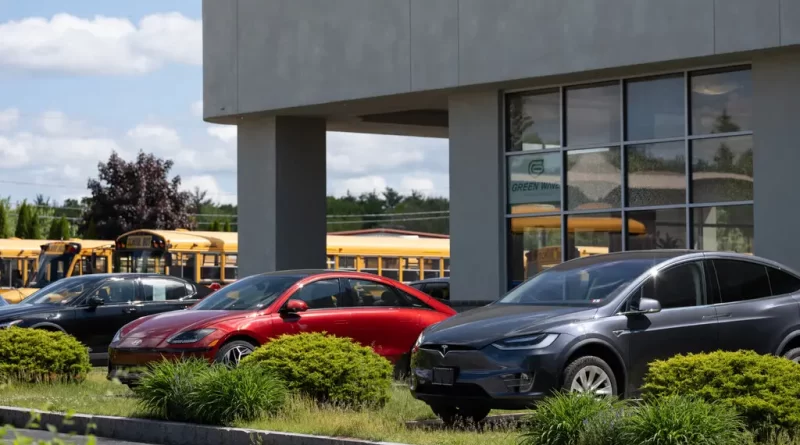
What to Know About Electric Cars When Gas Prices Are Surging

War in Iran has disrupted global oil supplies, which is prompting some car shoppers to look for ways to climb off “the gas-price roller coaster.”

Electric car owners may be feeling smug because they don’t need to worry about soaring gasoline prices. And people with combustion engine cars may be wondering whether it’s time to buy an electric vehicle.
It’s anyone’s guess how long war with Iran will last and how high oil prices will climb. But the argument for electric vehicles has clearly become stronger.
Whether electric vehicles are a good option for any individual or family depends on many factors, including where you live, whether you have access to a charger and how much you drive.
In the United States, prices for new electric vehicles have fallen but still average $6,500 more than vehicles that run on fossil fuels, according to Cox Automotive. From a purely financial point of view, an electric vehicle makes sense for people who will save that much on fuel and maintenance during the time they own it.
The New York Times offers a tool to help people make that calculation based on local electricity prices and driving habits. But there is more to the decision than dollars and cents. Some benefits of electric vehicles are hard to put a price on, like the peace of mind that comes from not being at the mercy of geopolitics.
There are tentative signs that “people want to be taken off the gas-price roller coaster,” said Jessica Caldwell, head of insights at Edmunds. The share of people researching electric vehicles on Edmunds’s online car shopping site rose to 24 percent at the beginning of March from 21 percent in early February.
Here are some things to consider if you’re thinking about electric vehicles.
E.V.s are getting more affordable.
Last year, Congress eliminated a federal tax credit that could close the price gap between new electric vehicles and cars that run on gasoline. But some states and utilities still offer credits, rebates or other financial support for electric car buyers, and there are exceptionally good deals to be had on used electric vehicles.
Illinois and New Jersey offer residents up to $4,000 in incentives depending on their income. New Yorkers are eligible for incentives of up to $2,000.
While new electric vehicles are more expensive than comparable gasoline-powered cars, used electric vehicles are often cheaper.
A used Tesla Model 3, Ford Mustang Mach-E or Hyundai Ioniq 5 sells for about the same price as a used Toyota RAV4, Nissan Rogue or Honda CR-V, according to Recurrent, a firm that tracks the market for used electric vehicles. But used electric vehicles are likely to have been driven for fewer miles than the gasoline cars and trucks and to be newer.
“And it’s probably loaded with a lot more cool technology inside,” said Scott Case, the chief executive of Recurrent. “It boggles the mind that that free lunch hasn’t been taken.”
Car buyers are noticing. Sales of used electric vehicles in February rose 29 percent from a year earlier, according to Cox.
Automakers are introducing new electric models.
Some automakers delayed or scrapped electric models after federal tax incentives disappeared last year. This month, Honda canceled production of three new electric vehicles in the United States. Ford Motor has stopped making the F-150 Lightning pickup.
The cancellations may create the impression that electric vehicles are hard to find. That is not the case. There is a growing selection of moderately priced cars that charge faster and travel farther between charges than vehicles available a few years ago.
Toyota and its luxury brand Lexus, which had been slow to sell electric vehicles, will sell four new models this year. Rivian and Lucid, whose vehicles sell for more than $70,000, are preparing to sell models for around $50,000.
General Motors has reintroduced the Bolt compact with a starting price below $30,000. The Nissan Leaf, one of the first mass-produced E.V.s, has gotten cheaper and better, with a starting price under $30,000 and 300 miles of range.
Tesla began selling entry-level versions of its Model 3 sedan and Model Y sport utility vehicle last year for $37,000 and $40,000 before destination charges.
The supply of used electric vehicles is expected to increase in coming months as hundreds of thousands of leases expire. That should help keep prices low.
Charging electric cars can be cheap.

Electricity is not immune to price increases, but it generally doesn’t swing as much as gasoline. The cost per kilowatt at a public fast charger has barely budged since the war in Iran began on Feb. 28, according to Paren, which tracks data on electric vehicles.
Meanwhile, gasoline prices have risen about 30 percent nationwide. In many states, gasoline has risen more than $1 per gallon.
The fuel cost savings from electric vehicles are greatest for homeowners who can install chargers in their garage or driveway. Home chargers can replenish a car’s battery overnight, easily taking care of daily driving needs for most people.
A home charger eliminates most refueling stops, except on long trips. The cost of installing one varies widely but is usually at least $1,000. Some utilities and state governments offer incentives that cover part of the cost. Electric vehicles can also charge at standard outlets, but it can take several days to refill a typical battery.
Some utilities, including Con Edison in New York, Georgia Power and Pacific Gas & Electric in California, offer lower electricity rates to people who charge their vehicles when demand for power is lower, usually at night. Charging a vehicle at home costs a few dollars per session.
“Anyone who can charge at home is a really good candidate,” said Stephanie Valdez Streaty, director of industry insights at Cox Automotive.
People who can’t install home chargers may be able to use what are known as Level 2 chargers, which are increasingly found at apartment complexes, shopping centers or office parking lots. These chargers are generally inexpensive or even free but take several hours to refill a battery.
Many electric car drivers use fast chargers as their main fuel source, charging companies say, much the way owners of conventional vehicles use gas stations. The time to refuel at fast chargers is dropping to less than half an hour because of technical advancements.
A road trip with an electric vehicle takes some planning. But it’s getting easier. There are more than 72,000 fast-charging ports in the United States, according to Paren, about 2,000 more than at the start of the year.
Fast chargers can be expensive, however, in some cases more costly per mile than filling up with gasoline.
Electric cars also require less maintenance.
Electric vehicles don’t need oil changes and don’t have fuel pumps, mufflers and other parts that wear out and need to be replaced. Brakes tend to wear more gradually because of systems that recover energy when the car slows down.
But these vehicles tend to be heavier and can wear out tires more quickly. Many owners, however, report getting 40,000 miles or more before needing new tires as long as they don’t drive aggressively.
Contrary to widespread perception, batteries do not quickly lose their ability to hold a charge. On average, they still have 95 percent of their original capacity after five years, according to Recurrent.
Electric vehicles tend to be less reliable than hybrids or cars that run solely on gasoline or diesel, largely because the technology is new. But as the industry has gotten better at making them, the cars have become more reliable.They are likely to keep getting better and someday become more reliable than cars that run on fossil fuels.
“It isn’t necessarily an issue with the cars themselves, something that’s fundamentally less reliable about an E.V.,” said Keith Barry, senior autos reporter at Consumer Reports. “If you think about it, an E.V. should be more reliable because it has fewer moving parts and less to worry about.” ( New york Times)
=====================================================
Francesca Paris contributed reporting.
Jack Ewing covers the auto industry for The Times, with an emphasis on electric vehicles.