
Tehran Fires New Barrages After U.S. Claims Progress on Talks
Israeli officials said missiles launched from Iran had hit Tel Aviv and other parts of the country, and the Kurdish region of Iraq was also struck. In Bahrain, an Iranian missile hit Emirati military forces.
 Gabby SobelmanYeganeh Torbati and Natan Odenheimer-
Gabby Sobelman reported from Rehovot, Israel.
Waves of Iranian missiles targeted Israel and Iraq on Tuesday, and Persian Gulf nations also reported new strikes after the United States and Iran sent conflicting signals about whether they were negotiating an end to the war.
The strikes were the latest reminder that Tehran is still able to inflict damage across the region, despite claims by American and Israel officials that its ballistic missile program has been severely battered.
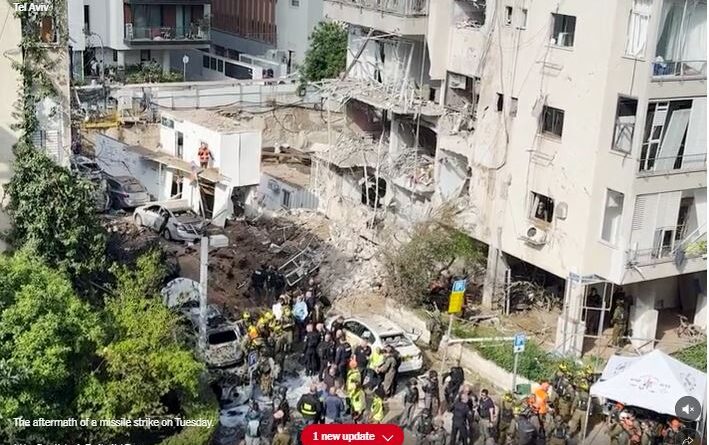
The Israeli authorities said missiles launched from Iran hit Tel Aviv and other parts of the country on Tuesday. A direct hit in Tel Aviv caused extensive damage to at least three residential buildings, they said. At least six people were treated for injuries in Tel Aviv, according to the national emergency service.
In the semiautonomous Kurdish region of Iraq, a volley of six Iranian ballistic missiles killed six Kurdish fighters and wounded 30 others, the regional government said. Iran did not immediately comment publicly on the attack.
Persian Gulf nations also reported more drone and missile launches. In Bahrain, an Iranian missile attack killed a Moroccan contractor working for the Emirati armed forces and injured five Emirati service members, the Emirati defense ministry said on Tuesday.
The continued hostilities followed President Trump’s comments on Monday that the United States and Iran were engaged in “very strong talks” to end the war and that he would postpone a deadline for a threatened attack on Iranian power plants. Iran denied that any negotiations were happening.
Here’s what else we’re covering:
-
Lebanon: Israel’s defense minister said its military would expand its occupation of southern Lebanon, retaining control of territory south of the Litani River. The waterway has long served as a geographic boundary in conflicts between Israel and Hezbollah. It is unclear whether Israel would deploy troops across the entire area or rely on its air force for some parts.
-
Saudi Arabia: The kingdom’s de facto leader, Crown Prince Mohammed bin Salman, has been pushing Mr. Trump to continue the war against Iran, according to people briefed by American officials on the conversations.
-
Group of 7: Secretary of State Marco Rubio is set to travel to France on Friday to discuss the war and other topics with diplomats from the Group of 7 nations.
-
Death tolls: Iran’s U.N. ambassador said that at least 1,348 civilians had been killed in the country since the start of the war — a toll that has not been updated for over a week. More than 1,000 people in Lebanon have been killed, the authorities there said on Thursday. At least 15 people were killed in Iranian attacks on Israel, officials said. The American death toll stood at 13 service members.
-
Energy crisis: Iran’s effective closure of the Strait of Hormuz, a conduit for a fifth of the world’s oil, along with recent attacks on oil and gas infrastructure in the Persian Gulf, is rippling through the world’s economy. The international benchmark for crude oil was trading above $100 on Tuesday. The Philippines declared a state of national energy emergency, and South Korea is urging people to take shorter showers and to avoid charging phones and electric vehicles at night.
-
Iran: A former Islamic Revolutionary Guards Corps general, Mohammad Bagher Zolghadr, has been named as Iran’s top security official, an aide to the Iranian president announced on Tuesday. He replaces Ali Larijani, who was killed in an Israeli attack last week.