
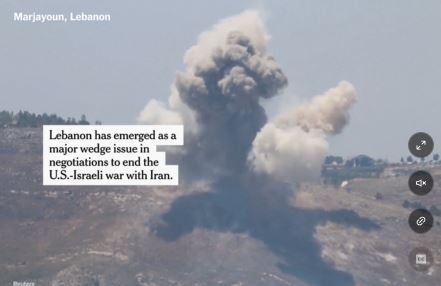
Iran War Live Updates: U.S. Launches Strikes on Iran; Tehran Claims Attacks on U.S. Fleet

https://www.nytimes.com/video/world/middleeast/100000010954773/lebanon-israeli-strikes-trump-iran-helicopter.html?smid=url-share
The exchange came after President Trump said Iranian forces had shot down a U.S. Apache helicopter near the Strait of Hormuz.

The United States and Iran exchanged attacks early Wednesday in the Middle East after the downing on Monday of a U.S. helicopter gunship near the Strait of Hormuz.
U.S. Central Command later said that Air Force and Navy jets had struck Iranian air defenses, ground control stations, and surveillance radar sites near the Strait of Hormuz.
The scale of damage was not immediately clear. Iran’s state television said that explosions and air defense sirens were heard in several cities along Iran’s Persian Gulf coast, including the city of Sirik and the island of Qeshm.
Iran then said that it had launched drone strikes against the U.S. Navy’s Fifth Fleet in Bahrain, where the government reported that warning sirens had been activated. Iran also said it had launched 21 attacks on U.S. bases in the region, including in Jordan, but U.S. Central Command said that was not the case.
A U.S. official said Iran launched multiple missiles and drones at U.S. bases around the Middle East, and nearly all were intercepted, according to initial American assessments. There have been no reports of American casualties, and no reports as yet of damage to U.S. bases in the region from the Iranian attacks, the official said.
In a statement, Central Command called the U.S. strikes “self-defense” operations carried out on President Trump’s order, saying that they were “a proportional response to unjustified Iranian aggression.” Central Command said the airstrikes were launched at 5 p.m. Eastern time, or 12:30 a.m. on Wednesday in the Middle East.
On Tuesday, Mr. Trump had blamed Iran for shooting down the aircraft. “The United States must, of necessity, respond to this attack,” he said on social media.
After the U.S. strikes began, Iran’s foreign minister, Abbas Araghchi, said in a social media post that his country’s armed forces would “leave no attack or threat unanswered.”
Mr. Trump did not offer any more details on the downing of the U.S. Army Apache helicopter. Iran did not take responsibility for the attack, and its state broadcaster, IRIB, quoted an unnamed military official who said the country had conducted no military operation over the strait in the prior 24 hours.
The U.S. and Iranian exchanges came after a deepening Israeli assault across southern Lebanon on Tuesday, including on the large city of Tyre, where at least eight people were reported to have been killed. Hostilities have flared in recent days after Israeli strikes on Lebanon prompted Iranian retaliatory strikes on Israel and waves of tit-for-tat strikes.
The latest attacks underlined how Lebanon has emerged as a major wedge issue in efforts to negotiate an end to the U.S.-Israeli war with Iran.
Iran had warned Israel that attacks on southern Lebanon would trigger another wave of retaliatory strikes. But Iran had not acted upon that threat when the wave of U.S. strikes began hitting its territory.
Mr. Trump has repeatedly said the United States and Iran were nearing an agreement to end the war, resolve the fate of Iran’s nuclear weapons program and reopen the Strait of Hormuz, a vital artery for oil and gas shipments.
Here’s what else we’re covering:
-
Lebanon warnings: The Israeli military called on Tuesday for the evacuation of the entire city of Tyre, one of the largest cities in southern Lebanon, including, for the first time in the war, the Christian quarter of the ancient port city.
The mother sat on the curb outside a hospital in southern Lebanon, holding her phone and pleading with a photo of her sons on its screen.
“I’m waiting for you, answer me, answer me,” the woman, Fatima Kholeif, cried. “I’m your mother, just answer me.”
Her relatives huddled around her, unsure of what to do. When one tried to coax the phone from Ms. Kholeif’s hands to calm her down, she just clutched it harder. Didn’t they understand? The photos were all she had left of her sons — the sons who had just bought her hair dye so she could color her wispy, gray curls, a respite from the Israeli bombing. The sons who had kissed her cheeks that morning as they left for work harvesting oranges in an orchard nearby. The sons who were killed in that orchard in an airstrike.
-
Markets: The price of oil rose slightly in the afternoon after Mr. Trump threatened to retaliate against Iran for the downing of the helicopter. Still, prices were lower than they were two days ago, after an exchange of strikes between Israel and Iran.
Oil prices rose on Monday after Iran and Israel exchanged strikes, casting fresh doubt on the future of a fragile cease-fire in the Middle East and stoking fears of an escalation in violence.
The strikes came after Israel attacked the outskirts of Beirut, targeting Hezbollah, the Iranian-backed militant group. Iran retaliated by firing a barrage of ballistic missiles, which prompted a counterattack from Israel. The attack and counterattack are the first such hostilities since a cease-fire paused the war with Iran two months ago.
President Trump said on Monday that Israel and Iran should “immediately stop” the strikes and suggested that a more enduring peace deal was in the works. The rise in oil prices moderated somewhat during a lull in the fighting.
-
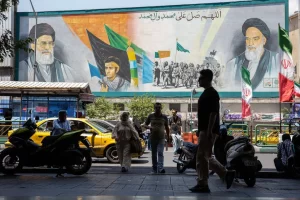
Tehran this week. Hard-liners in Iran could derail what American officials have described as the hazy outlines of an accord.Credit…Arash Khamooshi/Polaris for The New York Times -
Negotiations: The Trump administration’s negotiations with Tehran have focused on four major elements of a nuclear agreement that U.S. officials say would grind Iran’s program to a halt for 15 years or so.
In the days before the latest flare-ups of violence in the Middle East, President Trump’s aides were negotiating with Tehran on four major elements of a nuclear agreement that U.S. officials contend would grind the program to a halt for 15 years or so.
The negotiations, according to U.S. officials and diplomats who have been briefed on the confidential talks, have gone considerably beyond discussion about reopening the Strait of Hormuz, which the Iranians have all but shut down for 101 days.
The result is what American officials describe as the hazy outlines of an accord — assuming the Islamic Revolutionary Guards Corps and hard-line Iranian politicians do not overrule Iran’s chief negotiator, Foreign Minister Abbas Araghchi, or torpedo the much more detailed talks that the United States has proposed to hold in Switzerland this summer.