
IT’S NOT JUST FRANCE. EUROPE’S POLITICAL CENTER IS CRUMBLING.

Europe’s centrist parties are losing ground among young people and workers, who are increasingly tempted by populist promises of radical change.

(Steven Erlanger, based in Berlin, writes about European politics and diplomacy.)
Centrist parties are in trouble in Europe’s largest and most important nations. Anger over low economic growth, high inflation, sizable government debt and poor prospects for the young are feeding protest and populist parties of the far right and far left.
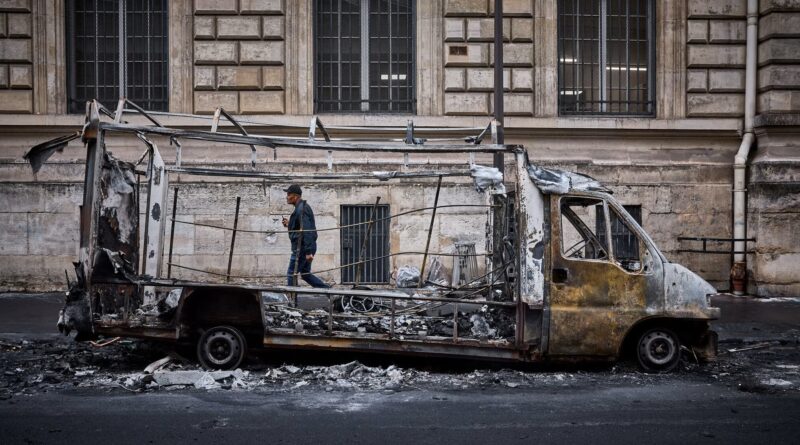
The mass riots in France, which started as protests over underfunded schools, are a shocking example. But the phenomenon has been building for years, with the perceived failure of liberal democracy to make good on its promises of a better future, especially for the young and the salaried working class.
There is a growing perception among many Europeans that traditional parties of the center-left and center-right do not offer real alternatives and are led by an educated elite that has lost its connection to the poor, the workers and the young. Facing rising deficits, expenses and interest rates, governments feel constrained in what they can do to respond.
Instead, many people are supporting parties like the National Rally of Marine Le Pen, leading the polls for the French presidency on the far right, and France Unbowed of Jean-Luc Mélenchon, on the far-left, running second. In Germany, they are turning to the far-right Alternative for Germany and the far-left Die Linke party.
With major elections coming in the next year in four of Europe’s most populous states — Spain, France, Italy and Poland — there are significant challenges coming from more extremist parties. Even in Italy, where protests erupted over the weekend, the right-wing prime minister, Giorgia Meloni, faces a former general, Roberto Vannacci, who is running even further to the right.

Hard-right parties also sit in the governments of the Czech Republic, Finland, Slovakia and Croatia, while Slovenia’s government relies on outside support from one, Alberto Alemanno, a professor of European Law at HEC Paris, recently noted. And competition from even farther to the right is already pushing some of them to harden their positions.
Satisfaction with how democracy is working has been declining dramatically, according to regular opinion polling from the Pew Research Center. In France, Pew found this year, 69 percent of the population is dissatisfied with democracy. In Spain, it is 68 percent. In Italy, 62 percent. In Poland, the newest democracy after years of Soviet occupation, it is 47 percent. In the United States, it is 69 percent.
There are many reasons put forward for the decline in optimism and faith in centrist politics. But Daron Acemoglu, a Nobel laureate in economics, puts it simply. “We started taking democracy for granted,” he said.
Liberal democracy has failed to keep faith with ordinary citizens, and especially with the larger working class. “If liberalism is to rise again, it must be with the working class at its heart,” he said.
Shared Prosperity
The rapid nationwide spread of the French protests to include workers and pensioners angry at inflation and high interest rates, especially given rising prices for energy and for borrowing costs, points to a larger failure of President Emmanuel Macron’s center-right government and of liberal democracy writ large.
The violence of what became riots in many cities is expected only to help Ms. Le Pen and her anti-liberal complaints about immigration and lawlessness.
Mr. Acemoglu, a professor at M.I.T., has tried to provide both an analysis and some prescriptions in a recent book, “What Happened to Liberal Democracy?” In it, he outlines “two broad lines of failure” over the last half-century, which have led to widespread alienation and anti-establishment sentiment.
The first is what he calls the failure to deliver on shared prosperity, especially for a salaried working class hit by automation, globalization and sharply increased inequality, and which now feels deep anxiety about artificial intelligence.
Leaders have forgotten that a key part of their pact with voters is to “take care of the drains,” he said, to ensure the good functioning of the infrastructure of daily life, from roads to education to health care.

The second, Mr. Acemoglu said in an interview, is “the rise of top-down cultural politics,” whereby a college-educated elite now dominates even traditional Socialist and working-class parties throughout the Western world and in his view patronizes or dismisses the concerns of those who traditionally supported them.
As a result, working-class voters are moving toward populist parties on the far left and especially the far right, as in France and Germany, threatening traditional values, shrinking historically “large church” parties of the center and threatening the working of parliamentary democracy.
In Britain’s 2024 election, the two long-dominant parties, Labour and Conservative, won their lowest combined vote share in more than a century. The far-right Reform UK party surged in the polls last year, though it has since fallen somewhat.
Centrist parties need to regain the trust of voters that they not only hear them but empathize with them, said Steven E. Sokol, president of the American Council on Germany. “A constant in all these countries are the people who feel left behind, who feel they are no part of the prosperity and security they see all around them,” he said.
The Center Under Stress
Germany offers another example of the exhaustion and splintering of the center. The Volksparteien, or “people’s parties” of the center-right and center-left — the Christian Democratic Union (and its partner, the Christian Social Union), and the Social Democratic Party — alternated running democratic Germany since World War II. But they are being hollowed out, said Mr. Sokol, with workers and the young moving to more extreme parties, like the Alternative for Germany (AfD) and Die Linke.
Given the difficulty of forming coherent coalitions now, the two Volksparteien are locked together in a squabbling coalition that is increasingly unpopular and perceived as failing to deliver economic growth and security.
Under former Chancellor Angela Merkel, the C.D.U. moved to the center, but it was cautious, “risking nothing, even in the face of obvious challenges,” said Norbert Röttgen, a prominent legislator in the party.
Those challenges included increased migration, a declining export market with China, sharpened tensions with Russia and slow economic growth. The move to the center and Ms. Merkel’s embrace of large-scale immigration, he said, alienated many of the party’s traditional conservative voters.
That gave space to the right, filled by the AfD, which is now attracting traditional C.D.U. voters among the working class, Mr. Röttgen said. “But to seriously deliver on our problems requires majorities, and this,” he said, “is our paradox.”

As for the Social Democrats, they took the path Mr. Acemoglu described of many left-wing parties, where intellectual elites and left-wing academics “conquered the party and disconnected it from its traditional voters,” Mr. Röttgen said.
An average of current opinion polls in Germany shows how hard it is to construct a workable centrist coalition.
The AfD is the most popular party, with some 28 percent support, followed by the C.D.U./C.S.U., with 19.8 percent. The Greens have 15 percent, and the Social Democrats only 13.1 percent, barely ahead of Die Linke, with 11.3 percent.
Both mainstream parties are divided internally about how to proceed — for the Christian Democrats, to move closer to the AfD and not just copy some of its policies; for the Social Democrats, to move farther to the left to defend itself against both the Greens and Die Linke.
A Splintered Europe
With these four important elections and the pull of the far right in each of them “we’re going to have a major transformation,” with fragmented governments, said Ivan Krastev, chairman of the Center for Liberal Strategies in Bulgaria and a fellow at the Institute for Human Sciences in Vienna.
Right-wing coalitions will likely contain small far-right parties “which will keep the mainstream far-right parties hostage and may prevent them from moving to the center.”
If they do well, “then very quickly you’re trying to normalize them, because otherwise the European Union cannot function, and this is not making people feel more secure,” he said.
The French presidential election next spring will be key. A victory by Ms. Le Pen could have major implications for Brussels, for the euro, for NATO and for European support for Ukraine.

Mr. Acemoglu argues for “a big-tent populism,” that channels the anger of voters in the name of inclusivity.
“The centerpiece has to be creating jobs and wage growth and career paths for people without college degrees and diverse skills,” he said. “There must be an agenda for shared prosperity, which is why artificial intelligence and how it is used is critical.”
Steven Erlanger is the chief diplomatic correspondent in Europe and is based in Berlin. He has reported from over 120 countries, including Thailand, France, Israel, Germany and the former Soviet Union.