
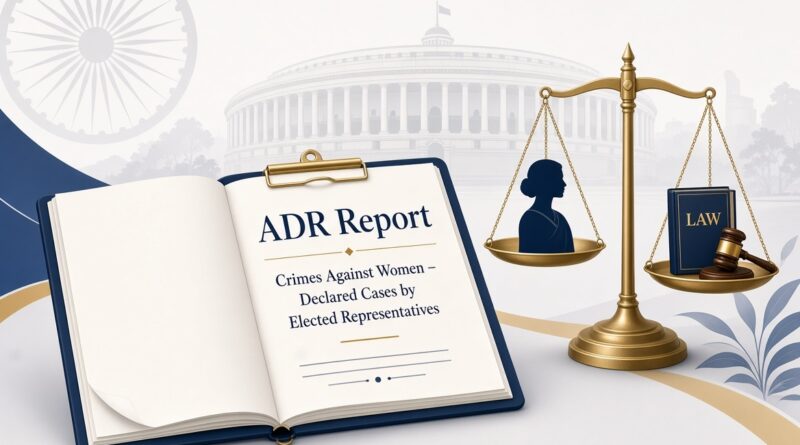
187 Indian Lawmakers Face Cases of Crimes Against Women

A report by the Association for Democratic Reforms (ADR) and National Election Watch reveals that 187 sitting Indian MPs and MLAs have declared criminal cases involving crimes against women, including 14 with rape-related allegations. The BJP leads with 106 representatives, followed by Congress (20) and TDP (18). West Bengal tops the state rankings with 69 lawmakers. Based on 4,881 election affidavits, the findings raise serious concerns about political accountability and candidate selection. ADR demands electoral reforms, speedy trials, transparent nominations and stronger victim protection. However, allegations do not establish guilt, and the current status of cases may differ.
BJP accounts for 106, Congress 20 and TDP 18; 14 lawmakers have declared rape-related cases
By Jay Singh Rawat
A new report by the Association for Democratic Reforms (ADR) and National Election Watch (NEW) has raised serious concerns about the criminal backgrounds of elected representatives and the accountability of political parties in ensuring women’s safety. According to the report released on October 23, 2026, as many as 187 sitting MPs and MLAs have declared criminal cases related to crimes against women, including 14 who have disclosed rape-related cases in their election affidavits.
The report examines 4,881 election affidavits, comprising 772 sitting MPs and 4,109 MLAs, submitted to the Election Commission of India during elections and by-elections held between 2022 and 2026. Of the 187 representatives, 19 are MPs and 168 are MLAs.
Importantly, these figures reflect cases declared at the time of elections. Their present judicial status may have changed, and the existence of a criminal case does not establish guilt.
BJP Leads with 106 Representatives
The Bharatiya Janata Party has the highest number of elected representatives who have declared cases related to crimes against women, with 106 MPs and MLAs. The Congress follows with 20 and the Telugu Desam Party (TDP) with 18.Although the BJP leads in absolute numbers, comparisons must also account for the different sizes of political parties in Parliament and state legislatures. The findings nevertheless raise questions about candidate selection by parties that routinely promise women’s safety, dignity and empowerment during election campaigns.
West Bengal Tops State Rankings
West Bengal leads the state-wise list with 69 sitting MPs and MLAs who have declared cases related to crimes against women. Andhra Pradesh follows with 22 and Odisha with 17. Together, these three states account for 108 of the 187 representatives, or approximately 58 per cent of the national total. These figures represent criminal cases declared by elected representatives and should not be confused with the overall incidence of crimes against women in the respective states.
Four BJP and Four Congress Representatives Among 14 Facing Rape Cases
One of the report’s most disturbing findings concerns 14 sitting lawmakers who have declared rape-related cases under Sections 376 and 376(2)(n) of the Indian Penal Code, including provisions concerning repeated rape. These include two Lok Sabha MPs and 12 MLAs. The BJP and Congress each account for four such representatives. The BJP’s four include two MPs and two MLAs, while all four Congress representatives are MLAs. One MLA each from the TDP, Trinamool Congress, Biju Janata Dal, National People’s Party, Bharat Adivasi Party and All India Secular Front has also declared rape-related cases. These are allegations recorded in election affidavits, not findings of guilt by courts.
Over 1,200 Crimes Against Women Registered Daily
The ADR report also cites National Crime Records Bureau (NCRB) data showing that 4,41,534 cases of crimes against women were registered across India in 2024, averaging approximately 1,210 cases every day. The national rate stood at 64.6 registered cases per lakh female population, while Delhi and Telangana recorded rates nearly twice the national average. Although these NCRB figures concern crimes registered nationwide rather than offences attributed to lawmakers, they underline the wider challenge of women’s safety.
ADR Calls for Electoral Reforms
ADR and NEW have expressed concern that politically influential accused persons may be able to interfere with investigations, exploit judicial delays or exert pressure on victims and their families. The organisations have called for stronger restrictions on candidates with serious criminal backgrounds, permanent electoral disqualification of persons convicted of heinous offences such as rape, and exclusion of lawmakers facing serious crimes against women from ministerial positions. They have also demanded speedy trials, impartial police investigations and stronger protection for victims. Referring to the Supreme Court’s February 2020 directions, ADR has urged political parties to publicly explain their decisions to nominate candidates with criminal cases. It has recommended substantial financial penalties for parties violating these requirements and accountability for responsible office-bearers.
Women’s Safety Versus Political Expediency
The report exposes a troubling contradiction in Indian politics. Political parties regularly promise stronger laws, better policing and greater protection for women, yet continue to nominate candidates who have disclosed serious criminal allegations. At the same time, the distinction between accusation and conviction remains fundamental to justice. Every accused person is entitled to the presumption of innocence, and any electoral restriction must respect constitutional and legal safeguards. The central issue, therefore, is not merely how many elected representatives face allegations, but whether political parties are prepared to adopt transparent and responsible standards in selecting candidates.
Women’s safety cannot remain an election slogan while political expediency determines who receives a party ticket. Meaningful reform requires accountable political leadership, credible investigations, timely judicial decisions and effective protection for victims.
=====================================================
About the Author :Jay Singh Rawat is a veteran Indian journalist, author and political analyst with nearly five decades of experience in journalism. He has held senior editorial positions in several newspapers and served as the Uttarakhand State Correspondent for the Press Trust of India (PTI). A recipient of prestigious journalism awards, including the K.C. Kulish International Award and Bhairav Dutt Dhuliya Award, he writes extensively on politics, governance, history, environmental issues and Himalayan affairs, with a particular focus on Uttarakhand.
Disclaimer: The views and opinions expressed in this article are solely those of the author in his personal capacity and do not necessarily reflect the views of any publication or organisation with which he is associated.