
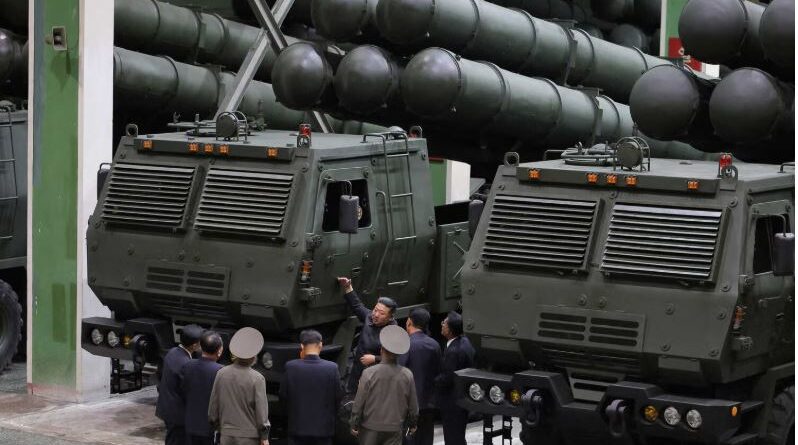
Arms Race Intensifies in Korea as the North Is Emboldened by Russia Alliance

A rare escalation this month exposed the increasingly lethal arsenals the two Koreas are building up across the world’s most heavily fortified border.


An intensifying arms race is gripping the Korean Peninsula, as both sides trade missile tests and North Korea supercharges development of more lethal warheads, attack drones and other new weapons to threaten the South.
North and South Korea have maintained a fierce military rivalry since the Korean War ended in an uneasy armistice, with Pyongyang turning to nuclear weapons after the Soviet bloc collapsed. Now, North Korea is rapidly upgrading its conventional forces with the help of its military partnership with Russia, recently revitalized by the Ukraine war.
In exchange for North Korean arms and soldiers, Russia has given the North a live combat laboratory to test its weapons and troops, refine its missile performance and master drone warfare. The North’s military may soon be able to unleash vast swarms of low-cost drones to overwhelm the more expensive, high-tech defenses of South Korea and the U.S. forces stationed there.
Rising hostility along the inter-Korean border has given an ominous tone to the region’s military buildup. In recent months, North Korea has begun heavily fortifying its border with more powerful weapons and additional barbed-wire fences, concrete barriers and minefields.
Tensions escalated further after three South Korean soldiers were injured last month by North Korean land mines that Seoul says were buried south of the ill-defined border. The two Koreas have since traded warning shots and threats of military conflict.
Then, a rare tit-for-tat escalation this month exposed the increasingly lethal arsenals that the countries are amassing across their border, already the world’s most fortified.
Early this month, under the watch of its leader, Kim Jong-un, North Korea launched what it called a nuclear-capable ballistic missile from its east coast toward waters between Russia’s Far East and Japan’s northern island of Hokkaido.

Officials in South Korea and Japan estimated the missile traveled around 430 miles. But Pyongyang said it flew 621 miles. It ridiculed them for losing track of the warhead, claiming it performed sudden, irregular “wavelike” maneuvers while flying at several times the speed
According to Shin Jong-woo, secretary-general of the Korea Defense and Security Forum in Seoul, North Korea’s launch “was not a mere show of force, but a demonstration that the advancement of its hypersonic weapon system is in its final stage.”
South Korea usually responds to North Korean missile tests with brief statements condemning them as provocative. But five days after the North’s launch, it test-fired its own hypersonic ballistic missile for the first time, observed by President Lee Jae Myung, indicating that Seoul has grown increasingly uneasy
Russian Dividends
over the rapid advancement of North Korea’s missile technology.
During North Korea’s hypersonic missile test, Mr. Kim urged the nation’s military to “repeatedly make the enemy recognize the reliability and fatality” of its weapons.
It has been able to make such strides thanks to valuable battlefield data and feedback acquired while helping Russia fight in Ukraine, said Anton Ponomarenko, a researcher at Pacific Forum who monitors Russia-North Korea military cooperation. He noted that improved accuracy and maneuverability of its warheads made the threat to South Korea “more substantial.”

Cooperation with Russia has also helped the North develop new drone capabilities. Pyongyang has learned from the conflict in Ukraine and the Middle East that inexpensive drones can overwhelm costly air-defense systems. During a North Korean drill last month, a drone swarm attacked a target island, while cruise and ballistic missiles struck simultaneously from different directions. North Korea’s evolving tactics will eventually force South Korea and its allies to redesign their air defenses at exorbitant costs, defense experts said.
The drone partnership has scaled rapidly. Russia has recruited 12,000 North Korean workers to its Geran-2 drone factories in Tatarstan while dispatching officers to North Korea to train drone operators, according to Ukrainian officials. A sanctions-monitoring group warned last month that Russia’s appetite for North Korean labor across various defense sectors raises the risk of vital military technology ending up in Pyongyang’s hands.
The consequences are already visible: Photos from Mr. Kim’s visit to a drone factory last month indicated that North Korea has begun mass-producing drones.

“We will see a deepening imbalance between low-cost attacks and high-cost defenses,” said Hong Min, an analyst at the Korea Institute for National Unification in Seoul.
Balance of Fear
Even before North Korea began receiving help from Russia, its military was working to make its weapons harder to target. It has tested missiles launched from submarines and mobile launchers hidden in tunnels. It also switched from liquid to solid fuel to drastically reduce missile launch preparation time.
As North Korea continues to improve its missiles, some of which can carry both conventional and nuclear warheads, “it will become extremely difficult for us to discern the nature of the warhead or the intent behind an attack based solely on the launch itself,” said Kim Yong-ho, a former director of strategic intelligence at the South Korean Defense Ministry.

South Korea still relies on the presence of U.S. military bases, and ultimately the American nuclear arsenal, as a deterrent against a nuclear attack. It has not sought to develop its own atomic weapons, but instead to offset the North’s growing strike capabilities by building up conventional arms to create what analysts call a balance of fear. That means strengthening its three-pronged strategy for responding to a potential attack: pre-emptive strikes, missile defense and massive retaliation.
On the day South Korea tested its first hypersonic missile, President Lee’s office released a photo of him inspecting another new weapon, the Hyunmoo-5 missile. Dubbed a “monster” by local media, it reportedly carries an eight-ton bunker-buster warhead that can penetrate shelters deep underground to kill enemy leaders.
Dring an interview with The New York Times last month, Mr. Lee described South Korea’s conventional retaliation capability as “probably one of the most capable in the world.”
“Even if North Korea possesses nuclear weapons, they would serve only as a last-resort defensive measure,” he said. “Using them offensively would ensure the North’s self-destruction.”

To monitor North Korean missile activity, South Korea operates reconnaissance aircraft and satellites in close coordination with the United States. Seoul also maintains air and naval superiority, while Pyongyang largely depends on aging Soviet-era aircraft and the capabilities of newly built destroyers remain unproven.
Like North Korea, South Korea has leveraged overseas conflicts to boost its defense industry. In June, Mr. Lee said that during the wars in Ukraine and Iran foreign leaders have rushed to secure South Korean air-defense missiles, with one country even sending a cargo plane to collect them directly from the production line.
Pyongyang put its first military spy satellite in orbit in 2023, although South Korean officials dismissed its technology as rudimentary. Yet North Korea is catching up in more areas, fueling a cat-and-mouse arms race.
Four days after Mr. Lee inspected the Hyunmoo-5, North Korea launched what analysts identified as a bunker-buster missile of its own, capable of carrying a 2.5-ton payload, unusually large for a short-range ballistic missile.
Defense analysts say North Korea has now surpassed South Korea in some capabilities. Some of the South Korean military’s recent drone tests ended in high-profile flops, with drones crashing shortly after takeoff. And North Korea unveiled the completed hull of what it called its first nuclear-powered submarine in December, while South Korea is still negotiating with Washington to secure fuel for a similar vessel it hopes to build by the mid-2030s.

South Korea is reacting to the growing threat from the North by increasing military spending at a record pace. It has pledged to raise defense expenditures from 2.8 percent to 3.5 percent of gross domestic product, becoming the first American ally to adopt such a target amid Washington’s pressure on partners to reduce reliance on U.S. forces.
However, the greatest threat posed by the North might not even target South Korea. If Russia helped it develop an ability to strike the United States directly with nuclear warheads, this might make Washington think twice about coming to the South’s aid, said Lami Kim, a Korea chair at the London-based International Institute for Strategic Studies.
“This would undermine the credibility of U.S. extended deterrence, as Washington would face the prospect of risking nuclear strikes against American cities to defend South Korea,” she said.
===============================================================================
Choe Sang-Hun is the lead reporter for The Times in Seoul, covering South and North Korea.