
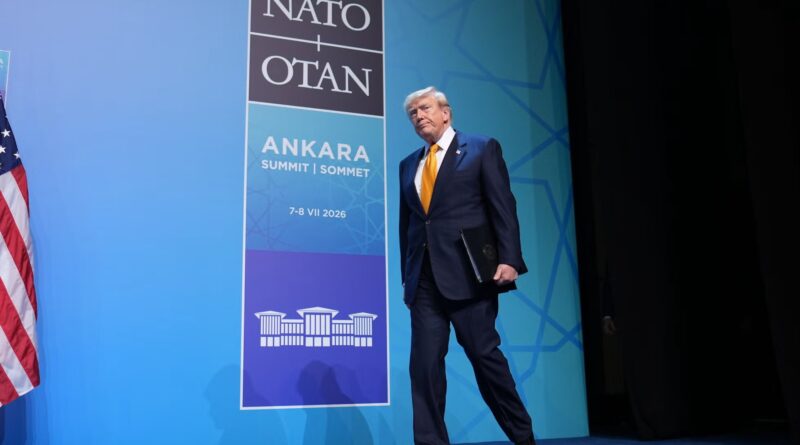
Why Europe Worries About a Politically Wounded Trump

The commanding victory of the Democrats has brought private relief to some Europeans but no official glee, with Ukraine, Iran and NATO all hanging in the balance.

Steven Erlanger, based in Berlin, writes about European diplomacy and security.
President Trump may be politically damaged by the midterms, but he remains an immensely powerful and unpredictable actor who has legacy on his mind.
In the wake of a stunning electoral defeat for his Republican Party, European governments have largely restrained from any official glee, recognizing that they must retain good relationships with Mr. Trump.
They do not know if a lame duck Mr. Trump will become an angry one. But they understand, officials and analysts said, that the new Congress will have only limited constraints on Mr. Trump’s foreign policy. And they believe he wants to leave his mark not just on Washington, but on foreign affairs, where he has broad freedom of action.
In the short run, they expect him to push as best he can to resolve the conflicts in Iran and Ukraine and keep the pressure on Europe to take more responsibility for its own defense. They also assume that Mr. Trump will continue to focus on the Western Hemisphere, especially Venezuela and Cuba.
Looking ahead, European allies will want to reach out to the new faces in Congress to better understand a changing United States and to try to convince a new generation of politicians and business leaders that the trans-Atlantic relationship is adaptable and vital to America’s long-term interests.
“Europeans need to try to keep the Trump administration engaged in Europe, so we don’t want to add insult to injury” by lauding his defeat, said Wolfgang Ischinger, a former German ambassador to Washington and chairman of the Munich Security Conference. “Let the Americans celebrate. If we celebrate an opposition win, we’re not doing our jobs.”
At the same time, he said, it is a time for Europeans to increase their engagement across the United States. “There is a small chance that American decision makers might develop a new interest in Europe, not as an unnecessary burden but as an interesting and important ally.”
In the past two years alone, Mr. Trump has badly strained the trans-Atlantic relationship by questioning the utility of NATO, threatening to seize Greenland from a NATO ally and reducing U.S. support for Ukraine as it battles a Russian invasion.
The longer-term hope is for a more productive relationship after a new president is elected in 2028. There is general acknowledgment that there is no return to the warm ties of the Biden years regardless of who wins, said Thorsten Benner, director of the Global Public Policy Institute in Berlin. For Europeans the lesson should be clear, he said — “double-down on our ability to defend ourselves without relying on the U.S., rather than slowing down what until now is only a halfhearted effort to stand on our own feet militarily.”
Most Pressing: Iran and Ukraine
The most immediate concerns are about the wars in Ukraine and Iran, and about what Mr. Trump will decide about the presence and location of American forces in Europe.
Mr. Trump’s outreach to President Vladimir V. Putin, offering Russians business deals, high-level meetings and an end to diplomatic isolation, contradicts and undermines the European effort to increase economic and diplomatic pressure on Russia to stop the war in Ukraine.

Ukrainian officials are anxious that Mr. Trump will try to use the period between now and the sitting of the new Congress in January for further efforts to mollify Mr. Putin, including another summit meeting in Florida, two senior European officials said.
“For Europe, the greatest danger comes from Trump’s erratic policy toward Russia and Ukraine,” said Daniela Schwarzer, president of the Hertie School and a professor of European governance and geopolitics. “The risk of an even closer alignment between Washington and Moscow remains as Trump is now weakened.”
The American efforts will continue next week with a scheduled trilateral meeting in Abu Dhabi among American, Russian and Ukrainian envoys to discuss steps toward a peace treaty and future security assurances that “might include all of Europe,” Mr. Trump said on Thursday. European officials will be there to support Ukraine but are unlikely to be in the room. And they are not optimistic that Mr. Putin is open to serious negotiations now, the officials said, while he is pounding Ukraine’s civilian infrastructure before a bitter winter.
If Mr. Trump sees the Ukraine war as a legacy project, so does Mr. Putin.
The officials believe that Mr. Putin will wait to see what happens in the United States, but also for the result of the French presidential election in the spring, where Marine Le Pen, the far-right politician who wants to end French financial support for Ukraine, remains the front-runner. Mr. Putin also sees cracks in Poland and in Germany, where the government is widely unpopular and the main opposition party, the Alternative for Germany, opposes aid to Ukraine.
At the same time, Mr. Trump continues to sell American weaponry to Europeans to pass on to Ukraine and to provide vital intelligence about incoming Russian missiles and troop deployments. Even if he decides to pull some American troops out of their traditional bases in Germany, the Europeans would not be unhappy if more were then sent to frontline states like Poland.
On Iran, Mr. Trump appears to want to negotiate instead of escalating a war that has proved so unpopular with American voters, officials and analysts believe. He has so far rejected pleas to do so from Benjamin Netanyahu, the caretaker Israeli prime minister after inconclusive elections. The uncertain future of Mr. Netanyahu and the efforts of his foremost rival, Gadi Eisenkot, to form a government are further reasons to hold off a bombing campaign, said Aaron David Miller, a former Mideast negotiator now at the Carnegie Endowment.

Few officials or analysts believe that new military strikes will do much to change Iran’s position or its belief that it can outlast American pressure, and a frustrated Mr. Trump may still decide to escalate the war.
“Having lost Congress and seen the Iran war become an electoral liability, Trump now faces a choice: cut a face-saving deal and declare victory, or double down militarily to reclaim the initiative,” said Ali Vaez, a Geneva-based Iran expert at the International Crisis Group.
No New Normal
Going forward, there’s a risk that Europeans will overestimate the change in American views of the world, warned Emily Haber, a former German ambassador to Washington. “There will probably be some degree of self-delusion in Europe that we’ll be back to the old normal in two years,” she said. “But this does not alter the declining role of Europe for American policy in security and global order, which has structural reasons and is not tied to partisanship.”
The main implication for Europe may be less about foreign policy than about politics as it heads into a year of crucial elections in Spain, France, Italy and Poland, argued Nathalie Tocci, a professor at the Johns Hopkins School of Advanced International Studies, Europe.
“There is a possible contagion effect of ‘democracy is back’ on European politics,” she said. After recent elections that defeated authoritarian figures of the right in Hungary, Brazil and Serbia, she said, “the midterms convey an incredibly powerful but intangible sense of, ‘Yes we can’ defeat the far right.”
=================================================================
Steven Erlanger is the chief diplomatic correspondent in Europe and is based in Berlin. He has reported from over 120 countries, including Thailand, France, Israel, Germany and the former Soviet Union.