
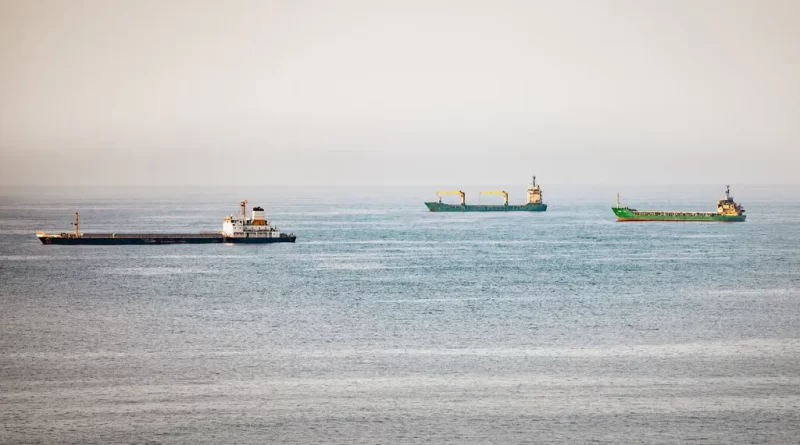
Iranian Forces Say They Closed Strait of Hormuz

Iran’s military command blamed the U.S., saying it failed to prevent Israel from violating the cease-fire in Lebanon. Mediators in Pakistan said “technical talks” between the U.S. and Iran to end the war would be held on Sunday.


Iran’s military said on Saturday that the Strait of Hormuz had been closed to maritime traffic, citing what it called a “clear breach” of U.S. commitments to implement a preliminary deal to end the war, according to a statement carried by state media.
The Khatam al-Anbiya Central Headquarters, a central military command, cited the killing and the displacement of Lebanese residents from southern Lebanon, along with Israel’s refusal to withdraw from the region, as factors for closing the strait.
The deal between the United States and Iran stipulated an end to hostilities on all fronts, including Lebanon.
The announcement on the strait came as delayed talks between the United States and Iran appeared ready to restart. Pakistan, which has served as an intermediary in negotiations to end the war, said in a statement that “technical talks” between Washington and Tehran would begin Sunday in Switzerland.
Vice President JD Vance told Fox News earlier on Saturday that Steve Witkoff and Jared Kushner, who serve as envoys for President Trump, were in Switzerland and ready to negotiate, and a spokesman for Iran’s foreign ministry said that an Iranian delegation was on its way.
The United States has not yet commented on the Iranian military statement on the strait. There had been an uptick in the number of ships passing through the waterway in recent days, after a deal between the United States and Iran was announced. Iran had closed the strait, a vital waterway for oil and gas shipping, in the early days of the war, rattling the global economy.
Israel and the Iran-backed militant group Hezbollah exchanged fire on Saturday, just a day after a cease-fire had raised hopes of easing their conflict and smoothing a path toward an end to the U.S.-Iran war.
The truce, agreed to on Friday afternoon, had appeared to largely hold, but early Saturday, Lebanese state media reported Israeli airstrikes on towns and cities in southern Lebanon. Lebanese health authorities said that at least seven people had been killed and 13 others wounded in the strikes.
The Israeli military said that Hezbollah had fired more than 50 projectiles at Israeli forces in southern Lebanon overnight, prompting Israeli strikes on what the military described as Hezbollah targets in the region.
In a statement on Saturday, Hezbollah said that it was adhering to the cease-fire, but accused Israel of attempting to advance overnight toward Ali al-Taher, a strategic ridge overlooking the Nabatieh area in southern Lebanon, and said its fighters had ambushed an Israeli infantry force.
The conflict in Lebanon, once seen as a secondary front to the U.S.-Israeli war on Iran, has become one of the main obstacles to ending it.
The United States and Iran agreed to a preliminary deal earlier this week, which stipulated an end to the fighting on all fronts, including Lebanon, and set the stage for more negotiations that had been set to begin Friday in Switzerland.
Iran pulled out of those talks after Israeli strikes in Lebanon, three diplomats said on Friday. Vice President JD Vance was expected to be part of the talks in Switzerland but the White House said late Thursday that his visit had been postponed.
Switzerland’s foreign ministry said on Saturday that it was continuing to provide a “discreet and reliable setting” for the talks, adding, without naming them, that diplomats from several countries remained engaged in efforts to keep the dialogue going.
Here’s what else we’re covering.
-
Lebanon strikes: The diplomatic breakdown on Friday was the second time in recent weeks that the conflict in Lebanon has upended talks between the United States and Iran.
-
Supreme leader: Ayatollah Mojtaba Khamenei, Iran’s supreme leader, distanced himself from the agreement with the United States.
-
Economic repercussions: If the deal holds, billions of dollars in frozen Iranian assets could be released.