
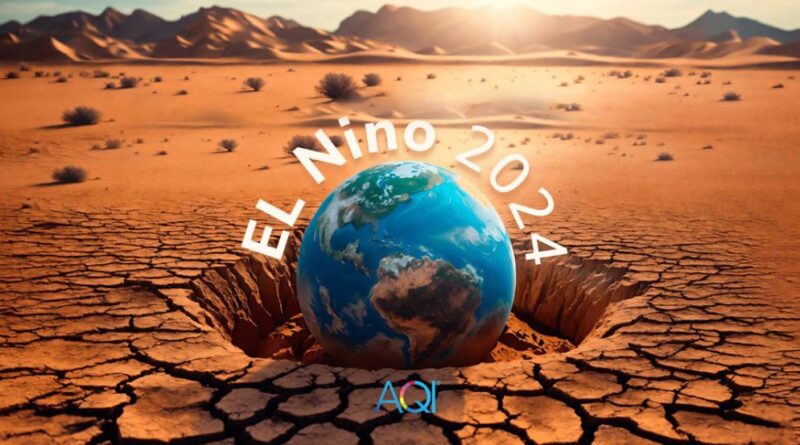
IS THE WORLD HEADING TOWARD A SUPER EL NIÑO?


By Jay Singh Rawat
Sometimes, shifts within the Earth’s climate system trigger cascading effects felt tens of thousands of kilometers away. One such profound disruption occurs along the Pacific coast of South America, where sea surface temperatures experience a dramatic shift—a phenomenon known as El Niño. Currently, meteorologists and climate scientists worldwide have their eyes trained on the Pacific Ocean. The latest assessments indicate that the Earth is once again transitioning into an El Niño phase, with signs suggesting it could intensify into a “Super El Niño” during the latter half of the year. If these projections hold true, this could rank among the most powerful El Niño events recorded since 1950. Its ramifications will extend far beyond oceanic boundaries, leaving deep imprints on India’s monsoon patterns, agriculture, water resources, and the fragile Himalayan ecosystem.
Understanding El Niño: How It Reshapes Global Weather
Under normal conditions, equatorial trade winds blow from east to west across the Pacific Ocean, pushing warm surface waters toward Asia and Australia. This results in heavy rainfall over the Western Pacific, while cooler, nutrient-rich waters rise to the surface along the coasts of South America.
However, during an El Niño event, these trade winds weaken. The warm water sloshes back eastward, spreading across the central and eastern Pacific. As sea surface temperatures climb well above average, the global atmospheric circulation is completely disrupted. This shift alters cloud formations and storm tracks, triggering a domino effect of severe droughts, catastrophic flooding, intense heatwaves, and erratic storm patterns across various parts of the globe. It is precisely this far-reaching grip that makes El Niño one of the most powerful natural climate drivers on Earth.
La Niña: The Mirror Image
The antithesis of El Niño is La Niña, characterized by abnormally cool sea surface temperatures in the eastern Pacific and significantly stronger trade winds. This setup concentrates warm water in the Western Pacific, typically boosting rainfall across India, Southeast Asia, and Australia. For India, a La Niña phase is generally welcome, as it injects vital energy and moisture into the Southwest Monsoon. The relatively bountiful monsoon seasons India experienced in recent years can be largely credited to La Niña. However, an excessively intense La Niña carries its own risks, occasionally triggering severe flooding and widespread landslides.
Why India Watches the Pacific with Bated Breath
Nearly half of India’s agriculture remains entirely rain-fed. The livelihoods of millions of farmers, the replenishment of vital reservoirs, drinking water supplies, and hydroelectric power generation are inextricably linked to the monsoon. Consequently, any indication of an impending El Niño sparks immediate national concern. Historical data confirms a strong correlation between several of India’s major droughts and historical El Niño events. However, climate dynamics are rarely linear; not every El Niño guarantees a monsoon failure, nor is every deficient monsoon solely caused by it. The performance of the monsoon is a complex puzzle influenced by the Indian Ocean Dipole (IOD), Arabian Sea temperatures, Himalayan snow cover, and regional atmospheric factors. Nonetheless, during a powerful El Niño year, the probability of a weak or erratic monsoon rises substantially.
Climate experts warn that if the current El Niño reaches extreme strength, rainfall distribution will become highly skewed. Some regions may face severe deficits, while others could experience sudden, torrential downpours—complicating both agricultural planning and national water management.
Escalating Heatwaves and Thermal Stress
The most immediate and tangible impact of El Niño is felt in global temperatures. As a massive expanse of the Pacific Ocean warms, it releases staggering amounts of thermal energy into the atmosphere, driving up the global average temperature. Scientists warn that a potent El Niño could push global temperatures to record-breaking highs.
For India, this translates into longer, more intense, and frequent heatwaves. Temperatures across the northern and central plains are projected to soar well above normal, escalating public health risks, driving up power grid demands, and placing immense stress on depleting water sources. The rural economy will likely bear a heavy burden as livestock and standing crops face prolonged thermal stress.
The Acute Vulnerability of the Indian Himalayas
For Himalayan states like Uttarakhand, Himachal Pradesh, Sikkim, and Arunachal Pradesh, the unfolding El Niño demands urgent attention. The mountain ecosystem is already under severe duress due to broader climate change; glaciers are retreating at an accelerated pace, glacial lakes are expanding dangerously, and the frequency of landslides is rising.
During an El Niño year, precipitation patterns over the Himalayas tend to become highly volatile. While the cumulative seasonal rainfall might drop below average, the rain that does fall often occurs in short, hyper-intense bursts. Such extreme precipitation events are catalysts for cloudbursts, flash floods, and massive debris flows.
Recent catastrophes in Uttarakhand—including those in Kedarnath, Rishiganga, Chamoli, and various mountain valleys—have painfully demonstrated how hyper-sensitive this terrain has become. If El Niño amplifies extreme weather events, regional vulnerability will skyrocket. Furthermore, elevated temperatures in the high Himalayas accelerate glacial melt, increasing the volume of glacial lakes and raising the looming threat of Glacial Lake Outburst Floods (GLOFs). It is with good reason that scientists refer to the Himalayas as the Earth’s “Third Pole,” repeatedly warning of its structural fragility.
A Dangerous Synergy: Climate Change Meets El Niño
Scientists emphasize that El Niño itself is not a modern anomaly; it has been a fundamental component of Earth’s natural climate cycle for millennia. The modern alarm stems from the background environment in which it is now occurring. The planet is significantly warmer today than it was in the pre-industrial era, heavily loaded with greenhouse gases emitted by decades of human activity.
When a natural warming phenomenon like El Niño is superimposed onto a baseline of global warming, its destructive potential multiplies exponentially. This volatile combination explains why the world has recently witnessed unprecedented marine heatwaves, catastrophic wildfires, and extreme weather anomalies breaking historic thresholds.
The Road Ahead: Vigilance and Preparedness
Given these projected vulnerabilities, India must proactively reinforce its water management strategies, agricultural contingency plans, disaster response frameworks, and meteorological forecasting networks. The immediate priorities must include delivering hyper-local, timely weather advisories to farmers, accelerating decentralized water conservation, and establishing rigorous, real-time monitoring of high-risk zones across the Himalayan belt.
The warming waves rising in the Pacific Ocean may be physically distant from India, but their ecological and economic shocks will inevitably reverberate through the nation’s fields, rivers, mountains, and cities. El Niño is not merely an oceanographic curiosity; it is a stark reminder of the interconnectedness of our global climate system. Over the coming months, the world will watch the Pacific, as the shifts occurring there will ultimately dictate the weather, agriculture, and disaster readiness of India and the world.
—————————-
ABOUT AUTHOR- Jay Singh Rawat is a veteran Dehradun-based journalist, researcher, and author of nine reference books, including works published by the National Book Trust. The first recipient of the Pandit Bhairav Dutt Dhulia Award, he specializes in Himalayan ecology, tribal history, and socio-political dynamics with nearly five decades of media experience.–ADMIN