
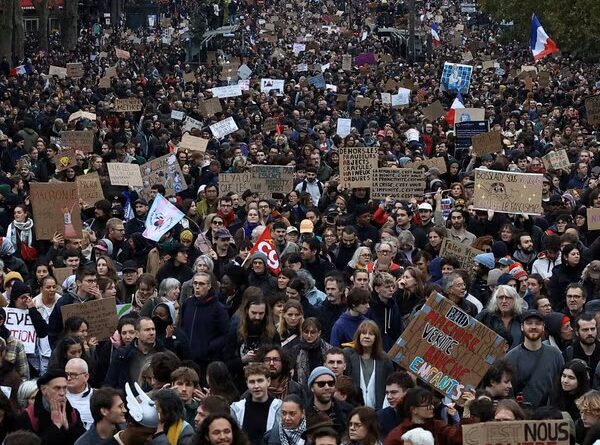
Protesters March in France Amid Heavy Security

In Marseille, clashes broke out between protesters and the police, who fired tear gas. As many as 70,000 police and security officers will try to avert the arson and looting that shocked the country last weekend.

Reporting from Paris
The authorities deployed large-scale security forces across France on Saturday to prevent a repeat of last weekend’s mass protests, which degenerated into arson, looting and other violence.
By midday local time, the police had arrested 135 people, according to Laurent Nuñez, the interior minister. He estimated that 35,000 people were on the streets nationwide, fewer than at the same time last Saturday, when more than a half million people demonstrated by the end of the day.
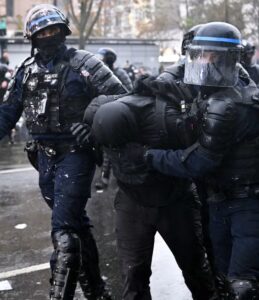
The lone protest permitted in Marseille, where looters ravaged a commercial avenue last week, drew thousands of people, including students and some parents with young children. Close to where the authorized protest was intended to end, clashes broke out between protesters and the police, who fired tear gas at one point.
In Orléans, south of Paris, a protest against France’s main far-right party, the National Rally, which is holding its convention in the city, ended peacefully in the afternoon. The local authorities said 11,000 protesters had gathered, while organizers in the crowd said 26,000 had joined.
Thousands of people turned out on the southeast edge of Paris, even after organizers were forced to change the protest location at the last minute.
With rallies also planned in other cities, France will face a test of whether it can get a grip on the outbreak of urban violence that has shocked the public and thrown the country’s leaders on the defensive.

What began as a student-led protest movement has mutated into something darker — a nationwide cycle of violence that raises basic questions about France’s ability to preserve law and order. On Oct. 14, the police failed to control marauding bands as they shattered shop windows, looted merchandise, incinerated vehicles and besieged public buildings.
On Saturday, as many as 70,000 police officers and gendarmes, reinforced by elite military troops, armored vehicles, drones and helicopters, filled streets and the skies in Paris, Marseille, Lyon and other cities. Several cities, including Le Havre, Toulon and Nice, banned all demonstrations in their downtown areas.
Here’s what to know:
-
Economic backdrop: Fears about France’s ballooning government deficit pushed the yield on its 10-year bond to above 5 percent on Friday for the first time since 2002, raising the prospect of a full-blown financial crisis. The government was spared another blow on Friday when the ratings agency Moody’s opted to maintain its rating on France’s sovereign debt. It had been widely expected to downgrade the rating. With demonstrations set to resume this weekend in France over the high cost of living and deteriorating school conditions, the government is still trying to contain growing turmoil in its bond market.
This week, investors continued to shun French debt, pushing the yield on 10-year bonds above 5 percent for the first time since 2002, raising the cost of public borrowing. The government got a small respite late on Friday, after the ratings agency Moody’s held the country’s credit rating at Aa3, skirting the possibility of a small downgrade.
But Moody’s noted that the outlook remained negative and that France still needed a “significant and sustained fiscal effort” to stabilize its debt burden.
Concerns about France’s public finances have been building for years, but the situation has escalated in the past several months as borrowing costs rose around the world. That has exposed France’s vulnerability in markets. The country’s debt has grown quickly in recent years and is expected to exceed 120 percent the size of its economy next year.
-
›Closures: Shops across Paris boarded up their windows. The Louvre and other cultural institutions announced they would close on Saturday, and the Art Basel fair ended on Friday, two days early. A Sunday soccer match between Paris Saint-Germain and Olympique Lyonnais was postponed.
-
Nationwide unrest: The protest movement began with a handful of student demonstrations at high schools in suburban Paris last month. It has since broadened spread.The nationwide unrest in France began with a handful of student demonstrations at high schools in suburban Paris last month.Now, in cities across the country, antigovernment marchers are protesting expensive living conditions, high fuel prices and conditions in schools. Using the unrest as a smoke screen for vandalism, rioters and looters have also joined in. With the protests in their second month, the police have arrested thousands, and politicians are divided over how to respond. By Sept. 29, the unrest had spread to around 400 schools around the country, according to rally organizers. The union of high school students said the blockades were a protest against a “lack of teachers and staff, dilapidated schools, overcrowded schedules and classrooms.” Students barricaded the entrances to some schools with obstacles including e-bikes, while others threw projectiles and set fire to trash cans. The French education minister, Édouard Geffray, said that some of the students’ demands were “legitimate” but condemned the confrontational nature of their protests. He said that students had chased teachers and targeted school principals with firework-launching tubes
-
Student protesters: On Friday, President Emmanuel Macron invited representatives of the high school students to his office, the first time he has engaged with them since they began protesting the state of the education system last month.
.