
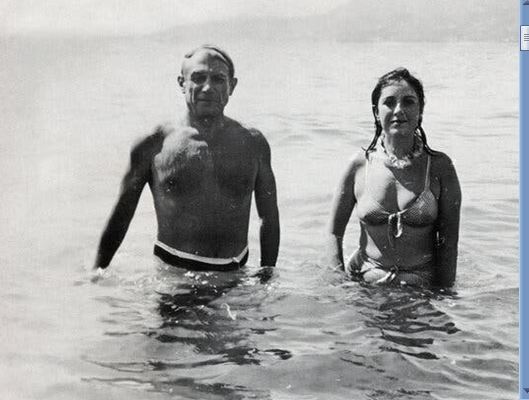
Sex and Surrealism on the French Riviera

A group of artists gathered at a hotel on the Côte d’Azur in 1937. A new book by Anna Thomasson captures the art and escapades the holiday inspired.
By Emily Eakin
Emily Eakin is a senior editor at the Book Review. Her book, “The Frenchmen: Or, My Life in Theory,” will be published this month.
A VAST HORIZON: Artists and Lovers, Freedom and War, by Anna Thomasson
Ady loves Man Ray who loved Lee who is married to Aziz but is now with Roland who loves Picasso who loves both Dora and Marie-Thérèse. Paul still loves Gala but is married to Nusch who is sleeping with Joseph — and, possibly, Man Ray and Picasso — who is officially with Eileen who had an affair with Paul. Got that?
In “A Vast Horizon,” by Anna Thomasson, these details are of more than prurient interest. An inspired chronicle of a group of talented iconoclasts who gathered at the hilltop Hôtel-Restaurante Vaste Horizon on the Côte d’Azur in the summer of 1937, the book conjures a fleeting world where pleasure was paramount and freedom a creed. For the members of this circle, which included the art-world celebrities Picasso and Man Ray as well as the photographer and painter Dora Maar, the photographer Lee Miller, and the poet Paul Éluard and his wife, the model Nusch, sexual license was of a piece with their art: defiant acts of nonconformism.
A Vast Horizon
Given all the lovemaking, it’s remarkable any of them had time for painting or poetry. But each activity reinforced the next, sex flowing into art, art turning into sex, all of it transforming what was ostensibly a holiday by the sea among friends into a frenzy of erotic and creative expression — an outpouring that, as Europe girded for war, acquired a rebellious political charge. “It’s as if the group were thumbing their noses at fascism,” Thomasson writes, their lives and work serving as a “manifesto for an alternative world to the one that was coming into being.”
Thomasson, the author of a previous book, about the friendship between the British painter Rex Whistler and a bluestocking three decades his senior, is aware that she is wading in well-trod territory. With the exception of Ady Fidelin, a Guadeloupean dancer who was 20 when she moved into Man Ray’s Montparnasse apartment in 1935 and who stayed behind when he fled Paris for New York during World War II, Thomasson’s subjects have all been extensively written about.
Instead of straight history, “A Vast Horizon” takes the ingenious form of a scrapbook or collage, alternating evocative descriptions of photos and paintings with capsule profiles of the figures they depict and the artists who made them. It’s an approach befitting the book’s subjects — most of them Surrealists, after all — and enhanced by the author’s keen eye and loose-limbed prose.
“We get a powerful sense of physicality,” Thomasson writes of the images taken that summer by Lee Miller, Dora Maar, Man Ray, Roland Penrose and Eileen Agar. “Of bodies, of limbs and breasts and bottoms and penises, alone or entwined, still or in action. We feel the warm sun and salt water on bare skin and sand between toes, intimacy and proximity and responsiveness and desire.”
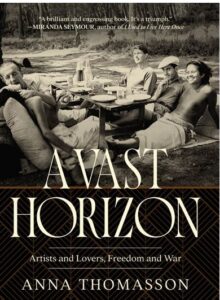
The photo by Miller with which she begins the book sets the tone: three men and two women casually arranged on a picnic blanket in a sunlit glade around a low table littered with the detritus of a meal. The women (Fidelin and Nusch) are topless; one (Nusch) is being passionately kissed by the man to her left (her husband, Paul). Everyone looks happy, relaxed, carefree — a 20th-century bohemian update on Manet’s scandalous “Le Déjeuner sur l’Herbe.”
For Thomasson, the photo is a testament to freedom and fellowship across national, ethnic and gender lines, its subjects encompassing a Black woman (Fidelin), a Jewish American man (Man Ray) and a wealthy English Quaker (Miller’s lover, the art collector and impresario Penrose) — just the kind of people the Nazis would soon seek to lock up or kill. (It’s a shame that Thomasson’s publisher, in reproducing this image on the book’s cover, has committed its own act of censorship, awkwardly photoshopping the women’s bare nipples.)
If Miller was the group’s unofficial documentarian, constantly snapping photos over the course of the monthslong holiday, Picasso was its “master of revelries,” presiding over meals on the hotel terrace and directing the entertainment, at one point instructing his friends — already swapping lovers — to swap names. “This was living surrealism,” Thomasson exults.
Mostly, though, Picasso turned every outing and occasion into art — sculpting a landscape from a matchbook, sketching Nusch in pencil, wine and lipstick on a scrap of paper tablecloth, drawing nudes with a stick in the sand. In the afternoons, ensconced in the best room at the Vaste Horizon, a modest pension surrounded by vineyards and olive groves in the hills above Cannes, he painted, producing portraits of Miller, Nusch, Fidelin and Maar, their fractured features rendered in extravagant shades of pink, azure, yellow, orange and green.
But even Picasso couldn’t ward off the looming specter of war. He arrived at the hotel weeks after completing “Guernica,” his massive cri de coeur against the fascists’ bombing of northern Spain. And while he was there his work was on display in Munich — enlisted in the Nazis’ infamous propaganda show of “degenerate art.”
After the summer of 1937, the bande à Picasso would never be all together again. Dispersed by war and hardship, these men and women who ate, drank, played and slept together embedded the record of that magical summer in the art they left behind. ( With courtsey from New York Times)