
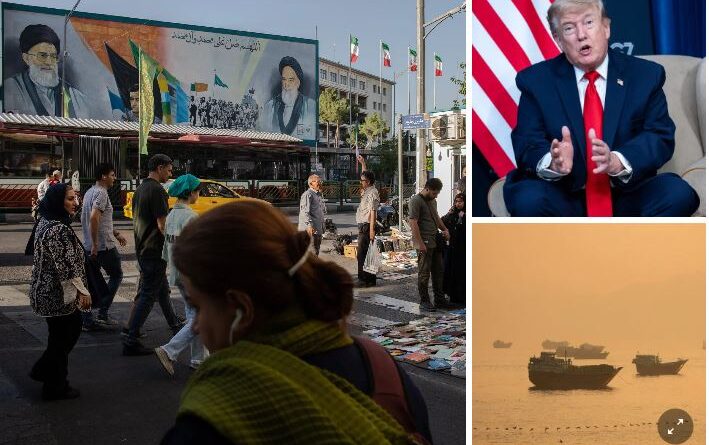
U.S. and Iran Look Ahead to Next Round of Talks

Iran’s foreign minister said that new negotiations with the United States would start immediately after their preliminary deal is signed on Friday. President Trump said he hoped the conflict would soon be in the “rearview mirror.”

President Trump said he hoped the war with Iran would soon be in the “rearview mirror” on Tuesday, even as the terms of a cease-fire he signed remained secret and Vice President JD Vance acknowledged that it was “a very general document” with few details.
Iranian and U.S. officials tamped down the more heated rhetoric they had used in recent weeks, expressing hopes that the short-term agreement will lead to a long-term peace deal. “We’re dealing with people that I think are very rational,” Mr. Trump said. Mohammed Reza Aref, one of Iran’s vice presidents, said that he hoped for a resolution on outstanding issues and called on Iranians to respect the outcome of the talks.
U.S. and Iranian officials are expected to gather at a lakeside resort in Switzerland on Friday to sign an initial agreement and kick off a 60-day cease-fire and negotiating period in which they will try to resolve issues that have kept the two countries at odds not just during the war, but for decades. The signing will take place at the Alpine resort of Bürgenstock, the Swiss authorities said.
Mr. Trump has said that Friday is also when the United States and Iran will lift restrictions they have placed on the movement of a significant portion of the world’s oil and gas shipping fleet through the Strait of Hormuz. But even that step comes with hurdles that the preliminary agreement may not be able to immediately eliminate.
U.S. forces are searching for mines Iran may have laid in the strait. Shippers need mine-free waters and a calmer atmosphere to feel comfortable moving through the narrows. Months of hostilities in the region have frayed nerves and left many skittish that a return to fighting could happen at any moment.
Iranian officials have also suggested that they may charge fees for ships passing through the strait — something they did not do before the war.
The thorniest points of contention are Iran’s stockpile of highly enriched uranium and its proxy war with Israel. Israel’s armed forces and the Iran-backed militia Hezbollah have been locked in a pattern of tit-for-tat strikes since soon after the war with Iran began on Feb. 28. More than 3,600 people in Lebanon have been killed, and more than a million have been forced from their homes.
Abbas Araghchi, the Iranian foreign minister, said that under the terms of the initial agreement, Iran expected Israeli forces to immediately withdraw from Lebanon and halt their attacks in the country. But Israel has said its military will remain in Lebanon, where its forces have continued to launch strikes since the preliminary deal between Iran and the United States was announced over the weekend.
On Tuesday, Mr. Trump said that Israel was overly aggressive in that conflict and “too many people are being killed.” He urged Prime Minister Benjamin Netanyahu of Israel to “be more responsible with respect to Lebanon.”
Here’s what else we’re covering:
-
Oil prices: The price of Brent crude, the global oil benchmark, fell below $80 a barrel on Tuesday for the first time since March, far below its wartime highs but still well above the prewar price.Oil prices fell further on Tuesday, extending declines spurred by the United States and Iran’s announcing on Sunday that they had reached a preliminary agreement to end the war. Stocks were mixed after rising in recent days.Despite the drop in oil prices, they are still more than 10 percent higher since Iran effectively closed the Strait of Hormuz in retaliation for U.S.-Israeli strikes on Iran starting in late February. Hundreds of ships remain stranded in the Persian Gulf unable to transport oil and gas to global markets.
-
Securing the strait: Energy output is expected to take time to return to prewar levels because of the effort involved in restoring production and repairing damaged infrastructure.The deal to reopen the Strait of Hormuz has raised hopes that “oil will flow on both ends,” as President Trump said Sunday, quickly easing an impending energy crisis.But it might not be that simple. To restart ship traffic in the strait, one of the most important questions will be whether the Iranians laid naval mines and, if so, how quickly they can be found and neutralized.
-
G7 summit: At the meeting of the leaders of the world’s largest wealthy nations, on the south shore of Lake Geneva, the focus was on Ukraine and the Middle East as Mr. Trump sought help to clear the Strait of Hormuz.President Trump signaled on Tuesday that the war in Ukraine was not a priority for the United States, telling reporters at the Group of 7 summit in France that his country had “nothing to do” with a war that was “thousands of miles away.”Mr. Trump’s remarks highlighted persistent divisions with G7 allies even after the announcement of a preliminary deal with Iran had eased some of the tension heading into the summit in Évian-les-Bains. European leaders have hoped to rekindle his interest in engaging with Russia on a settlement to end the war, and his comments were a reminder that Europe has increasingly had to fend for itself, more than four years after the full-scale invasion of Ukraine.
-
U.S. senators (don’t) react: Some lawmakers on Capitol Hill were reluctant to praise the preliminary deal without seeing its terms, including Republicans like Senator John Thune of South Dakota, the majority leader, and Senator Lindsey Graham of South Carolina, a close ally of the president. President Trump’s declaration that the United States and Iran had reached a preliminary agreement to halt hostilities drew cautious optimism and frustration from lawmakers on Capitol Hill, where even some Republicans were reluctant to praise a deal whose terms the administration has yet to disclose.