
What to Know About the Ebola Outbreak

Aid agencies are racing to help health workers in the Democratic Republic of Congo. The virus is known to have killed at least 140 people, but the true toll may be far higher.


Lynsey ChutelAmelia Nierenberg and Matthew Mpoke Bigg
(Matthew Mpoke Bigg reported from Nairobi, Kenya.)
The Ebola outbreak spreading through the east of the Democratic Republic of Congo could become the deadliest in history, aid groups have warned, outpacing the international response.
Congo’s Health Ministry on Friday said there were 689 confirmed cases in the country as of Thursday and 139 deaths. The Africa Centers for Disease Control reported on Wednesday that there were 19 confirmed cases in Uganda and two deaths.
The outbreak is the 17th that Congo has faced in recent decades, and it has tested the country’s expertise and resources. At its center, health workers and aid groups are racing to fight the virus and have set up infrastructure to slow its spread. Education and social outreach are crucial parts of the effort.
The type of Ebola virus behind this outbreak, known as Bundibugyo, is rare, with no targeted vaccines or treatment. Early surveillance and testing failed to identify it, delaying the response, and fighting in eastern Congo has displaced millions of people, making it even harder to trace. About 120,000 people fled last year to neighboring countries, the United Nations’ refugee agency said, in an indication of the severity of the conflict.
Here’s what you need to know:
- Where is the outbreak?
- What is it like on the ground?
- What international aid is coming?
- What is the international impact?
- How does Ebola spread?
- What are the particular challenges of the Bundibugyo species?
Where is the outbreak?
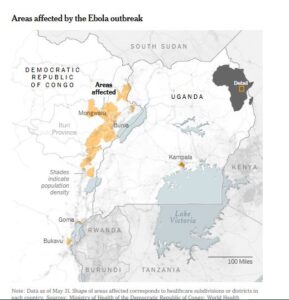
The outbreak was first identified in May in Ituri Province, in northeastern Congo. Ituri remains by far the worst-affected province, but there are also dozens of cases in neighboring North Kivu and a handful in South Kivu.
Many people in Ituri have been displaced by conflict, and the region has gold mines that draw migrant laborers. The World Health Organization has said that the high degree of population movement could make it easier for the virus to spread.

Crowd Burns Ebola Treatment Center in Congo Over Burial Dispute
What is it like on the ground?
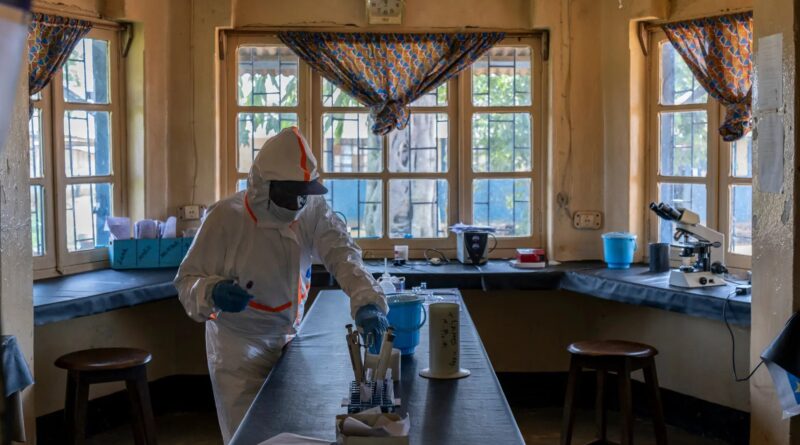
A New York Times reporter, Declan Walsh, recently visited the hardest-hit area, where he found medical workers struggling to treat patients and to curb the outbreak. Aid workers raced to erect isolation tents and disinfection stations near hospitals where people were dead or dying.
Patients cannot always find the treatment they need, or even food or clean drinking water. Relatives come to care for the sick or to collect bodies for burial, often without wearing protection against the highly contagious disease. And even though Congo has been through outbreaks before, many health workers have not been trained to treat the disease. Some have died themselves.

What I Saw Inside an Ebola Ward
But there are glimmers of hope. About 25 people have recovered from the virus, the Africa C.D.C. said on Wednesday.
The W.H.O. said late last month that some of the people who had recovered were Congolese health workers
What international aid is coming?
The United States said in late May that it had committed more than $162 million to the outbreak and that it had mobilized an additional $50 million to support the establishment of clinics.
But public health experts and health workers say a significant obstacle to the international response is how little the United States, which once funded robust disease surveillance networks in the region, has done. The United States withdrew from the W.H.O. in January, and last year the Trump administration shut the U.S. Agency for International Development, which played a major role in containing previous outbreaks.
Video

Top health officials are sounding the alarm. In late May, Dr. Tedros Adhanom Ghebreyesus, the leader of the W.H.O., went to Bunia, the Congolese city at the center of the outbreak, where he oversaw the opening of a treatment center. “This thing is everybody’s business,” he said.
On Monday, he was in Uganda assessing that country’s response to the outbreak.
Here are some other sources of aid:
-
The European Union Commission on Monday made a more than $13 million commitment to the Africa C.D.C. to support its response to the Ebola outbreak.
-
The head of the U.N. humanitarian relief coordination agency said he had allocated $60 million for the response.
-
The W.H.O. said it had released $3.9 million from its contingency funds.
-
The European Union and Unicef said they were sending more than 100 tons of equipment.
-
South Africa’s government has pledged $2.5 million.
-
Congo’s government has set aside $20 million from its own budget for the outbreak, its Health Ministry said.
-

Health workers preparing to transport the body of a person presumed to have died from Ebola in Mongbwalu.Credit…Arlette Bashizi for The New York Times What is the international impact?
Several countries are screening travelers or have tightened their borders.
United States
The State Department has “strongly” urged Americans not to go to Congo or to neighboring South Sudan or Uganda. People traveling from those countries to the United States are being rerouted to four American airports for screening.
Additionally, a 30-day order from the U.S. Centers for Disease Control and Prevention allows the United States to bar foreigners from entering if they have been in Congo, Uganda or South Sudan during the previous 21 days.
In late May, U.S. officials unveiled plans for a 50-bed quarantine center at an air base in central Kenya to house Americans who have been exposed to the virus. But the project has incited angry protests in the town of Nanyuki, close to the air base, by Kenyans who fear Ebola contagion. At least three people have been killed. In addition, Kenya’s high court has ruled to suspend work on the Ebola unit pending a hearing, the date for which will be set on June 23. Despite the ruling, U.S. officials say that work on the site has continued.
Some Americans were also sent to Germany and the Czech Republic for monitoring.
During previous U.S. administrations, Americans exposed to the Ebola virus were brought home to be treated at specialized medical units.

A port official issued hand cleanser in May to people getting off a boat in Goma, a Congolese city.Credit…Arlette
Canada
Canadian officials said in late May that travel and immigration processing for citizens of Congo, Uganda and South Sudan would be suspended for 90 days, the national public broadcaster reported.
Uganda
The country has closed its border with Congo, citing growing concerns about the outbreak.
How does Ebola spread?

Health workers carrying a patient suspected of having Ebola in Mongbwalu in May.Credit…Arlette Bashizi for The New York Times Ebola is an illness caused by a group of related viruses, known as orthoebolaviruses, which fruit bats are thought to carry without being sickened by them. Outbreaks have mostly occurred in sub-Saharan Africa; the largest recorded Ebola epidemic began in 2014, with cases in southeastern Guinea, Liberia and Sierra Leone. It lasted two years.
People can contract Ebola through contact with the bodily fluids of an infected, sick or dead person or with contaminated objects like clothing, bedding, needles or medical equipment.
Four of the six known species of Ebola viruses can be fatal to humans. People may first experience so-called dry symptoms such as fever, aches, pains and fatigue before progressing to wet symptoms including diarrhea, vomiting and bleeding, according to the C.D.C.

Worshipers last month as an ambulance passed with the body of a pastor who died of Ebola in Mongbwalu, in the eastern Democratic Republic of Congo.Credit…Arlette Bashizi for The New York Times What are the particular challenges of the Bundibugyo species?
Vaccines and an antiviral drug have been approved for the Zaire species of Ebola, the most common one. But there is no vaccine or specific treatment for the Bundibugyo species.
Its incubation period ranges from two to 21 days. People are usually not infectious until symptoms appear. Early symptoms like fever and fatigue resemble those of other illnesses, including malaria, so early detection can be difficult.
Fatality rates during the last two outbreaks of this form of Ebola have ranged from 30 percent to 50 percent of those infected, according to the W.H.O.
===================================================================
Brian Otieno contributed reporting from Nairobi, and Isabella Kwai from London.
Lynsey Chutel is a Times reporter based in London who covers breaking news in Africa, the Middle East and Europe.
Amelia Nierenberg is a Times reporter covering international news from London.
Matthew Mpoke Bigg is the East Africa bureau chief for The New York Times, based in Nairobi, Kenya.