
In a Milestone for A.L.S., a Treatment Helps Some Patients Improve
The drug is for a small subset of patients. But evidence that breathing and strength can get better for some of them is remarkable for a paralyzing, usually fatal disease.

(Pam Belluck spent time with an A.L.S. patient who is being treated with the new therapy in Miami.)
Time was running out for Amanda Sifford, she and her doctors could tell. A.L.S., the paralyzing neurological disorder, was stealing her ability to breathe.On a breathing test, her lung function was only at 48 percent of capacity, a sharp drop from 86 percent five months earlier.
“I couldn’t take 10 steps and be able to breathe,” she said. “I could no longer step up on a curb.”
Ms. Sifford, 58, a school psychologist in Cape Coral, Fla., has lost 14 family members, including her father and grandfather, to a rare genetic form of A.L.S., also known as amyotrophic lateral sclerosis or Lou Gehrig’s disease. Her symptoms had been developing gradually, but her breathing suddenly nose-dived.
“It was very scary,” said Dr. Nathan Carberry, one of her neurologists at the University of Miami Health System. “I worried that we were looking at months of life left.”
“Was I thinking about dying?” said Ms. Sifford, pausing to collect herself. “I had my affairs in order.”
It was May 2023, and the Food and Drug Administration had just approved the first therapy for a genetic form of A.L.S., even though clinical trial results had not yet proven the drug would be effective.
The drug, tofersen, made by Biogen and marketed as Qalsody, targets the form of A.L.S. that Ms. Sifford inherited, so Dr. Carberry and Dr. Michael Benatar, the executive director of University of Miami A.L.S. Center, scrambled to establish a clinic to administer it.
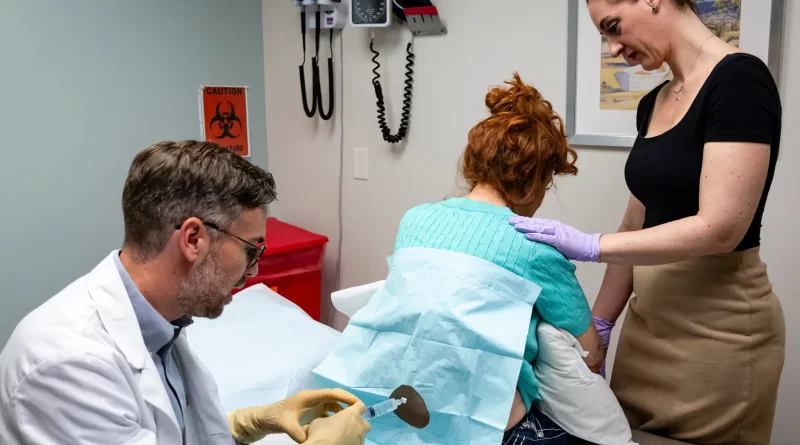
She began receiving tofersen monthly, through infusions into her spinal canal.
It took time to notice any benefit, and months after treatment started, she experienced spinal inflammation, a serious side effect requiring her to temporarily stop the drug. But gradually, her breathing, muscle strength and mobility stopped getting worse, and then improved. Such outcomes are remarkable for a disease that almost always causes continual decline and death.


In January, at the Miami center, she scored 63 percent on the lung capacity test, the highest since she had started tofersen in July 2023. “Can you believe it?” cried Anne-Laure Grignon, a senior project manager, tearfully throwing her arms around Ms. Sifford.
Tofersen targets only about 2 percent of A.L.S. patients, those whose disease is caused by a mutation on the SOD1 gene. (About 90 percent of A.L.S. has no known genetic cause; the rest is caused by other mutations.) Tofersen reduces levels of a toxic form of SOD1 protein.
Despite the small numbers, evidence that some patients are getting better — and that others are not getting worse — is generating excitement and optimism for people with a disease that diminishes the ability to walk, speak and breathe, often killing patients within five years.
Many experts had expected that if tofersen were effective, it would only slow decline, not stop or reverse it.
“Those of us who have taken care of people with A.L.S., we don’t ever see improvement,” said Dr. Timothy Miller, the tofersen trial’s principal investigator and a neurologist at WashU Medicine in St. Louis. Patients with the fastest-progressing form of SOD1-caused A.L.S., the most common variant in North America, often die within a year.
When tofersen was approved, results had not shown it worked better than a placebo. But because it reduced levels of a protein that indicates damage to neurons, the F.D.A. granted conditional approval, requiring Biogen to conduct another study to demonstrate if the drug could slow A.L.S.
Now, some evidence is in. A study following 46 of the trial patients for about three years found that nearly 20 percent improved in breathing, strength and function.
While about 75 percent did not stabilize or improve, their decline was still slower than expected, said Dr. Miller, whose lab developed tofersen with Biogen and Ionis Pharmaceuticals. That was especially true if they received tofersen earlier in their disease, at the trial’s start, instead of first receiving a placebo for six months. For patients with fast-progressing A.L.S., those who received tofersen at the beginning lived about three years longer than delayed-start patients.
“It tells us that A.L.S. is treatable,” Dr. Miller said.
Rickey Malloy, 44, of Hillsboro, Ill., started tofersen weeks after being diagnosed with A.L.S. in July 2023. At the time, Mr. Malloy, a longtime plumber, was limping, wore a brace for a foot-drop and needed assistance to climb ladders and stairs. Now, he said, most of those issues have stabilized or improved.
Last year, doctors deemed him healthy enough to undergo knee replacement surgery for an unrelated issue and to participate in a physical therapy clinical trial at WashU Medicine.
“I’m making progress,” he said. “There’s not an overnight fix and it’s a lot slower than I would like, but we’re getting there.”


For Paula Trefiak, of Regina, Saskatchewan, A.L.S. was so prevalent in her family that as a child, she learned to walk by pushing relatives’ wheelchairs and to read by holding newspapers for an afflicted cousin. Twenty-six relatives have died of A.L.S., including her father at age 56.
In her 20s, she began experiencing muscle twitching. An avid amateur ballet dancer, she had to quit because of balance problems. Later, she had to stop working as an emergency medical responder.
She started in the tofersen trial soon after being diagnosed in 2016 but didn’t receive the full dose until 2019. Gradually, her breathing and strength improved. Now, “I can go up on my toes” like a ballerina, she said.
She is 44, an age she wasn’t expecting to reach because most of her female relatives with A.L.S. died younger.
Her 18-year-old son recently learned he has the SOD1 mutation, although he does not yet have any symptoms.
“I had that anxiety that, Oh my gosh, this diagnosis is going to be so devastating,” she said. “But he keeps telling me: ‘Mom, this isn’t the same diagnosis that you got. I now have a treatable disease.’”
Despite extensive research, there are only two other approved treatments specifically for A.L.S.: riluzole, which can extend survival by several months, and edaravone, which can slow progression by about 33 percent.
Another, Relyvrio, was approved in 2022, but withdrawn in 2024 after failing a large trial.
With tofersen, “there’s still a lot we need to learn,” said Dr. Benatar, a co-author of the recent tofersen study. “As ecstatic as I and the whole field are to see people improving, it’s still early days for us to understand what that means. Will it be sustained? Will the disease in other ways progress, despite what’s improved?”
And, Dr. Benatar said, “there can be serious side effects that we have to look for, be mindful of, try to treat.”


The most severe have involved inflammation of the spinal cord or spinal nerve root. Ms. Sifford developed both, which can cause weakness, tingling and pain. About a year after beginning treatment, while on a boat, she called Dr. Carberry, saying, “It feels like there’s an electric current right into every part of my body.”
“Get off the boat and go to the hospital,” he instructed. She needed numerous steroid treatments and an immunotherapy drug.
“She’s had the worst inflammatory reaction so far,” Dr. Carberry said. “We were very worried about it the whole time because her breathing was so tenuous.”
Eventually, she resumed tofersen, with steroids injected into the spinal canal before each infusion, plus the immunotherapy drug every six months.
Dr. Benatar is studying whether tofersen can delay or prevent A.L.S. for SOD1 carriers who don’t yet have symptoms but whose disease-related protein levels have increased.
Another major question is whether tofersen could help other A.L.S. patients, those without SOD1 mutations. Dr. Miller and Biogen recently started a small clinical trial, based on evidence that some patients in the broader A.L.S. population also have misfolded SOD1 proteins without the mutation, said Stephanie Fradette, Biogen’s head of neuromuscular development. But, she said, it’s unclear whether their misfolded proteins do anything to cause or worsen their A.L.S.
“It’s far from a slam dunk,” she said. “But it is an important hypothesis to evaluate.”
Tofersen’s list price is $15,500 per monthly dose, making it largely unaffordable without insurance. Doctors have fought insurers that denied patients coverage. Biogen said it offers co-payment assistance and a free drug program for qualifying patients who cannot pay.
In January, Miami’s medical team extensively evaluated Ms. Sifford, including with cognitive testing and collecting tears from her eyes to search for A.L.S.-related proteins.


Several months before starting tofersen, her breathing was so precarious that she could barely carry on a conversation, and doctors inserted a feeding tube port, worried that if she needed tube feeding later, her lung function would be too compromised for surgery. She began using a noninvasive portable ventilator, which she named Vinny, and needed it more and more.
Now, she uses Vinny less often.
About two months after starting tofersen, her breathing scores stopped worsening. Around that time, she achieved a milestone outside Mel’s Diner in Cape Coral, when she was able to step up on the curb.
After about a year, her scores began improving. Last summer, at a Key West bar, she managed to dance for the first time in years, swaying to a Lou Rawls song as a bartender held her hands to keep her from falling.
But tofersen has not helped all her symptoms. A.L.S. has progressed to her throat muscles, making swallowing harder and causing her speech to slur. “The speech disturbance is new, so parts of the disease have slowed and improved, but parts haven’t,” Dr. Benatar said.
Tofersen treatments seem less able to reach muscles linked to the tongue, throat and face, he said, possibly because the drug has trouble distributing there from the spinal infusion location.
Dr. Carberry wants to increase her infusions to every three weeks, something he’s done with another patient, hoping the additional medication reaches those muscles, which are also important for breathing. Insurance wouldn’t cover that, so he’s planning it as a clinical trial for several patients. “We’re not comfortable just putting up a ‘Mission Accomplished’ sign,” he said. “The medication’s not perfect. The disease is horrendous.”
During the evaluation, Dr. Carberry used devices that assess motor nerve function. A.L.S. is a tug of war between nerve injury and regrowth, and the goal is for regeneration to outpace degeneration, he said. As jumping lines flashed on a screen, he said, “We’re not seeing a lot of active degeneration, and we’re seeing some regrowth that’s very cool to see.”
After the tests and the next day’s infusion, Ms. Sifford was exhausted but grateful.
“I’ve gotten a chance to help find treatment for something that killed my father and my grandfather,” she said, gesturing at her father’s high school ring. And “I’m alive.”
=======================================================================
Pam Belluck is a health and science reporter for The Times, covering a range of subjects, including reproductive health, long Covid, brain science, neurological disorders, mental health and genetics.