
U.S.-China Rivalry Reaches South American Skies
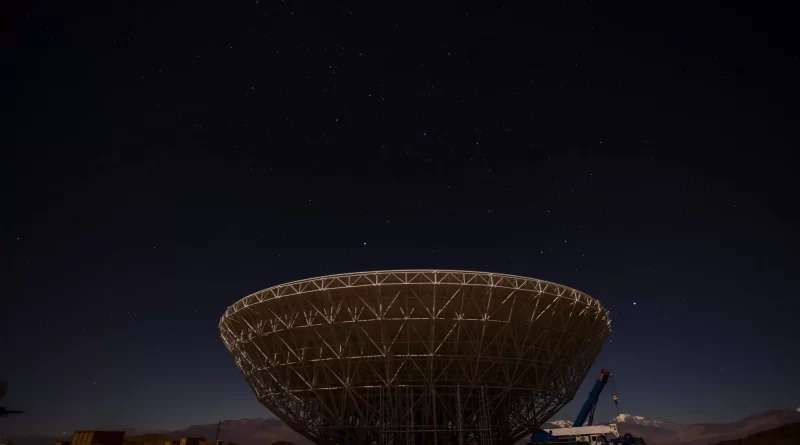
In the foothills of the Argentine Andes, the enormous Chinese radio telescope sits in one of the world’s premier stargazing locations, surrounded by vast, undulating mountain ranges and beneath skies untouched by light pollution. It is also on the opposite side of the planet from Beijing, offering China a window on the half of the heavens it would not otherwise see.
But the Chinese telescope at the site, the Cesco observatory in San Juan Province, picks up no signals. After the U.S. government repeatedly pressed them on the issue, the Argentine authorities stopped the project’s completion. Lacking key parts, the telescope now sits dismembered, its gigantic antenna pointing blindly at the sky.
As the United States increasingly views Beijing as a rival in space, the stars above South America have become flash points in a geopolitical struggle, with top American officials trying to halt astronomy projects in the Andean deserts out of fear China could use them for military purposes.
The Trump administration says it is enforcing an updated Monroe Doctrine, in part to counter China’s growing footprint in the Western Hemisphere. China is a key trading partner for many countries in Latin America, and it is trying to build scientific and security ties. Its relations in the region could come up in official talks this week in Beijing between President Trump and Xi Jinping, China’s leader.
Last year, Argentina’s neighbor Chile stopped a Chinese astronomical observatory project in the Atacama Desert after strong urging from a U.S. ambassador. And in the case of the Cesco observatory’s Chinese radio telescope project — which would be the largest of its kind in South America — authorities have held some key, final parts for it at customs for about nine months.
According to a document from the Argentine government’s cabinet chief, procedural violations in renewing the deal with China prevented the project from going forward. The government declined to comment on whether the U.S. diplomacy played a role in the decision.

But current and former American officials, some of whom spoke on the condition of anonymity to discuss sensitive diplomacy, said the U.S. government had repeatedly expressed concerns with the Argentine authorities about the Chinese telescope, worried it could be used to track U.S. satellites and communicate with Chinese ones.
The campaign began during the Biden administration and continued under President Trump.
Argentine astronomers, who have spent most of their lives observing stars light years away, have received a crash course in earthly politics.
Scientists had looked forward to sharing the telescope with China and other nations. Then they learned that the U.S. effort to check China had reached the deserts of South America, threatening their search into the vastness of space.
“We are stuck in a political black hole,” said Ana Maria Pacheco, 61, an astronomer.
The radio telescope, she said, would have helped compensate for the relative scarcity of such instruments in the Southern Hemisphere compared with the Northern Hemisphere.
The State Department did not reply to requests for comment.
In 2015, as China was expanding its presence across South America, the Chinese military built another facility, a $50 million satellite and space mission control station in Neuquén Province, in Argentina’s Patagonian desert. Argentina gave China the use of the land where the station was built, rent free, for 50 years.
For China hawks in Washington, that Patagonian base became a symbol of how Argentina was being pulled into China’s orbit, and the site’s antenna there stands as a 450-ton cautionary tale.


The Trump administration has forged a tight bond with Javier Milei, Argentina’s right-wing president, and aided him with a $20 billion lifeline ahead of key midterm elections last year.
While running for president, Mr. Milei expressed hostility toward China. But after being elected in 2023, he softened his tone, perhaps facing the reality that China’s economy is entwined with that of Argentina through trade, infrastructure, mining projects and financial assistance, just as it is in other Latin American countries.
U.S. officials say they are aware that dislodging China from Latin America will be hard. Still, they see the frozen gears of the San Juan radio telescope — which was built in partnership between the National University of San Juan and the National Astronomical Observatory of China — as a sign that U.S. diplomacy can help thwart aspects of China’s space ambitions, and perhaps its military ones too.
The Chinese Embassy in Buenos Aires said in a statement that the U.S. was “looking for an excuse to contain and suppress China.” They said the project was aimed at promoting scientific progress in both Argentina and China, with benefits for all of humanity. They called the American position “ridiculous and regrettable.”
When the Chilean observatory project was halted last year, the Chinese Embassy in Santiago said in a statement that the United States also uses telescopes in Chile and accused it of a “pure and simple manifestation of hegemonism.”
The United States does have a significant astronomical presence in South America, with NASA using several space stations to track satellites.


Stargazing With China
The Argentine observatory in San Juan where the disputed Chinese telescope stands was inaugurated in the 1960s in partnership with Yale and Columbia University. Argentina has some of the world’s clearest, cloudless skies, and German, Russian and Brazilian institutions built telescopes that now dot the observatory’s grounds. Construction has started on a new telescope in collaboration with the University of Texas.
But the venture with China tested the limits of this astronomical cosmopolitanism.
The China Argentina Radio Telescope was a $32 million investment that started about 15 years ago. It has a 130-foot-wide antenna: a gigantic satellite dish that allows scientists to capture invisible radio waves from space to map the birth of stars and distant galaxies. It is thanks to these types of telescopes that astronomers captured the first-ever image of a black hole in 2019.
In 2023, 100 trucks carrying the telescope’s enormous iron components wound their way up narrow mountain roads to the observatory. Along with the machinery came a team of Chinese technicians who took up residence in Barreal, the nearest town, where horses and cows wander past low-slung houses.
From early in the Biden administration, top White House national security officials and State Department diplomats were aware of the project. In August 2021, Jake Sullivan, the national security adviser, and Juan Gonzalez, the top White House adviser on Latin America, raised the issue during a visit to Buenos Aires, Mr. Gonzalez said.
The American officials told Alberto Fernández, then the president of Argentina, that they were concerned about several Chinese projects, including the radio telescope, a port in Ushuaia in the far south, and the base in Neuquén, he said.


The Argentine president said he would ensure the projects were not used for military purposes, Mr. Gonzalez said, but a 50-year lease on the land in Neuquén meant China had a strong legal case to continue using that site.
American officials, in diplomatic conversations, pushed harder on the radio telescope project in San Juan.
The Trump administration kept up the pressure. In February 2025, Secretary of State Marco Rubio discussed “space collaboration” with Gerardo Werthein, Argentina’s foreign minister at the time, according to a State Department summary of the call.
That spring, experts from the Sandia lab in Albuquerque, run by the Department of Energy, traveled to Buenos Aires to brief Argentine officials about the possible risks posed by the Chinese telescope, American officials said.
At the State Department’s urging, the office of the U.S. trade representative included language in a new bilateral trade agreement that tried to limit Argentina’s ability to work with China on space projects.
The document says Argentina must cooperate with “U.S. government technical experts to implement sufficient control measures at space installations operated by other countries to ensure their exclusively civilian use.”
Argentina’s agreement with China to build the telescope expired last summer. Shortly after, customs authorities froze some key parts of the antenna in the port of Buenos Aires.
Summoning the Scientists
In November, the U.S. government flew scientists from the National University of San Juan to the Sandia lab in Albuquerque for a three-day training on “concerns about dual use in civilian space research facilities,” according to an invitation seen by The New York Times.

Marcelo Segura, the coordinator of the Chinese radio telescope project at the National University of San Juan, said he and his team tried to persuade American officials that the Chinese telescope would be used only for civilian purposes.
“It did not work,” said Mr. Segura, who had studied Chinese to discuss the telescope’s work with Chinese colleagues.
The telescope’s white metal components sit idle like a giant skeleton. Inside the telescope’s basement, chopsticks, cans of oyster sauce and tins of green tea left behind by the Chinese workers remain on tables. A Chinese-language sign on the wall offers guidance on how to handle encounters with pumas.
A similar situation is evident across the border, in the Atacama Desert in Chile. There, the authorities carved a road through the lunar landscape to a tall peak designated for a Chinese space observatory.
It was going to include 100 telescopes intended to help monitor asteroids and extragalactic explosions, according to the Catholic University of the North, which was in charge of the project. Chilean scientists would be permitted to use the telescope two nights a month, university officials said.
That road now leads to nothing. The Chilean authorities blocked the observatory project after repeated pressure by American officials.
Bernadette Meehan, the U.S. ambassador to Chile under President Joseph R. Biden Jr., said she raised the observatory with the highest levels of the Chilean administration.
“It was very important for the U.S. government that the project was not allowed,” said Ms. Meehan, calling it one of her most urgent priorities.
Strong relationships with places like Chile and Argentina, she said, are crucial to “guard against Chinese efforts to seek stronger strategic inroads.”

================================================================================
Daniel Politi contributed reporting from Buenos Aires, and John Bartlett from Santiago, Chile.
Emma Bubola is a Times reporter covering Argentina. She is based in Buenos Aires.
Edward Wong reports on global affairs, U.S. foreign policy and the State Department for The Times.