
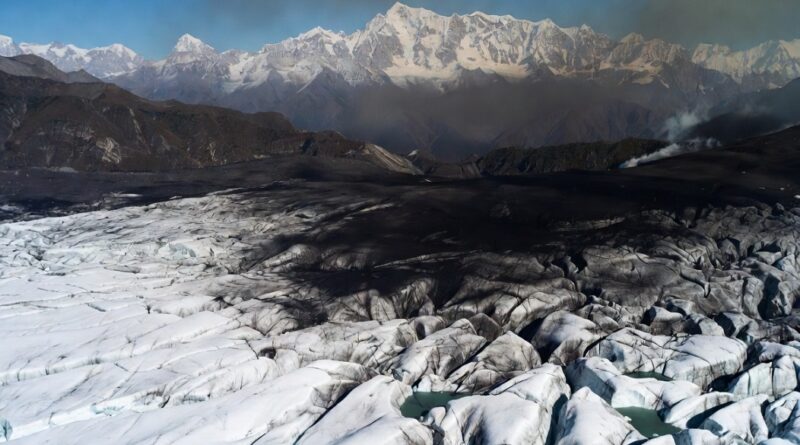
Beyond the Slogans: Confronting the Terrifying Reality of Himalayan Black Carbon
In this article, veteran journalist and author, Jay Singh Rawat highlights black carbon as a major but often overlooked threat to the Himalayas, accelerating glacier melt beyond the impacts of greenhouse gases alone. Soot from vehicle emissions, forest fires, construction activities, crop-residue burning, and industrial pollution settles on snow, reducing its reflectivity and increasing heat absorption. This has intensified glacier retreat, disrupted water cycles, dried traditional springs, and increased the risk of devastating Glacial Lake Outburst Floods (GLOFs). The author argues that unchecked development, tourism, and infrastructure expansion are worsening the crisis and calls for ecology-centric policies, sustainable engineering, and community-led conservation efforts.-Usha Rawat, Admin/ Editor

By Jay Singh Rawat
Whenever serious concerns about climate change are raised on global platforms, our attention often shifts to industrial countries and greenhouse gas emissions. Undoubtedly, these factors are raising the Earth’s temperature. However, when we talk about Asia’s “Third Pole”—our Himalayas—a more cruel, local, and immediate face of the crisis emerges. This crisis is black carbon.
It is not merely a technical term from environmental science; it is the invisible soot that is prematurely ageing our life-giving rivers and this sacred crown of mountains. On this Environment Day, if we wish to look beyond traditional slogans and rituals, we must confront the terrifying truth of Himalayan ecology—one that scientific research and geological data are screaming out loud.
The Himalayas are not just a silent, majestic structure of rocks and ice. They are the foundational pillar of the entire civilisation, culture, and economy of the Indian subcontinent. The glaciers that have kept the rivers—on which more than half the country’s population depends for water—pristine for centuries are now facing an unprecedented crisis.
Recent reports from the Wadia Institute of Himalayan Geology in Dehradun, ISRO’s National Remote Sensing Centre, and the Intergovernmental Panel on Climate Change (IPCC) confirm that the rate of glacial retreat in the Himalayan region has increased dramatically over the past few decades. The alarming part is that this rapid melting is not solely due to invisible gases floating in the atmosphere, but also due to the direct black soot being deposited in the sensitive mountain environment because of our own greed and unplanned policies.
To understand the scientific dimension of this crisis, we must grasp one of nature’s most beautiful and simple rules: the albedo effect. Nature has provided these peaks with a brilliant shield of pure white snow that functions like a giant mirror. When sunlight falls on this shining white snow, it reflects 80 to 90 percent of the solar radiation and heat back into space. This is why the glaciers remain protected even during the hottest months.
But when black carbon generated by human activities in the plains and mountains drifts through the air and reaches these high glacial regions, it settles as a thin black layer on the white sheet. This fine layer of soot directly destroys the snow’s brightness—its albedo. Science has established that black colour is the greatest absorber of heat. As soon as the snow becomes dirty or black, instead of reflecting sunlight, it begins to absorb it. Scientists have concluded that due to this direct effect of black carbon, the rate of glacial melting has more than doubled.
The question then arises: how is such a large amount of this soot reaching the extremely remote and uninhabited high Himalayan regions? The causes are very close to us and highly local.
The first and biggest reason is the uncontrolled and haphazard pressure of tourism and transportation in the mountains. Every year, millions of diesel and petrol vehicles flood the Char Dham pilgrimage routes and other tourist destinations. Traffic jams lasting hours in narrow mountain valleys and the thick, unfiltered smoke from heavy commercial vehicles rise with the wind currents and travel directly toward the high glaciers.
The second major and destructive cause is the forest fires that break out every summer. The devastating fires in the pine forests of the central Himalayas are no longer confined to the forests alone. Tons of ash and dense black carbon released from these blazes ride atmospheric currents and settle directly into the sensitive glaciers of Gangotri, Yamunotri, Chorabari, and others.
Added to this is the dust raised by reckless dynamite blasting for all-weather roads and hydropower projects, along with emissions from heavy machinery, which are pushing local pollution to extreme levels. The large-scale burning of crop residue (parali) in the plains during winter and pre-monsoon months, and industrial pollution from the National Capital Region, are equal partners in this destruction.
Geologists at the Wadia Institute, through their long-term studies, have found that the Gangotri Glacier is retreating at an average rate of 15 to 20 metres per year, while the shrinkage of smaller glaciers at lower altitudes is even more concerning. Experts clearly estimate that if the current rate of temperature rise and black carbon deposition continues, nearly one-third of the glaciers in the Hindu Kush-Himalaya region could disappear forever by the end of this century.
But the issue is not limited to the shrinking of glaciers. This accelerated melting has triggered a highly dangerous and destructive chain reaction that is completely disrupting our hydrology. When glaciers melt faster than normal, they leave behind huge quantities of unstable water and boulder debris. This water accumulates behind weak natural dams of moraine, known in scientific terms as moraine-dammed lakes. When these lakes grow beyond their carrying capacity, they become “time bombs.”
When a slight seismic jolt, landslide, or avalanche causes these weak natural dams to burst, it results in sudden catastrophic floods in the lower valleys—known as Glacial Lake Outburst Floods (GLOFs). The recent Rishiganga disaster in Chamoli and the devastation along the Teesta River in Sikkim are living and terrifying examples of this phenomenon.
Another more serious aspect of this hydrological imbalance is that the entire human and wildlife ecosystem in the mountains depends on traditional water sources—springs and streams (dhara and naula). Under normal conditions, heavy winter snowfall slowly melts and seeps into the internal rocks, cracks, and underground pores of the mountains, recharging these natural sources throughout the year.
However, due to the effect of black carbon and untimely intense heat, the snowfall cycle itself is getting disrupted. The frozen snow turns into water and rushes away quickly, leaving the ground with no time to absorb it. As a result, nearly 50 percent of the traditional drinking water sources in the central Himalayan regions have either completely dried up or are on the verge of drying.
The conflict between development and nature conservation has now reached a point where any delay in policy reforms will be suicidal. Experts believe that development should not stop entirely, but the question is about its style. Immediate bans must be imposed on the destructive traditional dynamite blasting in the mountains. In its place, “eco-sensitive engineering” methods such as cut-and-fill techniques and tunnel boring machines should be made legally mandatory.
Before approving any new construction or tourism infrastructure, an impartial scientific assessment of the area’s carrying capacity must be mandatory. Governments will have to show strong resolve and impose a complete halt on new constructions in sensitive slopes that cannot bear the burden of concrete—otherwise, crises like those in Joshimath and Nainital will keep repeating.
Additionally, for forest fire control and forest management, the Forest Department must once again empower local communities and Van Panchayats with traditional rights. Until the local citizen has a direct emotional and livelihood connection with forests and water sources, environmental conservation will remain only on paper.
The time has come to make our development policies ecology-centric, so that future generations can inherit a safe and secure land.
==============================
ABOUT AUTHOR : Jay Singh Rawat is a veteran Dehradun-based journalist, author, and researcher with over 48 years of media experience across prominent national Hindi and English newspapers, magazines, and digital news portals. He is widely recognized for his authoritative research on Himalayan ecology, glacier recession, and regional governance. A recipient of the prestigious Pandit Bhairav Dutt Dhulia Award, Rawat has authored nine reference books—including acclaimed titles published by the National Book Trust of India—vividly documenting the socio-political history, vibrant folk culture, and demographic evolution of the region’s indigenous tribal communities.