
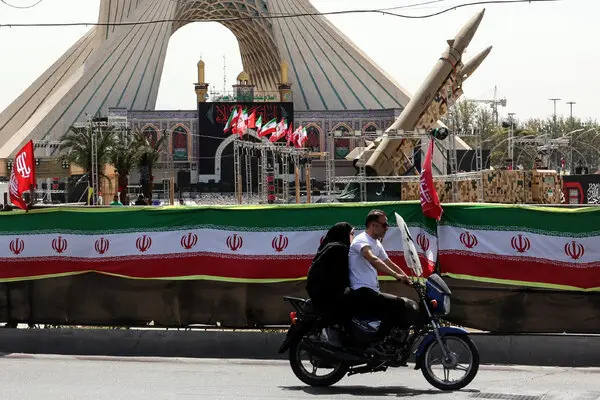
Why Iran Is in No Rush to Return to Talks With United States
Amid a reprieve in the fighting, Iran’s leaders are betting that they can endure more pain than President Trump can, and they have leverage over the Strait of Hormuz, analysts say.

(Yeganeh Torbati has reported for years on Iranian politics and society)
Iran’s skies have been free of the sound of explosions and airstrikes for the past several days, after a bout of renewed fighting with the United States. But Iranian officials say they have not agreed to a cease-fire and are in no hurry to hold direct talks with American negotiators.
Instead, Iranian officials insist that they are in a position of strength, military leaders boast of battlefield successes, and diplomats dismiss U.S. claims that they are eager to return to negotiations.
The rhetoric coming from Iran indicates that its leaders are comfortable with the state of limbo with the United States — something between peace and full-fledged war — believing that they can handle renewed conflict and that they have leverage over President Trump. The priority for Iran seems to be gaining recognition of its control over the strategic Strait of Hormuz waterway, a concession that the United States has been unwilling to make.
Despite the bluster, the uncertainty is a challenge for Iran, analysts say. Fighting could break out again at any time, a final settlement appears distant and Iran’s economy is almost certain to deteriorate further because of instability, wartime destruction and a U.S. naval blockade.
Ramazan Sharif, a former spokesman for Iran’s Islamic Revolutionary Guards Corps, the ideological military force that has solidified its control over Iran during the war, said on Sunday that Iran’s “enemy” had “faced strategic defeat at every step,” Iranian state media reported.
Iranian diplomats have reacted with more restraint to the pause in the fighting over the past few days, after two weeks of trading attacks. But there is little hint that they are in a mood for compromise.
“At present, what exists cannot be described as a cease-fire,” the Iranian foreign ministry spokesman, Esmail Baghaei, said at a news conference on Monday.
Mr. Trump said on Monday that Iran had asked for a pause to meet for talks, and that the two sides were engaged in discussions.
“We’re talking right now,” he told reporters aboard Air Force One, adding that there was “a good chance” a new round of diplomacy with Iran could yield a breakthrough. Last week he said at the White House, “they want to meet desperately to try and end it.”
Iran faces stark internal divisions over the diplomatic contacts, with hard-liners opposed to resuming negotiations and denouncing the elected government, which has engaged in talks in pursuit of a cease-fire.
Iran’s negotiations, Mr. Baghaei said, were with Oman, over management of the Strait of Hormuz, the critical waterway for oil and gas shipments that Iran effectively shut down after being attacked by the United States and Israel in late February.
“They believe that time is on their side, that they can absorb pain and pressure more successfully than Donald Trump can, and that ultimately he will agree to a deal that fits their demands without any concessions from their side,” said Gregory Brew, a senior analyst on Iran at the Eurasia Group, a political risk advisory firm.
The recent resumption of fighting caused oil prices to surge, raising prices at the gas pump for American consumers. Oil prices had fallen sharply, after the United States and Iran paused their attacks.
Mr. Trump faces a painful dilemma in deciding his next step on Iran.
The New York Times reported on Saturday that private U.S. deliberations over the war have focused on the Pentagon’s shrinking stockpiles of air defense munitions, making a return to war high risk. That is just one of several concerns for U.S. officials, along with the danger of a widening war, the effect on Gulf allies and global energy supplies.
It is difficult to know the state of Iran’s missile supplies, said Farzin Nadimi, a senior fellow with the Washington Institute and an expert on Iranian military affairs. Iran is believed to have produced between 700 and 1,000 solid-propellant ballistic missiles between the brief war with Israel in June 2025 and the outbreak of the current war, he said. Its output of liquid-fuel and cruise missiles is less quantifiable, he added.
Open-source information on Iran’s missile production can be fragmentary, Mr. Nadimi said. That opacity means that less is known about how Iran would fare in a return to full-blown war.
Still, Iran does not “want to return to a full-scale war that involves both the U.S. and Israel, and also one with open-ended prospects,” he said. Iranian officials have hinted in recent interviews that they agreed to the cease-fire partly because missile stocks were running low or were not fully accessible, he added.
Iran is at risk of overreaching, Mr. Brew said. For Mr. Trump, escalating the war could be more appealing than accepting a deal that gives Iran control over the strait, he added, and other countries are unlikely to accept tolls on ships. There is scope for both sides to de-escalate if Iran can accept a compromise arrangement for the future of the waterway.
===============================================
is the Iran correspondent for The Times.