
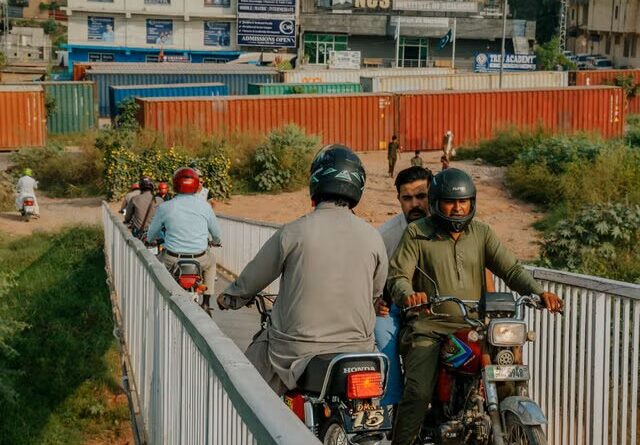
A Tetris-Like Maze Blocks Protests in Pakistan’s Capital
Pakistani authorities have barricaded Islamabad with more than 1,500 shipping containers to stop opposition protesters, choking off access to the capital.
A wall of steel. Citywide Tetris. “Containeristan.” This is what Pakistan’s capital, Islamabad, looks like these days after the police sealed off the city with more than 1,500 shipping containers ahead of a protest planned by the main opposition party.
Two rows of colorful containers snake along the road leading to the prime minister’s house and Parliament, pushing the representatives of the Pakistani people out of sight and out of reach.
Pakistan Tehreek-e Insaf, the opposition party, had called on its supporters to march peacefully on Islamabad to demand the release of its leader, the former cricket star and prime minister Imran Khan. He has been imprisoned since 2023 on corruption charges that he and his party describe as politically motivated.
But on Friday, party officials said they would postpone the march, which had been scheduled for Sunday, until Oct. 4. They said they hoped a delay would work in their favor: Either the government would unblock the streets by then, or the containers’ continued presence would further increase public anger against the government. On Friday afternoon, construction vehicles were still moving containers in and around the city, and they remained in place as of Friday evening.


The government has not yet said how long it will keep Islamabad in a state of quasi lockdown. But the containers have so far been the most visible sign of the government’s effort to quell widespread discontent over the repression of dissent and the crackdown on Mr. Khan’s party.

This week, three of Mr. Khan’s sisters and some senior party members were arrested on charges of threatening “public safety and maintenance of public order.”
The government has also declared any protest unlawful until the end of the month. It has deployed thousands of extra security personnel, provided the police with “net launchers” to catch protesters in mesh nets, and ordered hospital staff to remain on high alert ahead of a potential “mass casualty surge,” according to a document sent to hospitals and seen by The New York Times.
The use of containers to block access to Islamabad goes back at least three decades. During protests in 2014, Mr. Khan turned a container into an impromptu refuge and stage. In April, the government used them to secure Islamabad when Vice President JD Vance and an Iranian delegation held talks in the city.
The practice has become so routine that an Islamabad judge described the capital in 2024 as a “container city.” Residents sometimes call it “Containeristan.”
“Containers symbolize trade and progress,” said Naveed Iftikhar, an urban economist based in Islamabad. “Here in Pakistan they symbolize chaos and restrictions.”


This week’s array of containers appears to be among the most robust ever deployed in the city. The police stacked containers and welded them together to prevent demonstrators from displacing or climbing over them.
The police have rented some containers from freight companies and seized others randomly, even as drivers were transporting cargo. After the confiscation of trucks carrying medicine caused a public uproar last week, the interior minister ordered them to be released. It remains unclear when other drivers will get their seized containers back.
Zubair Niazi was driving his truck to Lahore, where he was supposed to pick up milk for delivery to Islamabad, when the police stopped him and ordered him to surrender his container, he said.
Working-class Pakistanis are the base of Mr. Khan’s party, and Mr. Niazi described himself as a supporter. He said police officers told him he would receive a call when he could retrieve his confiscated container, but he was not given any date, nor any financial compensation.
Malik Sher Khan, the president of a truck owners’ lobbying group, said the arbitrary confiscation of containers had disrupted the freight industry across the country.
“No one is ready to enter Punjab or bring goods to Islamabad,” Mr. Khan said. Punjab, Pakistan’s richest province, borders the capital.


The government has framed the move as a necessary precaution to stop what it says would be a violent protest. “They will hurt themselves, and they will hurt the people,” the interior minister, Mohsin Naqvi, said earlier this week of the protesters. “They should not go into a situation from which there is no way back,” he added.
Officials from Mr. Khan’s party have repeatedly said the march would be peaceful.
A group of eight drivers, their traditional shalwar kameez outfits faded by sun and sweat, sipped tea under the shade of a tree last week as they waited for the police to release their requisitioned containers.
Another driver stopped by with a question.
“Where is the Serena?” he asked, referring to one of Islamabad’s elite hotels.
He said his container had been sent to form a barricade there, so he was on his way to try to get it back.

======================================================
Salman Masood contributed reporting.
Elian Peltier is The Times’s bureau chief for Pakistan and Afghanistan, based in Islamabad.