
Bomb by Bomb, the Slow Death of My Hometown in Ukraine
It was possible, for a time, to think that Kramatorsk, where I was born and raised, would survive the war mostly unscathed. Not any more.
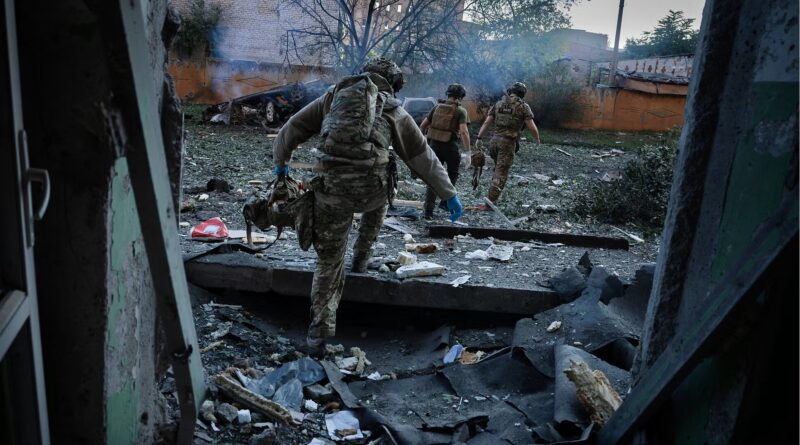
On the morning of Aug. 4, two Russian guided bombs, each weighing more than 1,000 pounds, struck the residential block where I grew up in Kramatorsk, eastern Ukraine.
I learned of the attack from social media, scrolling through videos until I recognized a neighboring building in flames. Then came the frantic search for any piece of information on whether my home had also been destroyed.
Finally, a man who still lives in my building sent me a video, filmed from inside my flat. The fire had spared it, but not the blast. Shards of glass covered the floor. In the kitchen, the window frame had been torn from the wall. In the living room, the windowsill was gone entirely. Even the bathroom tiles had cracked.
Russian forces have been advancing on Kramatorsk slowly but steadily, and I long knew that my childhood home would eventually find itself in the fight. Still, nothing prepares you for seeing the place you were born torn apart by bombs.

This is an experience shared by millions of people across Ukraine over four and a half years of war — those now watching their homes being damaged by the approaching fight, and those who’ve already lost them.
As a journalist, I have covered such stories repeatedly, watching city after city being destroyed: Sievierodonetsk, Bakhmut, Avdiivka, Pokrovsk, Kostiantynivka. Now, it’s my hometown’s turn.
Kramatorsk is a small city filled with parks and childhood memories. I remember splashing in a fountain in the city center on hot summer days and sledding down the hill near my school in winter. On weekends, my mother and I would walk to the local farmers’ market to buy fresh milk and homemade cheese that we would devour with breakfast. A Georgian restaurant near our home became a favorite spot for family evenings over a khachapuri and wine, a birthday celebration or just a cup of coffee.
Everything changed on Feb. 24, 2022, when Russia launched its full-scale invasion. Explosions woke my parents in Kramatorsk and they called me in a panic to ask what they should do, where they should go and what they should take with them.
I was in Mariupol that day, more than 100 miles to the south, working as a producer with a CNN team. Trying to organize my parents’ evacuation over the phone, I told them to pack the essentials — documents, a change of clothes and our cat — and get out of town.
They left the apartment tidy, expecting to come back soon. They’re still in Norway today, under refugee status.
Two months after the war broke out, I returned to Kramatorsk to report on Russian advances in the eastern Donetsk region. Russian troops were closing in, capturing village after village. Shelling had become an almost daily occurrence. It seemed like my last chance to see home.

When I opened the door, the first thing I noticed was the smell. Our apartment used to smell of my mother’s cooking. Now it smelled empty. Everything was covered in dust. Knowing I might not be able to return, I wanted to take as much as I could: family photo albums, my father’s chessboard, my grandmother’s hand-embroidered bedsheet. But it turned out a life doesn’t fit into a suitcase, and I had to leave much behind.
Outside my flat, though, Kramatorsk carried on a life that was both strange and strangely ordinary. There were constant reminders of the war, of course, like gasoline shortages and the absence of Coca-Cola from supermarket shelves; we managed to get both on the black market. But food delivery services still ran, and hotels were full of journalists.
Ukrainian forces pushed the Russian troops back and the city grew safer. Residents began to return. Kramatorsk became a rear base for journalists and humanitarian group staffers working at the front. Businesses reopened, including our favorite Georgian restaurant. As I began visiting Kramatorsk more often, I had lunch there.
Sitting in the same place my family used to gather, it was easy to believe that Kramatorsk had escaped the fighting. The same town, the same restaurant, the same me.
That, it turned out, was an illusion.
I had seen it play out before, in the town of Pokrovsk, about 40 miles southwest of Kramatorsk. Pokrovsk, too, had returned to something resembling normal life after the initial Russian invasion. For the news media teams I worked with, Pokrovsk was a safe place, somewhere to sleep and eat a good meal at the end of a day at the front.
But as the fighting closed in, guided bombs started to hit Pokrovsk more often. Starting in the fall of 2024, the streets grew emptier as people evacuated and shuttered their homes and businesses. Within months, Pokrovsk had emptied out, inhabited only by the soldiers preparing for the coming street fighting.

On my trips back to Kramatorsk, I began to recognize the same pattern in the past few months. As Russian forces pushed closer, their drones began reaching the city, flying through my neighborhood on the eastern edge of the city.
Bombs hit areas I have known my whole life. This spring, an airstrike hit the street I used to walk down to go to art school as a child, where I would stop at a little shop to buy a chocolate bar and cherry juice before class. The bomb landed a few meters away from the shop.
Finally, on Aug. 4, bombs landed near home. One struck the building next to mine; the other reduced the Georgian restaurant where I had spent so many happy family moments to rubble. All around, trees were uprooted and burned-out cars lay overturned in the street. In my own building, alongside blown-out windows, damaged balcony frames hung from the upper floors. Then, in late September, another attack sparked a large blaze that ravaged several dozen flats next to mine.
My home has survived, but will I have anywhere to return to, when the war is over? Deep down, I know how this story will end.

=========================================================================
Constant Méheut contributed reporting.