
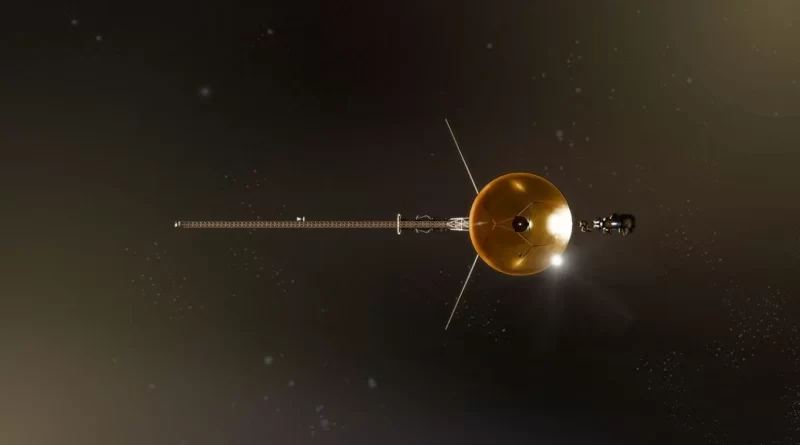
NASA Celebrates Voyager 1 Reaching One Light-Day from Earth

- A NASA COMUNIQUE-
On Wednesday, November 18, NASA’s Voyager 1 spacecraft will cross a historic threshold: it will be exactly one light-day away from Earth. At more than 16 billion miles (25.9 billion kilometers) distant, a radio signal traveling at the speed of light will take a full 24 hours just to reach the probe. Launched nearly 50 years ago, Voyager 1 remains the most distant human-made object in existence. To mark this remarkable milestone, NASA is hosting two public events that invite people around the world to celebrate the mission’s enduring legacy.
A Legacy in Interstellar Space
Voyager 1 lifted off on September 5, 1977, designed to explore Jupiter and Saturn during a rare planetary alignment that occurs only once every 176 years. After completing its primary mission, the spacecraft simply kept going. Today it travels at more than 38,000 miles per hour. In 2012 it became the first human-made object to cross the heliopause—the protective magnetic bubble created by the Sun—and enter interstellar space. Its twin, Voyager 2, followed in 2018.
Despite their age and the immense distances involved, both spacecraft continue to return unique scientific data about the environment beyond our solar system. They also serve as humanity’s ambassadors, each carrying a Golden Record filled with sounds, music, images, and greetings from Earth in 55 languages, intended for any extraterrestrial intelligence that might one day encounter them.
Shine Bright for Voyager
On Tuesday, November 17, NASA invites people worldwide to create a symbolic wave of golden light. After sunset in their local time zone, participants can use a phone or tablet to flash “VGR”—Voyager’s call sign—in Morse code into the night sky.
A custom flashing tool is available at go.nasa.gov/shinebright. Participants are encouraged to photograph or record their signals and share them on social media by tagging @NASA.
Expert Panel and Live Broadcast
On Thursday, November 19, at 12 p.m. EST (9 a.m. PST), NASA’s Jet Propulsion Laboratory will host a live panel discussion. Mission experts will discuss the current health of both Voyager probes, the science they continue to gather in interstellar space, and the engineering challenges of keeping half-century-old technology operational so far from home.
The broadcast will include a question-and-answer session and a preview of an upcoming NASA+ documentary marking the mission’s 50th anniversary in 2027. It can be watched live at nasa.gov/live.
Panel participants
- Nicky Fox, Associate Administrator, NASA Science Mission Directorate
- Jonathan Lunine, Chief Scientist, NASA JPL and Caltech Planetary Science Professor
- Suzanne Dodd, Voyager Project Manager, NASA JPL
- Kareem Badaruddin, Voyager Mission Manager, NASA JPL
- Jamie Rankin, Voyager Deputy Project Scientist, Princeton University