
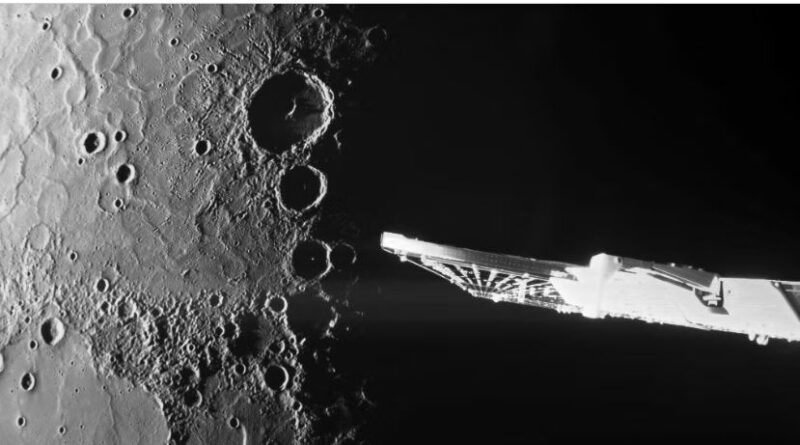
International Mission Arrives at Mercury to Study Its Mysteries

BepiColombo is now the second spacecraft in history to orbit the planet closest to the sun.
It’s not easy to visit Mercury, the closest planet to the sun. Any spacecraft flying toward our star is pulled along at extreme speeds by gravity. That makes it difficult to slow down enough to circle the little world. Orbiting Mercury requires more energy than flying all the way out to Pluto.
On Saturday, after a winding trip that flew by multiple planets to slow down, a spacecraft called BepiColombo became the second mission in history to enter orbit around Mercury.
Launched in 2018, BepiColombo is made up of a pair of orbiters built by Europe and Japan. These craft will separate in about 18 days. Equipped with shielding to withstand the extreme heat so close to the sun, the two missions will investigate the planet from the fringes of its magnetic field down to the structure of its massive iron core.
“Mercury is the terrestrial planet we know the least about,” said Geraint Jones, the project scientist for BepiColombo at the European Space Agency.

The information gathered by BepiColombo could reveal key details about the relatively tiny, rocky world that in turn may shed light on the formation of the solar system. In addition, scientists hope to infer new details about exoplanets, alien worlds orbiting other stars.
“We don’t know what the exoplanets look like up close,” said Carolyn Ernst, a planetary scientist at Johns Hopkins University’s Applied Physics Laboratory in Maryland. But, she noted, “a lot of the ones we’ve discovered are close to their host star, like Mercury.”
Some of these planets are roughly Earth’s size, and if they orbit stars that are smaller and cooler than the sun, they might have the right conditions for life.
What Do We Already Know About Mercury?
Visible with the naked eye, Mercury has been observed since ancient times. But from the ground, it’s been difficult to study because of its size and position.
NASA’s Mariner 10 spacecraft flew by Mercury three times between 1974 and 1975. The space agency’s Messenger spacecraft then became the first to orbit the planet, collecting data between 2011 and 2015. These two visits uncovered more than a few surprises.

Towering cliffs, some nearly two miles high, had been thrust into the air as the planet shrank and its crust buckled. A global magnetic field enveloped Mercury, similar to Earth but unlike Mars and Venus. Thin air clung to the ground, despite the planet’s tenuous gravity. And even nestled close to the sun, ice and other volatile materials survived on the surface.
Named for the Italian scientist Giuseppe Colombo, known as Bepi, who calculated the trajectory for Mariner 10, the new mission will help researchers build on these discoveries.
“We still have a lot of mysteries in Mercury,” said Go Murakami, the project scientist for the mission’s Mercury Magnetospheric Orbiter at the Japan Aerospace Exploration Agency.
How Did Mercury Take Shape?
On Earth, weather and geologic motion tend to erase past surface features. But Mercury has the barest of atmospheres and no active plate tectonics, so it retains a record stretching back eons. Astronomers can therefore read the pits and scars on Mercury’s surface like chapters in a history book.
In addition to the thousands of large cliffs called scarps that rose as Mercury cooled and contracted, the planet is wrinkled by smaller ridges that evince its continuing shrinking. The Mercury Planetary Orbiter, operated by the European Space Agency, will map the entire globe, helping geologists study the arrangement of those features to investigate the planet’s compression.

The surface also preserves signs of ancient volcanic activity. Lava flows that once nearly covered the planet cooled into vast plains of rock. But activity still bubbled beneath, occasionally erupting in explosive blasts that left behind pyroclastic vents. With more details about these vents, scientists can better estimate when they formed, revealing the closing chapters of the planet’s volcanism, which is crucial to understanding its building blocks.
How Do Icy Materials Survive on Mercury?
One of the most surprising discoveries from Messenger was an abundance of surface materials that readily vaporize, such as ice and sulfides. These volatile substances have survived on Mercury despite daytime temperatures that exceed 800 degrees Fahrenheit.
Unlike Earth, which is tilted on its axis, Mercury spins nearly upright. As a result, the floors of craters near the poles are permanently shadowed from the sun, reaching temperatures below minus 280 degrees. Data from Messenger suggested that large deposits of ice have most likely formed in these dark craters.
A suite of instruments on BepiColombo will allow scientists to study the chemical composition of the icy deposits in more detail.
The permanently shadowed craters are not the only places where volatile materials linger on Mercury. Unusual bright pits called hollows pock the surface, particularly inside impact craters. Found nowhere else in the solar system, their brightness suggests they are relatively young, as older material has been darkened by exposure to the sun.
“They all do look kind of fresh,” Ernst, of Johns Hopkins, said. “Fresh in a geological perspective could be yesterday; it could be 10 million years ago. We don’t know.” The hollows may have formed when volatile substances in the rock were exposed after impacts and evaporated into space. But the mechanism is not yet clear.
“That’s one area where I hope that the Bepi data can give us more,” Ernst said.
Why Does Mercury Have a Large Iron Core?
Before any spacecraft reached Mercury, scientists used telescopes to estimate its size and mass. These measurements revealed a planet nearly as dense as Earth despite having only about one-third the gravity. The high density comes from the planet’s immense iron core, which accounts for about 85 percent of its 1,516-mile radius.

“The prevailing theory is that it was struck in the distant past by another very large body,” Jones, of the European Space Agency, said. That impact could have been a glancing blow that stripped off much of the crust and mantle, or it could have been a direct hit that shattered the planet, and modern Mercury formed from the debris.
The European orbiter will probe Mercury’s interior and study the shape of the core. And with a better accounting of the minerals on Mercury, scientists may finally learn how a world can form as a massive ball of metal encased in a thin layer of rock.
“When we bring the data together from the different instruments over the coming years, then we’ll be able to better piece together the jigsaw of Mercury’s past,” Jones said.
What Powers Mercury’s Magnetic Field?
Aside from Earth, Mercury is the only rocky body in the solar system with a global magnetic field. It is driven by a liquid iron core surrounding the solid inner core. The initial discovery from Mariner 10 surprised scientists who thought the planet was a long-dormant world.
When Messenger arrived, it revealed another surprise: Mercury’s magnetic field is lopsided. For some reason, the planet produces a stronger magnetic field in the northern hemisphere.
“This is not understood,” Murakami, of the Japan Aerospace Exploration Agency, said. Theories include a calm outer layer of the liquid core to crystals of “iron snow” falling onto the inner core. It’s also possible some combination of existing theories could explain the phenomenon.
The Japanese spacecraft will fly in and out of Mercury’s magnetosphere, the border between the magnetic field and the stream of charged particles from the sun called the solar wind. While it studies the periphery, the European orbiter will measure magnetism closer to the planet. The two data sets could produce a picture of how solar wind enters the magnetic field and percolates inward, twisting and warping the field along the way.
“We’ll learn a huge amount about the magnetic field and, hopefully, how it’s generated,” Jones said.