
AS ICE MELTS IN THE ARCTIC, SOME DEEP-SEA CREATURES ARE THRIVING

A new study suggests that deep-sea life reaps the benefits of icebergs’ castoffs — a rare silver lining as a warming planet destabilizes glacial ice.

Scientists aboard the Polarstern research vessel were sailing along in 2021 when they came upon an unusual iceberg floating through the Fram Strait, an Arctic passage between Greenland and the Norwegian archipelago Svalbard.
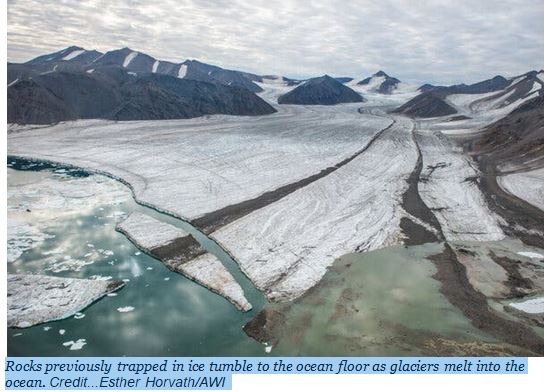
Unlike the white and blue icebergs one typically imagines, this one was covered in dark rocks.
Immediately, the research team — which had been taking seafloor samples and images — redirected its focus to the passing iceberg. A helicopter from the Polarstern landed on top of the floating ice, depositing the researchers on what felt like another planet. There, they avidly took photos, samples and measurements of the stones.
“We had this collective lightbulb moment,” said Kirstin Meyer-Kaiser, a marine biologist at Woods Hole Oceanographic Institution. “These are dropstones before they have dropped.”
Dropstones are rocks that were once trapped inside glacial ice. When parts of glaciers break away as icebergs, they start to melt, dropping the rocks and other debris onto the seafloor as they float along.
A new study — led by the researchers aboard the Polarstern and published in the journal Nature — helps confirm that warming oceans have caused the number of icebergs calving into the Fram Strait to drastically increase since the early 2000s. And the stones these icebergs are leaving behind are giving new clues about how global warming is reshaping the biodiversity of the ocean floor.
To come to its conclusions, the research team used 40 years of iceberg sighting data to calculate how the number of icebergs in the region has changed over the decades. The work revealed a sharp increase starting around the year 2000, which researchers attributed to increased calving of glaciers upstream — particularly those in northeast Greenland and the Russian Arctic.
Then, by analyzing deep-sea images from the Alfred Wegener Institute’s underwater HAUSGARTEN observatory, the researchers were able to also identify an increase in dropstones lining the ocean floor in the years after iceberg frequency ramped up.
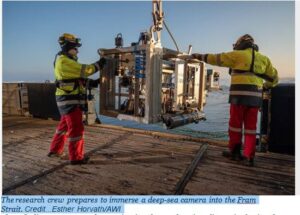
The research crew prepares to immerse a deep-sea camera into the Fram Strait. Credit…Esther Horvath/AWI
These findings gave researchers a view into how a changing climate is altering the creation of icebergs, which — because of their coloring and movement — can be difficult to track with satellites. The results also helped researchers to conceptualize the climate-driven changes happening deep in the ocean.
“It’s very difficult to connect something climate-change-induced that is happening on land to the consequences hundreds of meters further down,” said Thomas Krumpen, a sea ice physicist at the Alfred Wegener Institute and co-author of the study. “I think that’s what’s so special about the study.”
When dropstones hit the bottom of the ocean, they become an important part of the deep-sea ecosystem, providing a home for corals, sponges and other marine invertebrates that live by latching onto hard structures. Those populations then help support bottom-feeding shrimps and sea lilies, with whom they form symbiotic relationships. The researchers observed this flourishing deep-sea community using images from the HAUSGARTEN observatory.
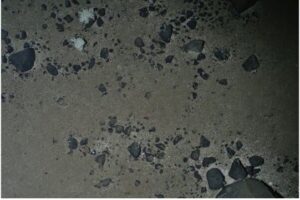
The dropstones become part of the habitat for sea creatures.Credit…Thomas Krumpen/AWI
“These stones are really important habitats for certain animals that like to settle on hard substrates,” said Melanie Bergmann, a marine biologist at the Alfred Wegener Institute and one of the study’s authors. “Of course, this then changes the biodiversity on the seafloor.”
The researchers hypothesize that, as dropstones continue to proliferate in the coming decades, the number of visible fauna and the level of biodiversity in the deep ocean will also increase. That’s a rare silver lining in the climate-driven changes in polar regions, where the melting of glaciers is catastrophic for animals closer to the surface and on land that call them home.
“Everything in nature has pluses and minuses, like most things in life,” said Bodil Bluhm, a marine ecologist at the Arctic University of Norway who was not involved in the new study. “That’s what this study here brought to light.”
Looking ahead, the researchers hope to investigate other areas in the Arctic where there is glacial instability — and whether those regions are also seeing a higher level of biodiversity in the deep sea.
=======================================================
R. Callawayis a science reporter and a member of the 2026-27 Times Fellowship, a program for journalists early in their careers.