
Astronomers Discover Rare Ancient “Stellar Fossil” Preserving the Chemistry of the Early Universe

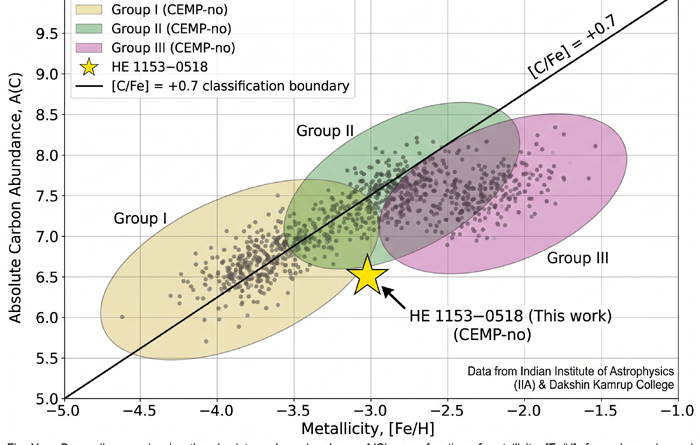
Fig: Yoon-Beers diagram showing the absolute carbon abundance, A(C), as a function of metallicity, [Fe/H], for carbon-enhanced metal-poor (CEMP) stars. The coloured ellipses show the approximate locations of the different groups as indicated. The large yellow star marks HE 1153-0518 from this work. The solid black line represents the CEMP classification boundary corresponding to [C/Fe] = +0.7.
BY- JYOTI RAWAT-
Astronomers have discovered a rare ancient star, HE 1153−0518, whose chemical composition preserves the signatures of some of the very first generations of stars in the Universe. Those earliest massive stars formed just a few hundred million years after the Big Bang. Although they burned out long ago in violent supernova explosions, they enriched the surrounding primordial gas with newly synthesized elements. Ancient metal-poor stars that later formed from this enriched gas locked those early chemical signatures in place. Acting as “stellar fossils,” these surviving stars allow astronomers to reconstruct the history of the early Universe, revealing the nucleosynthesis processes that shaped the chemical evolution of our Galaxy.
The discovery was made by a team of researchers from the Indian Institute of Astrophysics (IIA), Bengaluru—an autonomous institute under the Department of Science and Technology (DST), Government of India—and Dakshin Kamrup College, Assam. Using high-resolution spectroscopic data collected from the Subaru Telescope in Hawaii, combined with recent astrometric and photometric observations, the team determined the star’s atmospheric properties and chemical abundances with high precision. Their findings, published in the Monthly Notices of the Royal Astronomical Society (MNRAS), enable a comprehensive investigation into how the star’s elements were forged in nuclear reactions and how the star itself evolved.
A Rare Chemical Fingerprint
The study identifies HE 1153−0518 as a previously unknown member of a rare sub-class of carbon-enhanced metal-poor (CEMP) stars known as CEMP-no stars. Unlike other CEMP stars, CEMP-no stars exhibit strong carbon enhancement while remaining severely deficient in heavy elements, making them a direct window into the earliest phases of Galactic evolution. HE 1153−0518 contains only about one-thousandth of the Sun’s iron abundance, yet it is remarkably rich in carbon and sodium while lacking the heavy elements typically produced by neutron-capture nucleosynthesis.
Beyond its unusual elemental makeup, the star offers important clues about its own life cycle and immediate environment. The researchers measured a low carbon isotopic ($^{12}\text{C}/^{13}\text{C}$) ratio, which indicates that the star has undergone significant internal mixing of its gas. Additionally, its spectral energy distribution across optical and infrared wavebands shows excess infrared emission, suggesting the possible presence of circumstellar dust. Taken together, these observational characteristics shed light on both the intrinsic evolution of the star and the pristine chemical environment from which it formed.
Reconstructing the Early Milky Way
To trace the origin of HE 1153−0518’s chemical pattern, the authors compared its measured elemental abundances with predictions from theoretical nucleosynthesis models. Explaining the significance of such ancient relics, Aruna Goswami of the Indian Institute of Astrophysics and a co-author of the study said, “Ancient metal-poor stars are among the oldest surviving objects in our Galaxy. They formed from gas that had been enriched by the very first stellar explosions. Their chemical composition allows us to investigate nucleosynthesis that occurred more than 13 billion years ago. Discoveries such as HE 1153−0518 bring us closer to understanding how the first generations of stars enriched the universe with the elements that later became the building blocks of stars, planets and life.”
Partha Pratim Goswami from Dakshin Kamrup College, the lead author of the study, highlighted how each new finding strengthens our broader understanding of cosmic history. “Every newly discovered chemically primitive star helps us reconstruct the earliest history of the Milky Way and the lives of the first stars,” he explained. “These stellar fossils provide some of the strongest observational constraints on models of stellar nucleosynthesis and Galactic chemical evolution.”
By adding HE 1153−0518 to the growing inventory of known stellar fossils, the study underscores the power of high-resolution stellar spectroscopy—a field long pursued at the Indian Institute of Astrophysics—in uncovering relics of the early Milky Way. By decoding the elemental compositions of these ancient stars, astronomers can investigate cosmic events that occurred more than 13 billion years ago, long before the formation of the Sun and the Solar System.