
Borophene-based green lubricant can help save energy

Scientists have achieved a significant breakthrough in sustainable lubrication by demonstrating, for the first time, the use of borophene, a two-dimensional (2D) nanomaterial, as a high-performance lubricant additive in castor oil. This research has the potential to transform the lubrication industry by advancing renewable energy systems, marine applications, green lubrication technologies, and sustainable manufacturing.
Friction and wear are major causes of energy loss and equipment failure in industries worldwide. Developing advanced lubricants that can effectively minimize these losses is therefore a key scientific and technological challenge. While castor oil is an attractive renewable and biodegradable lubricant, its performance can be further enhanced using suitable additives.
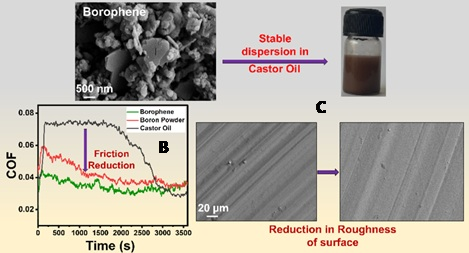
A research team from at the Institute of Advanced Study in Science and Technology (IASST), Guwahati, an autonomous institute of the Department of Science and Technology (DST), has shown that adding a very small amount of borophene (just 0.1 wt.%) to castor oil dramatically improves its lubrication performance, reducing friction by about 42 percent compared to pure castor oil.
The findings from the research conducted under the guidance of Prof. Devasish Chowdhury, with Mr. Ujjibit Boruah, INSPIRE Senior Research Fellow (SRF), as the first author, could pave the way for the development of environmentally friendly lubricants that improve machine efficiency, reduce wear and tear, and lower energy consumption in industrial systems.
“Two-dimensional materials have attracted enormous attention in recent years. Among them, borophene is particularly exciting because of its remarkable physical and chemical properties. Although borophene has shown great potential in batteries, supercapacitors, fuel cells, and other advanced technologies, its application as a high-performance lubricant additive had not been explored until now.” said Prof. Chowdhury.
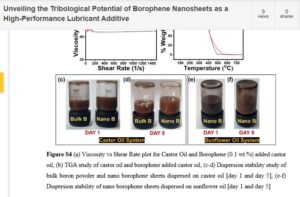
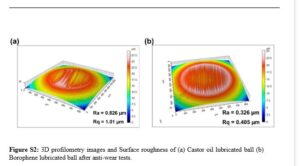
The researchers found that borophene disperses uniformly in castor oil without requiring any chemical modification. During operation, it forms a durable protective tribofilm containing iron oxides, carbonaceous species, and boron-based compounds. This protective layer reduces shear stress, enhances load-bearing capacity, and minimizes wear.
The findings demonstrate that the combination of borophene and renewable castor oil can create a high-performance bio-lubricant with significant potential for improving energy efficiency and extending machinery life. The work, recently published in the journal ACS Applied Engineering Materials opens a new avenue for the use of borophene in sustainable lubrication technologies.
Publication link: doi=10.1021/acsaenm.6c00540