
Deoria Tal’s Ancient Pollen: How a Quiet Lake in Uttarakhand Helps Explain Why the Harappan Civilisation Shrank

Understanding the vegetation dynamics and corresponding hydro-climate variability from the Garhwal Himalaya, India, could be crucial in understanding the monsoonal variability during the Late Holocene (Meghalayan Age; 4.2 ka to the present). The Holocene Lake records (Nachiketa Tal, Chharaka Tal, Dewar, Tal, Deoria Tal) from the Himalaya are limited by poorly constrained radiocarbon chronologies characterized by reservoir effects, large age errors and coarse sampling.
By- Jyoti Rawat
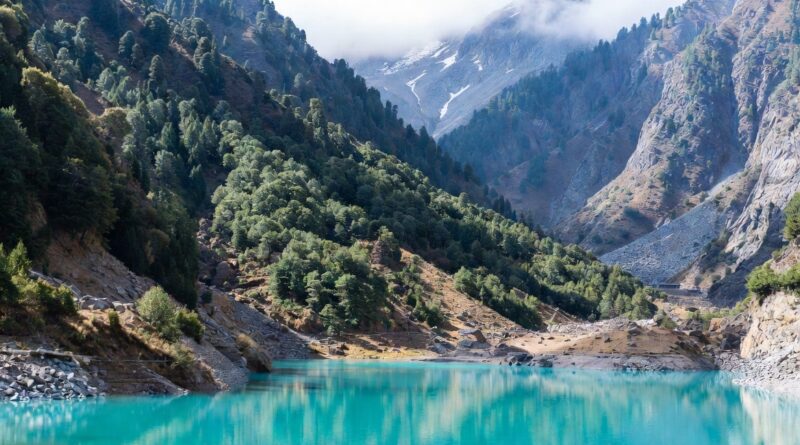
Deep in the Garhwal Himalaya of Uttarakhand lies a peaceful mountain lake called Deoria Tal. Its still waters hold more than scenic beauty. Buried in its muddy floor is a detailed climate diary spanning thousands of years—written not in ink, but in microscopic pollen grains.Scientists from the Birbal Sahni Institute of Palaeosciences (BSIP), Lucknow, have carefully read that diary. Their findings, published in Palaeogeography, Palaeoclimatology, Palaeoecology, offer a clearer picture of why one of the world’s earliest urban civilisations—the Harappan (or Indus Valley) Civilisation—began to shrink around 4,200 years ago.
The Lake That Keeps Secrets
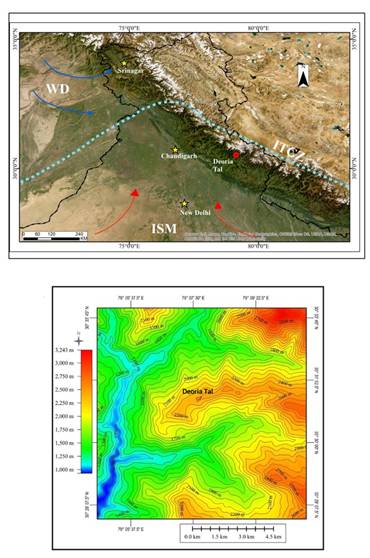
Deoria Tal sits high in the Garhwal region of Uttarakhand. Researchers recovered a long sediment core from its bed and dated it precisely using 10 AMS radiocarbon dates (measured on Trapa seed cases at the University of Georgia, USA). This gave them a reliable timeline from the mid-Holocene right up to the present—far more accurate than earlier Himalayan lake studies that suffered from large dating errors.
Pollen grains preserved in the layers act like tiny time capsules. Different plants release distinctive pollen. By counting oak, pine, grasses, and crop-related pollen at different depths, scientists can reconstruct how the surrounding forests and farmland changed as the climate shifted.
A Dry Spell That Changed History
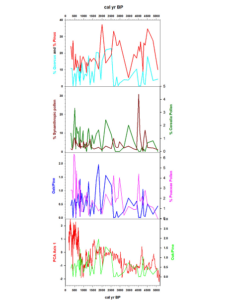
Around 4,250 years ago (calibrated years before present), the pollen record shows a sudden jump in the oak-to-pine ratio. This matches other evidence from the same lake of a short but sharp dry spell—the well-known “4.2 ka event.”
At that time the Indian Summer Monsoon weakened dramatically. Rivers that once flooded reliably along the Indus and Ghaggar-Hakra systems (near the edge of the Thar Desert) became less dependable. Farming communities that depended on those seasonal floods faced hardship. Many people gradually moved eastward into the wetter Ganga plains in search of more stable water and farmland. The great cities of the Harappan Civilisation contracted.
Researchers link this monsoon weakening to a southward shift of the Inter-Tropical Convergence Zone (ITCZ), stronger El Niño conditions, and a negative phase of the Indian Ocean Dipole—all responding to slowly decreasing summer sunshine in the Northern Hemisphere.
What the Lake Reveals About Later Centuries
Deoria Tal’s pollen record continues the story through later centuries:
- Roman Warm Period (roughly 2,500–1,450 years ago) and Medieval Climate Anomaly (1,050–650 years ago): Stronger monsoon rains, higher agricultural productivity, and the flourishing often called India’s “Golden Age.”
- Little Ice Age (roughly 650–100 years ago): Weaker monsoon linked to shifts in the Asian jet stream, North Atlantic Oscillation, and again a southward movement of the ITCZ.
These patterns show how tightly the Indian monsoon is connected to global climate systems—El Niño, ocean temperatures, solar activity, and atmospheric circulation.
Why Deoria Tal Matters Today
Most earlier Himalayan lake studies suffered from uncertain dates and coarse sampling. Deoria Tal’s well-dated, high-resolution pollen record fills that gap. It improves our understanding of how the monsoon has behaved in the past and helps scientists refine projections of how it may change in the future.
For policymakers, the message is practical: long-term climate patterns recorded in places like Deoria Tal can guide water management, agriculture planning, and disaster preparedness in a monsoon-dependent country.
A quiet lake in the Uttarakhand Himalaya, it turns out, has been quietly recording the rise and retreat of civilisations for thousands of years—one pollen grain at a time.