
NASA’s Roman Telescope Leaves Earth to Chart the Stars

Astronomers will use data collected by Roman’s wide, deep gaze to study the dark universe and hunt for new worlds.

Named after the agency’s first chief astronomer, Roman is NASA’s latest and greatest cosmic cartographer. The $4.3 billion telescope will use its sharp infrared vision to chart billions of galaxies, as well as hundreds of black holes and the dusty disks circling young stars, where new planets form. It promises a panorama so wide and so crisp that it would take more than half a million high-definition TVs to display in full.
At a news conference on Saturday morning, Nicola Fox, the associate administrator of NASA’s science mission directorate, explained that Roman’s vast gaze would contribute to solving some of the grandest mysteries about our universe, including how it works, what it is made of and if we are alone out there.
“To put it in perspective, it will be as if Hubble and James Webb kind of peered through a keyhole at the universe,” Dr. Fox said, referring to two other telescopes NASA has launched into space. “Well, Nancy Grace Roman will kick the door down.”
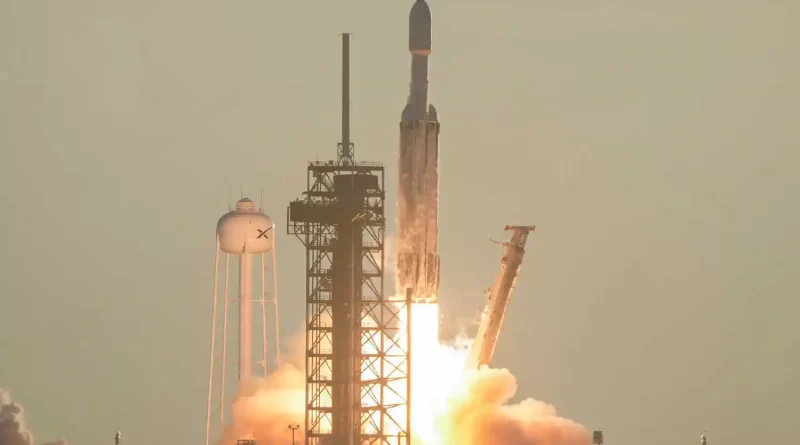
Months ahead of schedule, Roman lifted off from NASA’s Kennedy Space Center just after daybreak on a SpaceX Falcon Heavy rocket at the expected launch time. Reusable side boosters fell away from Roman, which was still attached to the rocket’s second stage, about two and a half minutes after the launch. (The side boosters flipped around and landed at Cape Canaveral Space Force Station seven minutes into the flight.) The rocket fairing protecting Roman fell away as the telescope continued to soar.
About 24 minutes into the flight, engines on the second stage fired, and seven minutes later, Roman floated away from the rocket into the black expanse of space.
The new telescope is headed to a location called L2, about a million miles away from us, where the gravitational pulls from the sun and Earth cancel out. This allows spacecraft to save fuel. It will take about 100 days for Roman to reach L2 and begin science observations, which will last for at least five years.
Once there, Roman will send a whopping one terabyte of data each day back home to scientists on Earth.
“It’s like a million songs that we’re streaming a million miles away every single day for the lifetime of Roman,” Jeremy Perkins, a Roman scientist at NASA Goddard Space Flight Center, said on the agency’s livestream.
Astronomers plan to use Roman’s data to probe the mysterious nature of dark matter, an invisible substance that shapes the structure of our universe, and dark energy, an unknown force threatening to rip it apart. They also expect to find more than 100,000 new worlds beyond the solar system and complete the census of planets across the Milky Way.

Part of the telescope’s appeal, however, lies in whatever surprises may be hiding in the data.
“Roman’s vast reach will allow us to find the weird, the rare and the unusual,” Julie McEnery, who leads Roman’s science team, said at an earlier news conference on Saturday. “We will redefine what it means to find a needle in a haystack.”
Roman has about the same infrared resolution as NASA’s Hubble Space Telescope, but its field of view is at least a hundred times wider. It is also up to a thousand times faster: In one month, Roman will complete a survey of the sky that could take Hubble a century, Dr. McEnery said.
Its primary instrument is a 300-megapixel infrared camera. With the cosmic snapshots, scientists will look for different kinds of gravitational lensing, an effect that occurs when matter distorts the light radiating from an object behind it.
The presence of dark matter, pervasive across the cosmos, can be inferred by the way its gravity bends the light of more distant galaxies in the background.
Charting the structure and spread of dark matter across cosmic time will offer insight into how the universe has expanded over billions of years. This, in turn, leads to a better understanding of the puzzling behavior of dark energy, which is pushing the cosmos to expand at an accelerating rate.
“Which is completely crazy,” Dr. McEnery said of the cosmic expansion. “It’s like you throw a ball in the air and instead of it coming down, it goes rocketing away.”
There are two other ways Roman can shed light on dark energy. The telescope will detect a certain type of supernova that explodes with a signature amount of light; observing the apparent brightness and distance of these explosions will provide a second measurement of the universe’s expansion. Studying the ever-widening separation of galaxies in different eras of cosmic time offers a third.
Data from Roman’s camera will also aid in the quest to identify new worlds. Astronomers will hunt for planets crossing in front of their own stars, which causes a temporary, detectable dip in brightness. They will also rely on microlensing, a type of gravitational lensing that happens on a smaller scale: Planets orbiting stars in the foreground can create brief boosts in the light radiating from stars in the background.
Other planet-hunting techniques are better at finding young, hot Jupiter-like worlds. But microlensing is ideal for identifying smaller, cooler planets that are more like Earth. According to NASA, just a couple of hundred planets have been discovered using microlensing. Roman will push that value to more than a thousand.
“That’s huge,” said Jonathan Fortney, planetary scientist at the University of California, Santa Cruz. He added that the growing catalog is moving scientists “from the era of exoplanet detection to the era of exoplanet characterization.”

Roman has a second instrument called a coronagraph that will directly image already-discovered planets by blocking the light from their host stars. NASA’s James Webb Space Telescope already has a coronagraph capable of imaging planets a million times fainter than their stars. But Roman’s will photograph worlds that are 100 million times fainter.
The new coronagraph is a proof of concept for NASA’s proposed Habitable Worlds Observatory, a future telescope that scientists hope will be powerful enough to directly image faraway Earths.
Roman joins two other powerful observatories already conducting deep, wide scans of the universe. The European Space Agency’s Euclid telescope was launched in 2023 and is mapping about a third of the sky. (Roman will image only about 12 percent.) There is also the Vera C. Rubin Observatory in Chile, which charts the entire southern sky every few days.
Roman’s vantage point is narrower than both Euclid’s and Rubin’s. But where it does scan, its view will be sharper.
“Roman is going to be the gold standard for that area of the sky,” said Jason Rhodes, an astrophysicist at NASA’s Jet Propulsion Laboratory in California.
Dr. Rhodes added that the data from Euclid, Rubin and Roman will eventually be combined. “And that’s where I think the truly revolutionary discoveries are going to come,” he said.
NASA’s latest offering to the stars is named after Nancy Grace Roman, who was hired six months after the agency’s founding as its first female executive. Dr. Roman came to be known as “the mother of Hubble” and played a pivotal role in building out the nation’s space astronomy program. She died in 2018.
In 1959, Dr. Roman penned a short article in which she mused about someday finding worlds around other suns. A rough calculation led her to conclude that a space telescope would most likely lack the size and accuracy to do so.
Thousands of planet discoveries later, Dr. Roman has a space telescope of her own.
“I think if she was here now,” Dr. McEnery said with a grin on Saturday, “she would really enjoy having been proved wrong.”
===================================================================
Katrina Miller is a science reporter for The Times based in Chicago. She earned a Ph.D. in physics from the University of Chicago.