
SpaceX Completes Mostly Successful Starship Rocket Flight

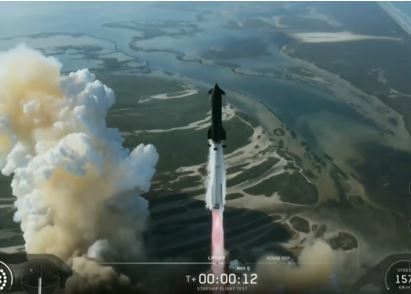
The 12th test flight of SpaceX’s gargantuan rocket launched on Friday evening and ended its journey in the Indian Ocean just over an hour later.

Despite some engine failures along the way, SpaceX completed a mostly successful test flight of its giant Starship rocket on Friday evening.
Starship is the largest and most powerful rocket ever built. The 407-foot-tall vehicle consists of an upper-stage spacecraft, also called Starship and often shortened to Ship, and a powerful booster stage with 33 engines, known as the Super Heavy.
The upper-stage spacecraft survived the re-entry into the atmosphere and performed a final maneuver to simulate a landing over the Indian Ocean even though only two, instead of the planned three, engines fired.
It then, as expected, toppled over into the water and exploded in a ball of fire.
It was the 12th test flight of Starship and the first launch of a major new iteration of the vehicle, known as Version 3. SpaceX officials have described it as almost a different rocket, incorporating numerous changes designed to improve reliability and performance.
The outcome was far better than Starship test flights last year, two of which disintegrated soon after launch, showering a rain of debris that disrupted air traffic over the Caribbean.
The promising results will boost confidence for NASA, which is looking to use Starship as the lander to take its astronauts to the surface of the moon. In a post on X, Jared Isaacman, the NASA administrator, congratulated SpaceX and Elon Musk, the company’s founder and chief executive. “One step closer to the Moon…one step closer to Mars,” he wrote.
SpaceX might also reap financial rewards. The company may be able to set a higher price for stock shares it plans to sell in an initial public offering as soon as next month.
The company stated in an update this week that Starship would allow for the deployment of “orbital data centers, and the ability to send people and cargo to the moon and Mars.”
“When you think about everything that the company is doing to drive its future growth, it’s all hinging on Starship,” Franco Granda, a senior research analyst at PitchBook, a financial data and research company, said in an interview before the launch. “This test has big implications for the I.P.O., because it’s all about the symbolism and the narrative of it all.”
Mr. Musk has said that the Starship will be a fully reusable rocket, with both stages returning to the launch site to be caught by giant mechanical arms. If SpaceX pulls off this vision, Starship could revolutionize the space industry, enabling launches of bigger, heavier satellites and other cargo at lower costs.

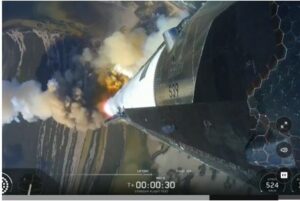
During Friday’s test flight, the Super Heavy successfully performed its main task of pushing the upper-stage spacecraft to space even though one of the 33 engines on the booster failed during the upward journey.
Subsequent engine burns needed to bring the Super Heavy back for a soft return did not work as expected, and video from the booster as it returned to Earth showed it descending quickly and apparently crashing into the Gulf of Mexico.
The upper-stage spacecraft successfully made it to space, even though one of the six engines also malfunctioned. To compensate, the other engines fired longer than planned.
As it was coasting over Earth, Starship deployed 20 dummy versions of its next-generation Starlink satellites. In addition, two modified versions of the current Starlink satellites were also deployed, which included tests of upcoming technology and also cameras that captured pictures of Starship as it moved through space.
SpaceX skipped a planned relight of one of the engines. That is a maneuver that will be needed for future orbital missions to allow Starship to return to Earth. On this test flight, the trajectory was designed so that Starship would safely re-enter the atmosphere over the ocean even if it suffered a major malfunction.
As SpaceX engineers review data from Friday’s flight, they will figure out needed fixes. But it appeared that most of the changes that SpaceX incorporated into the new version of Starship worked as designed.
Even with the engine failures, the Starship upper-stage spacecraft was able to reach its target landing site in the ocean.
SpaceX has the next Starship mostly completed, and the company hopes it can soon tackle other larger technical hurdles like docking two Starships in orbit and transferring liquid oxygen and liquid methane propellants from one to the other.
Because it is so big and heavy, Starship burns up almost all of its propellants to reach low-Earth orbit. Refueling is necessary before it can head to more distant destinations, like the moon.
NASA hired SpaceX to provide a version of Starship to take its astronauts from lunar orbit to the surface of the moon as early as 2028 during its Artemis IV mission. With Starship’s development running behind schedule though, NASA has raised the possibility that it could switch to a lander from Blue Origin, the rocket company started by Jeff Bezos, the founder of Amazon.
===========================
Ryan Mac contributed reporting.
Kenneth Chang, a science reporter at The Times, covers NASA and the solar system, and research closer to Earth.