
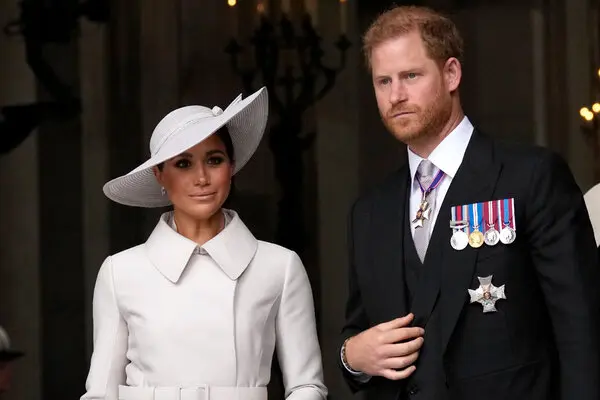
What Does Harry and Meghan’s Return to England Mean for Their Children?

One effect of moving back is that Archie and Lilibet now have the opportunity to be schooled as Britons. Here’s what that might look like.


Stephen Castle and Sarah Mervosh
Stephen Castle reported from London, and Sarah Mervosh from New York.
Prince Harry and Meghan are leaving the dry scrub of sunny Southern California for the drizzly pastures of England, and for their children, it could mean trading hoodies for blazers, and Lincoln and Grant for Disraeli and Gladstone.
The couple have not disclosed where Prince Archie, 7, and Princess Lilibet, 5, will attend school in Britain. The schooling for Britain’s royals has helped the family to introduce its children slowly as public symbols and, as education customs shifted over the past century, so did the royal family’s approach. While future sovereigns and their siblings were once home tutored, they have more recently attended schools — albeit exclusive ones — as the monarchy tried to modernize gradually and stay relevant.
The choices have sometimes proved fraught. Harry and Meghan’s move back to Britain opens a path for their children to attend some of the world’s best-known private schools, though that possibility lies years ahead. Such schools have in recent decades taught teenage members of the royal family, but it is a mixed legacy — neither Harry nor his father, King Charles III, enjoyed the experience.
Top private schools (known to Britons as public schools) have competitive admissions, rigorous academics, prices comparable to those of U.S. private universities, and a long history of educating the children of the wealthy and powerful from Britain and beyond. Just 6.3 percent of pupils are privately educated in England.
“Independent British education is a jewel in our crown in terms of soft power,” said Sarah Cunnane, who speaks for the Independent Schools Council, an umbrella organization that includes many of the country’s most famous fee-paying schools.
British schools tend to be “quite formal” compared with many U.S. private schools, even in the youngest grades, said Natasha Hilton, principal of the Nord Anglia International School New York, a private school in Manhattan that offers a British-style education.
There is a strong focus on academics from an early age. Phonics, the sounding out of letters, is taught in preschool (known as “nursery” or “reception”), and many students come into kindergarten (Year One) already reading simple sentences, Ms. Hilton said. School uniforms are common.
Lambrook School, not far from Windsor Castle, the choice for Prince William and Kate’s children, promises to combine “first-class teaching and superb facilities with traditional values” for students up to age 13. The 52-acre grounds include all-weather sports fields, a 25-meter indoor swimming pool, squash and tennis courts, a dance studio, and a nine-hole golf course. Students wear navy blue sweaters and blue-and-white checkered shirts or dresses.
In September, Prince George, the second in line to the throne and the elder son of Prince William, will attend Eton College, a boarding school for teenage boys that is perhaps the most famous and prestigious of its kind.

William and Harry were both schooled there, though not so happily for Harry, who in his 2023 memoir, “Spare,” called his arrival there “a profound shock.” Eton was “heaven for brilliant boys,” he recalled, but “purgatory for one very unbrilliant boy.” He struggled assembling the elaborate uniform and was out of his depth in his first language class, conducted in rapid, nonstop, French.
“Once or twice I’d confess to a teacher or fellow student that I wasn’t merely in the wrong class but in the wrong location. I was in way, way over my head,” he wrote. “They’d always say the same thing: ‘Don’t worry, you’ll be all right.’”
The prince’s staff have previously suggested that Eton would not be his choice for his son.
Eton in 1998 was probably less forbidding than Gordonstoun in Scotland, the school King Charles III attended in the 1960s, when it was renowned for an austere ethos. The future king slept in a dormitory, and his morning routine included a shower (first hot and then cold water) and a morning run.
According to British news media reports, the young Charles described the school as “Colditz in kilts,” a reference to a German World War II prison camp. In public, he was more diplomatic, but once admitted: “I didn’t enjoy school as much as I might have, but that was only because I’m happier at home than anywhere else; but Gordonstoun developed my willpower and self-control, helped me to discipline myself.”
Many private British schools use a house system, sorting students into competing groups.
If Harry and Meghan had stayed in California, their children would most likely have had a far different experience in the wealthy enclave of Montecito, in Santa Barbara County, where they lived starting in 2020 near Oprah Winfrey and other celebrities.
The public school system there is well regarded. But the family would have probably opted for private school for several reasons, including security, said Denise Pope, a senior lecturer at the Stanford Graduate School of Education. Many private schools in California are gated.
Elite private schools there offer strong academics, but tend to also put a major focus on social emotional learning, said Allen Koh, the chief executive of Cardinal Education, which counsels families on selective private school admissions.
“In Santa Barbara, they are going to be asking you how you feel and what you think a lot,” Mr. Koh said. By contrast, many clients he works with in Britain like the structure and tradition of British education.
Though it is not clear if it was a motive in the family’s return, British schooling will expose the royal children to British culture and the history of a nation shaped by their paternal ancestors.
Harry, however, will appreciate that this presents its own burdens.
In his memoir, he recalled being chided at Ludgrove School in Wokingham, west of London, which he attended before Eton, after failing to answer questions about English history.
“We’re talking about your blood relatives,” one teacher complained, asking, “Does that mean nothing to you?”
Harry responded: “Less than nothing, sir,” and was, he wrote, later given a wooden ruler with the names of every English monarch since 1066.
===============================================
Stephen Castle is a London correspondent of The Times, writing widely about Britain, its politics and the country’s relationship with Europe.
Sarah Mervosh covers education for The Times, focusing on K-12 schools.