
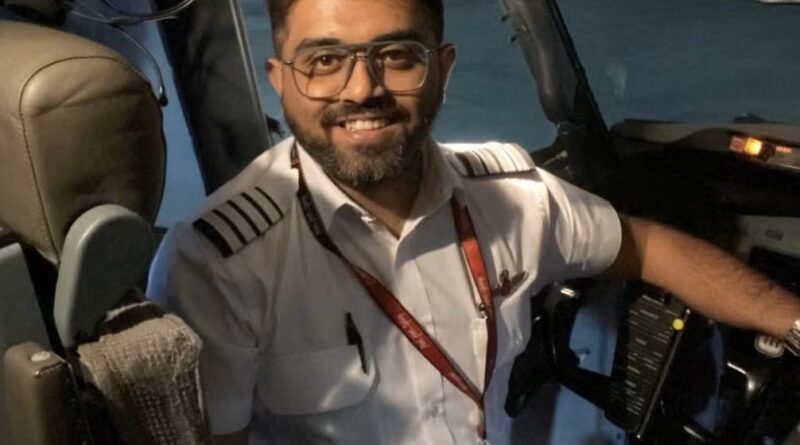
Who Is the Indian Pilot Being Hailed as a Hero?

Capt. Smit Machchhar suffered stab wounds while fending off an attack from his co-pilot, saving the lives of around 170 people on board, officials said.


Somini SenguptaSuhasini Raj and Mujib Mashal
Somini Sengupta reported from the Mumbai suburb where the pilot grew up.
Capt. Smit Machchhar, the Indian pilot hailed for averting a catastrophe on a FlyDubai flight, had faced a few challenges in the cockpit before. Monsoon rains. Fast-changing wind speeds. And the biggest challenge of all, he recalled on a podcast last year: preparing to land after a passenger went into labor on board.
“There was a sense of urgency,” he said. “In my head, I had zero margin of error.”
None compared to the bloody midair horror he found himself in on Wednesday, when witnesses and officials say a fellow pilot stabbed him in the cockpit of a Dubai to Tel Aviv flight on Wednesday.
Mr. Machchhar, bleeding, managed to open the cockpit door, allowing passengers and crew to overpower the assailant, while two others on board who had flying experience landed the plane in Saudi Arabia.
One passenger said he heard bloodcurdling screams before Mr. Machchhar fell out of the cockpit.
Israeli officials said his co-pilot had apparently tried to crash the plane, with 170 passengers on board. Neither the authorities in the United Arab Emirates, where the flight originated, nor in Saudi Arabia, where the aircraft touched down, have commented on what happened. The Emirati Attorney General’s office on Thursday announced an investigation.
Prime Minister Narendra Modi of India hailed the captain as a “hero” whose “valor helped save hundreds of lives and avert a great tragedy.”
“In the face of the gravest danger and despite being seriously injured, he showed immense courage and an unwavering resolve to protect the lives of others,” Mr. Modi said on X.
Mr. Machchhar has been airlifted to Abu Dhabi, the Emirati capital, according to two officials familiar with the matter. The Indian Embassy in the Emirates said on social media that the ambassador had visited Mr. Machchhar and his family at the hospital. “Captain Machchhar is in good health and recovering well,” it said.
As Indians rallied around him on Thursday, a portrait emerged of a pilot who found his calling somewhat accidentally, only to end up flying commercial planes for 13 years and later training aspiring pilots at an aviation school.
He grew up in a middle-class suburb of Mumbai, called Ghatkopar, not far from the city’s international airport. Journalists crowded on Thursday near his childhood home in an ordinary neighborhood, its streets lined with auto rickshaws and vegetable carts. A news conference planned with the pilot’s uncle was canceled and a local politician, Parag Shah, said his parents had flown to Dubai in the morning.

Mr. Machchhar attended a neighborhood school, and was set to join the family textiles business. His destiny changed when he attended a seminar on aviation.
“That is where the aviation bug bit me,” he said on the podcast, saying that flying had not been a childhood dream.
He said his mother was nervous.
“You didn’t hear a lot of people becoming pilots, no one had any idea how to do it,” he said. “So first of all, that was something that scared my mom — and of course, the flying bit.”
He enrolled in an 18-month program at a New Zealand-based aviation training school, called Mainland. Its director, Philip Kean, described the program as combining academic rigor and practical training.
“You’ve got to study. You’ve got to fly the plane,” Mr. Kean said. “He was a good student — a good average student. He did his job. He got his commercial license, which he had come here for.”
He began as a first officer, rose to the rank of captain, and according to Dhaval Patel, who knew him from school, soon became a trainer of other pilots at Spice Jet, a private Indian airline that has since folded.
He became a mentor to Mr. Patel, who also worked as a pilot. He was passionate about training other pilots. “He would also ensure that the pilot is confident enough to execute the job well,” said Mr. Patel, who now works in his family’s diamonds business.
“Everything is behind you and you should look ahead,” Mr. Patel recalled him saying many years ago, “because when you are flying, you always look ahead.”
Mr. Machchhar trains aspiring pilots as part of a private aviation school, called Fly By Aviation.
“You should be ready to multitask,” he says in a video directed at aspiring pilots on the school’s Facebook page.
Although the captain does not appear to have much of a public presence on social media, glimpses of his personality and his outlook could be gleaned from interviews. Some of them are striking to read in the aftermath of the FlyDubai incident.
In the hourlong podcast, posted last year, Mr. Machchhar said he avoided “deep discussions” with his colleagues in the cockpit, so as not to be distracted, and said pilots should get plenty of rest so they can perform under challenging situations.
“You have to perform. There’s no alternative,” he said.
Asked to describe his feelings about being a pilot in one word, he replied, “blessed.”
===============================================
Hari Kumar, Vivian Nereim and Pranav Baskar contributed reporting.
Somini Sengupta is the international climate reporter on the Times climate team.
Suhasini Raj is a reporter based in New Delhi who has covered India for The Times since 2014.
Mujib Mashal is the South Asia bureau chief for The Times, helping to lead coverage of India and the diverse region around it, including Bangladesh, Sri Lanka, Nepal and Bhutan.