
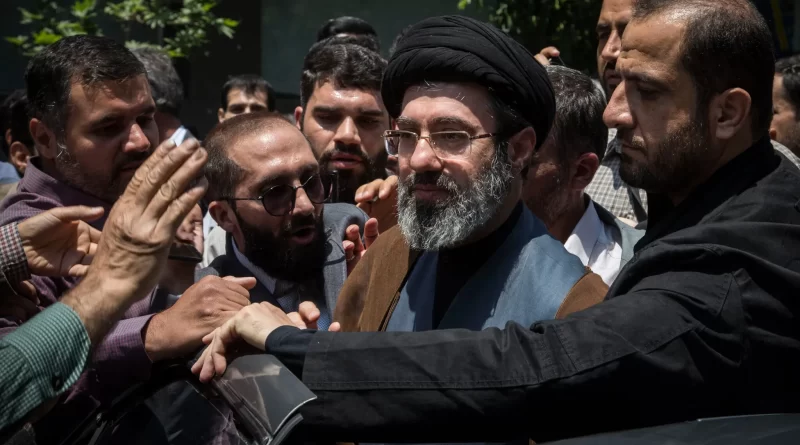
New Supreme Leader Inherits Sprawling, Secretive Office That Dominates Iran
His father, Ayatollah Ali Khamenei, had turned what was traditionally a religious affairs office into a shadowy national security juggernaut.

In the political annals of the Islamic Republic of Iran, one of the first notorious public episodes involving Mojtaba Khamenei, the man just named as the country’s new supreme leader, occurred during the 2005 presidential election.
After a dark-horse candidate, Mahmoud Ahmadinejad, surged abruptly into a runoff and eventual victory, the reformist politician who unexpectedly lost wrote an open letter to the supreme leader accusing his son Mojtaba of manipulating the vote.
“You are well aware that the unwise intervention of the relatives and aides of some religious and political officials in the past has had a very negative consequence,” the opposition candidate, Mehdi Karroubi, wrote in the letter, published by two newspapers that were forced to suspend publication afterward.
Ever since, Mr. Khamenei has had the reputation of operating in the shadows, using the power of his father’s office to manipulate events in the Islamic republic in favor of the hard-line faction.
That headquarters of the supreme leader, which he is now inheriting from his father, Ayatollah Ali Khamenei, has always played an outsize role in the country’s affairs.

In the 37 years that the elder Mr. Khamenei ruled before being killed in an American and Israeli attack, he transformed the office from a traditional religious affairs bureau with a political cast into a national security juggernaut with oversight of the military, intelligence, the economy, foreign affairs and, of course, the clergy.
“Under Khamenei, it became a complete security, political and economic state within a state,” said Saeid Golkar, a political science professor at the University of Tennessee who coauthored a report last January about the transformation.
Mojtaba Khamenei, 56, the second of four sons, was already considered the “mini supreme leader” advising his father on the office’s web of operations, Mr. Golkar added. His three brothers also worked there in advisory roles.
President Trump has said that his assault on Iran should give him a role in picking the country’s next leader. Asked about the younger Mr. Khamenei at a news conference on Monday, Mr. Trump said, “We think it’s going to lead to more of the same problems for the country, so I was disappointed.” Analysts considered the choice a sign of the regime’s seeking continuity amid the tumult of the war.
The name of the office is Bayt-e Rahbari in Farsi, meaning the House of the Supreme Leader, often known simply as the Bayt.
In Shiite Islam, tradition dictates that an ayatollah should establish a bayt to interact with followers on religious questions and to organize matters like charity. A son is often delegated to run it.
Ayatollah Ruhollah Khomeini, the founder of the Islamic Revolution, added a political element to that model. When the ayatollah began fading before his death in 1989, his son Ahmad Khomeini became his gatekeeper. That prompted considerable grumbling about excessive interference by the Bayt, especially after Ahmad was accused of torpedoing as too liberal the main candidate expected to succeed Ayatollah Khomeini.

The secretive Bayt that the next leader, Ayatollah Khamenei, established was on a different order of magnitude. While the previous Bayt had dozens of employees, said Mr. Golkar, 4,000 people now work there, and 40,000 more are affiliated throughout the government.
Ayatollah Khamenei created mirror offices for every government ministry, appointing powerful deputies for foreign affairs, education, cultural affairs and other departments who were all given a mandate to ensure that government policy conformed to his wishes. Other teams steer military and intelligence matters. Mr. Trump imposed sanctions on the supreme leader’s office in 2019.
Lacking venerable religious credentials or popular support when he became supreme leader in 1989, Ayatollah Khamenei set about consolidating his power through the security services and his Bayt.
Given his reliance on the security services to crack down on increasingly frequent waves of dissent, including fatally shooting thousands of street protesters months ago, Ayatollah Khamenei had surrounded himself with the military commanders of the Islamic Revolutionary Guards Corps.
The religious weight of the office declined further with the younger Mr. Khamenei’s appointment, said Behnam Ben Taleblu, a senior fellow at the Foundation for Defense of Democracies in Washington. The son is a mid-ranking cleric, even if official statements immediately started referring to him as an “ayatollah.”
“Neither Khamenei was religiously qualified for the position, and it is almost certain that the new supreme leader will emulate his father and cultivate security ties,” said Mr. Taleblu.
The son is considered even more entwined with the Guards, particularly since he vetted the appointments of the latest generation of commanders and his history with them goes back to his teenage years, when he served in a noncombat role toward the end of the Iran-Iraq war, said Mr. Golkar.
Mojtaba Khamenei, who was 22 when his father took over as supreme leader, matured within the Bayt. Throughout those years, the regime’s authoritarian bent has increasingly overshadowed the theocracy that first emerged from the 1979 Islamic Revolution.
“Iran has already moved from a theocratic regime to the theocratic security system under Khamenei, and now it is moving toward a more complete security state under Mojtaba,” said Mr. Golkar.