
He Raps, He Rants, He Promises Change. Meet Nepal’s Presumptive New Leader.
Balendra Shah’s party won a landslide in the election that followed Nepal’s Gen Z revolution. His style is pugnacious.
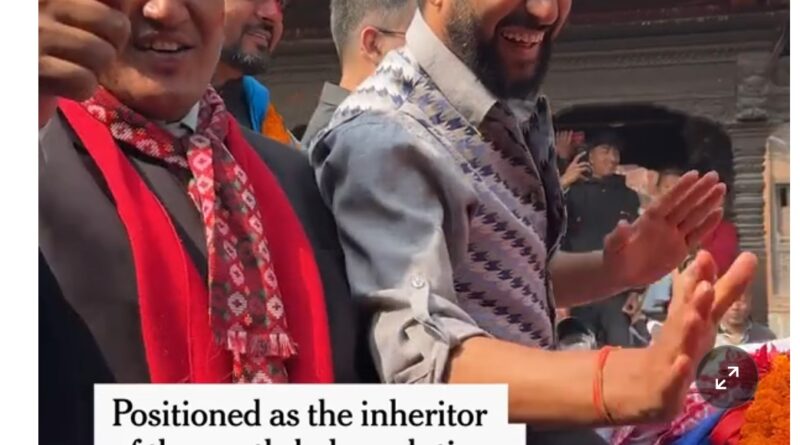
The vote was the first since a Gen Z-led uprising last year overthrew a government that many Nepalis viewed as corrupt and out of touch. The Rastriya Swatantra Party, a young political force that positioned itself as the inheritor of the Gen Z revolution, received the largest mandate in Nepal’s modern electoral history, winning a significant majority of 275 parliamentary seats, according to official results released on Tuesday. Mr. Shah, a millennial with an often aggressive and aggrieved style on social media, is its pick to lead Nepal.
Why did people vote for him?
Technically, Nepal’s electorate picked the R.S.P. But many Nepalis did not cast their ballots last Thursday for a party; they voted for Balen, as Mr. Shah is popularly known.
“People are saying, ‘Balen is a savior for Nepal,’” said Sanjeev Humagain, a political scientist at Nepal Open University. “They’re saying, in a populist way, that he’s a god.”

A socially conscious rapper, Mr. Shah has prided himself in not being bound to Nepal’s political establishment. Four years ago, he successfully ran as an independent for mayor of Kathmandu, the nation’s capital. He cultivated an image of a politician who got things done — tackling waste management, improving education and delivering health care — precisely because he wasn’t beholden to the ossified hierarchy of party politics.
As mayor, Mr. Shah lent early support to the Gen Z protesters, who had gathered peacefully in Kathmandu in September to condemn corruption and nepotism, as well as a sweeping social media ban. The protests quickly descended into violence when security forces killed unarmed young people. Mr. Shah branded K.P. Sharma Oli, who was prime minister during the fatal crackdown, a “terrorist.” Mr. Oli soon resigned, and the government collapsed.
After the elections were called, Mr. Shah chose to fight for the seat in Parliament that Mr. Oli, four decades his senior, had long held. He won with more than three-and-a-half times the number of votes.
What is Balen’s vibe?
Punchy and volatile. But also a bit mysterious. He hides his expression behind his signature rectangular sunglasses, which he insists on wearing indoors.
Mr. Shah rarely gives news conferences or media interviews. Instead, he communicates through social media, where his reach is unmatched by other Nepali celebrities; he has 3.7 million followers on Facebook, in a nation of 30 million people.
He has railed against the three big nations — the United States, China and India — and the three big Nepali political parties that for years had a stranglehold on the country’s politics. And, before he joined it in January, he also venomously criticized the R.S.P.
“All politicians, new and old, are thieves,” he wrote on social media.

Mr. Shah has expressed admiration for the managerial acumen of dictators like Hitler and ranted on social media about perceived slights — a hair trigger reflex that may not work when he assumes leadership of Nepal.
What is his music like?
A poet who learned to style his verse to a beat, Mr. Shah is a troubadour of the streets. Although he grew up comfortably as the son of a traditional medicine doctor, he wrote lyrics that championed the underdog and decried the powerful, in the mold of his inspirations, Tupac Shakur and 50 Cent.
In a country dominated by the Himalayas, Mr. Shah is on track to be the first prime minister of Nepal considered a son of Madhesh, the lowland province bordering India. People from the southern plains, who make up more than half the nation’s population, have long felt like second-class citizens.
One of Mr. Shah’s songs, released this year, expresses his sympathies to Nepalis, many of them from the lowlands, who by the millions work overseas because of official corruption that stymies their job opportunities at home.
“Money seems to grow on trees for those who sell their integrity, those who step on others, those who are selfish, those who write lies, those who oppress,” the song goes.
What kind of leader will he be?
As mayor of Kathmandu, Mr. Shah often acted first and figured out the procedural niceties later. He tried to bulldoze a squatter settlement that he found unbecoming. To make a point about slow road construction, he ordered a dump truck to deposit trash in front of the Department of Roads.

As leader of Nepal, Mr. Shah will have to be more flexible. Although his party has a large majority in the lower house, it doesn’t have a single seat in the upper house, making passing major legislation tough.
“We have a lot of problems in Nepal,” said Mr. Humagain, the political scientist. “One man, even Balen, is going to have learn a lot about compromise, communication and teamwork.”
Hannah Beech is a Times reporter based in Bangkok who has been covering Asia for more than 25 years. She focuses on in-depth and investigative stories.