
Iran War Live Updates: Iran Proposes Suspending Nuclear Activity for Up to 5 Years
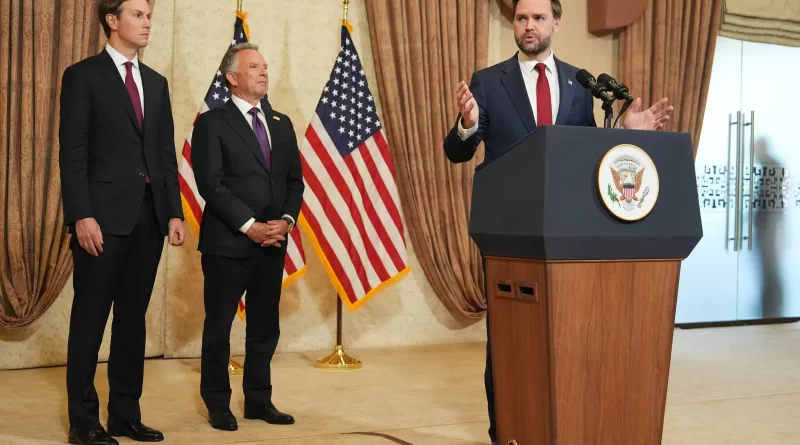
Vice President JD Vance sought a 20-year suspension in weekend negotiations, which ended without an agreement a day before the U.S. military blockade of the Strait of Hormuz began. President Trump rejected the Iranian offer.

The United States and Iran traded proposals for a suspension of Iranian nuclear activities during weekend negotiations in Pakistan, but remain far apart on the length of any agreement, according to Iranian and U.S. officials.
Iran said Monday that it could suspend uranium enrichment for up to five years — an offer the Trump administration rejected, insisting on 20 years, according to two senior Iranian officials and one U.S. official. Still, the discussions suggested that there may be a path to a peace deal, even as the U.S. military began its blockade of Iranian ports on Monday, threatening a nearly week-old cease-fire.
Officials said they were discussing a second round of face-to-face talks, but provided no details.
President Trump announced the blockade after high-level negotiations with Iran broke down over the weekend, and said that other countries would join in. But on Monday, several European leaders rejected the idea, and at least one vessel, a tanker linked to Iran, appeared to defy the blockade.
Shortly after the blockade went into effect Monday morning, Iran promised to retaliate. A spokesman for its powerful Revolutionary Guards threatened to “introduce new methods of warfare,” and an Iranian military spokesman, Ebrahim Zolfaghari, said “no port in the Persian Gulf and the Sea of Oman will be safe” if Iranian ports were threatened.
The goal of the blockade is to prevent Iran from profiting from oil exports and to put pressure on its leaders to accept American conditions for ending more than a month of war. The U.S. military said that it would block ships “entering or departing Iranian ports and coastal areas” while allowing other vessels to transit the Strait of Hormuz on their way to other ports.
Before the United States moved to restrict traffic through the strait, it was Iran that had essentially shut it down. Iranian forces largely barred Western tankers and ships from transiting the strait, a Persian Gulf waterway through which about a fifth of the world’s seaborne oil passes.
The price of oil has soared by more than 50 percent at times since the war began in late February. On Monday, the price of Brent crude, the global benchmark for oil, reached $102 a barrel and later settled at around $99.
Here’s what else we’re covering:
-
Israel: The 40-day war with Iran and the continued war with Hezbollah have left many Israelis despairing over how little they believe the fighting accomplished, particularly compared with what they had been promised, according to two new polls. Read more ›
-
Lebanon: The Israeli military said that its forces had encircled and raided the Lebanese town of Bint Jbeil, one of the largest communities near the border between the two countries. Israel’s attacks there have become a sticking point in the cease-fire negotiations, as Iran has demanded the truce extend to Lebanon. The Israeli and Lebanese ambassadors to the United States are scheduled to meet in Washington on Tuesday for rare direct talks.
-
Death tolls: The Human Rights Activists News Agency said at least 1,701 civilians, including 254 children, had been killed in Iran as of Wednesday. Lebanon’s health ministry on Monday said that 2,089 people had been killed in the latest fighting between Israel and Hezbollah, including 357 in a wave of Israeli strikes last Wednesday. In attacks attributed to Iran, at least 32 people have been killed in Gulf nations. At least 22 people had been killed in Israel as of Sunday, as well as 12 Israeli soldiers fighting in Lebanon. The American death toll stands at 13 service members.