
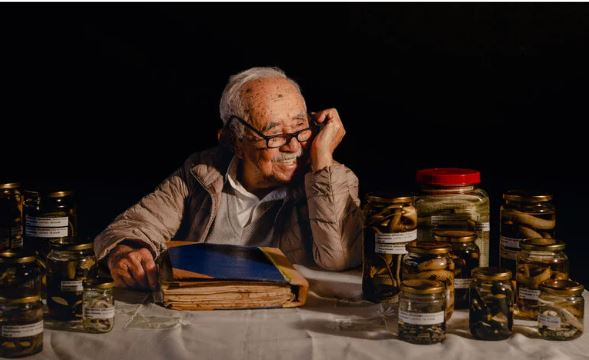
A Hidden Treasure of Rare Snake Specimens
In the foothills of the Ecuadorean Amazon, a 101-year-old farmer and a young scientist turned an amateur collection into a scientific survey of one of the most diverse snake habitats on Earth.
A decade ago, Alex Bentley, a young American scientist, traveled to the small Ecuadorean town of Mera to study an elusive species of snake known as the “X.” During his visit, a local park ranger mentioned an old man who had an extraordinary collection of snakes.
Arriving at a shack on the old man’s property, Bentley was greeted by a sign announcing admission prices of $1 for adults and 50 cents for children. Anthurium flowers and tropical evergreen plants lined the outside. He paid the dollar and stepped into a dusty small building with white lattice walls and a corrugated metal roof.
Inside, dozens of dead snakes, coiled in plastic bottles and glass jars, lined wooden shelves. The specimens, rare and obscure, drifted in a cane liquor that had clouded over the decades.
They were like a “little hidden treasure,” Bentley recalled, “something that had just been overlooked.” The jars held massive snakes and species even Bentley couldn’t name, in a menagerie that stretched back 70 years.
What captivated him even more was the collector: Manuel Genaro Peñafiel, a slight, mustachioed farmer who lived in the white house next door and had transformed the shack into a makeshift museum.
Peñafiel, then 90 years old, had spent a lifetime catching snakes on his finca, his rural estate, frequently risking fatal bites. His shelves held everything from thin whip snakes to the equis, the lethal pit viper whose hourglass markings give the “X” its name.
In a region where the customary response to a snake was a machete, Bentley was puzzled: Why had Peñafiel kept them at all?
It was difficult, Bentley admitted, to articulate his own obsession with these misunderstood creatures. But here was a farmer with no scientific training who had the same response. There was an immediate companionship between the two men — a shared connection over what Bentley described as “the calling of the snakes.”
‘If you find a snake, do not hurt it.’

Mera is a town of about 1,000 people in the province of Pastaza, nestled between the cloud forest of the eastern Andean foothills and the Amazon rainforest. The area receives roughly 10 feet of rain every year. Every afternoon, farmers bring fresh milk down from the fincas secluded in the hills above town.
Peñafiel arrived here in Mera — near Shell, which was named after the oil company — in the early 1930s, a boy of 7, along with his parents and brothers migrating from the Andean highlands. He became a farmer like his father, cultivating naranjilla (“little orange”) — a citrus-flavored fruit that tastes like a cross between pineapple and lime.
In those days, snakes were part of daily life. They turned up in the crops, in the kitchens and underfoot and were often quickly dispatched with a blade, their bisected bodies tossed outside.
But Peñafiel was fascinated by these creatures, and wanted to understand them.
In 1958, a year after marrying his wife, Maruja Acosta, he caught his first specimen, a small equis. Instead of tossing it, he kept it in a jar of sharp-smelling liquor. From then on, he issued an order to his farmworkers: “If you find a snake, do not hurt it.” He wanted undamaged specimens in his collection.

Mr. Peñafiel at home; an undated photo of him with his wife, Maruja Acosta; Ms. Acosta, who supported her husband’s interest.
He would wrangle them with a forked tree branch, pinning their heads while their bodies thrashed. Then he’d bind them with jungle vine. In the afternoons, returning from the fields, he would prepare two or three jars with alcohol and carefully slip the day’s find inside.
“I liked them,” he said in an interview in April. “And that was the beginning of the snakes.”
Acosta, his wife, who worked in the firewood kitchen, tolerated the hobby with pragmatism. With eight children, she feared snakebites; she killed any live snake found inside the house.
Those found outside, curled up in coils among the harvest, belonged to Peñafiel.
In the following years, he captured false coral snakes, glossy racers and ground snakes. Originally, they were kept on a wooden wall inside the house, above a desk. Milena Peñafiel, Peñafiel’s granddaughter, recalled running into the house as a child to check for new arrivals. Often, she and her cousins would play hide-and-seek among the shelves.
“I both feared and respected them,” she said. Each jar was a story her grandfather would tell of adventures in the forest.
Eventually, the family sold the finca and moved closer to central Mera. “I packed everything,” Acosta said, “including the snakes.”
They built a dedicated shack, where the jars were placed on shelves, and hung a sign for admission.
Their museum would bring Bentley to Peñafiel’s door.

In pursuit of the equis
At the turn of the 21st century, when Peñafiel moved to central Mera, Bentley was growing up in Salem, Va., with a singular focus. At 8 years old, he ran a lemonade stand for weeks to save up $80 for a kingsnake.
By the time he was 13, he was breeding several species of snakes, including ball pythons and corn snake morphs, and selling them on Craigslist. By high school, he was publishing scientific papers on snake diversity within Virginia’s Havens Wildlife Management Area. And in college, he was hunting for rattlesnakes at night with prominent snake researchers.
What he wanted most was to study snakes in the wild.
While majoring in biology and Spanish at Wofford College in South Carolina, he traveled to Mera to research the “X” snake’s natural history for a thesis project.
Bentley was “blown away” by Peñafiel’s collection. He came to Mera having believed that little had been done to document the snake populations in this remote corner of the Amazon.

The forest held all sorts of creatures. Frogs made sounds like video games (“pew, pew”) and insects glowed fluorescent under ultraviolet light. Band-bellied owls called in the night. Magic mushrooms grew underfoot. Glass frogs clung to leaves, their organs visible through translucent skin. Eels were longer than acoustic guitars. One shy tarantula had lived in a hole in a tree for five years.
“It would take lifetimes to understand all this,” Bentley said.
Part of what makes Mera so unusually rich, he said, is the vertical gradient — the dramatic ecological shift from the high Andes down to the Amazon basin. Snakes occupy every niche along the way: Andean forest pit vipers hunt in the high canopies, and mottled water snakes thread through the rivers below.
After officially moving to Mera in 2019 and living there for a couple of years, Bentley married Dione Fiallos, a local environmentalist whose family had been in the town for generations, and who was distantly related to the Peñafiel family. Together, they founded Waska Amazonía, a conservation nonprofit, and often rallied against the giant oil companies that were stepping into Mera.


A rio coca robber frog; Mr. Bentley on a nighttime survey with biologists and herpetologists in Mera; a species of spiny orb weaver.
In 2023, Bentley began the process of formally studying Peñafiel’s collection, cataloging a life’s work that had scientific value but had never been recognized or curated. The goal was to document the species found in Mera. But it would take a town to examine the contents. At first, Peñafiel’s family was hesitant. He was already 98 years old, and he feared damage to the collection, which was among his most prized possessions. He took a quiet pride in it. But they relented.
Over 100 people joined the effort, including firefighters, taxi drivers and international scientists. The research took place outside Peñafiel’s house, in an open wooden hut where the specimens were laid out on tables for study.
Over several days, scientists and volunteers worked through the jars one by one: photographing the snakes, counting scales and taking samples. Then, the old cane liquor was replaced; specimens were fixed in formaldehyde and transferred to new jars of 96 percent alcohol, each labeled in careful print with a scientific name.
The research eventually extended beyond the shack. Bentley and other scientists examined snakes from Mera held in museum collections and universities across Ecuador, including some in Quito. Collectively, they looked at 85 years’ worth of material: 666 individual specimens representing 66 species, seven of which had never been formally recorded in Mera.

One of Peñafiel’s specimens was the largest western ribbon coral snake ever registered — more than five feet long. No western ribbon coral snake of that size has been seen since.
Others hadn’t been found at such altitudes in years.
Some snakes hadn’t been seen in their original habitats in decades. The Pastaza water snake, caught in the stream by the Peñafiel family’s former finca, was named for the province and polluted river it once inhabited.
Among those involved in the study was Jaime Culebras, a herpetologist and photographer at Fundación Condor Andino, who said that Bentley’s work had “positioned Mera as a truly interesting place.”
The researchers found that at least a quarter of all snake species in Ecuador were present in Mera alone — making the town one of the most diverse snake habitats on Earth. And many specimens were in Peñafiel’s shack.
The researchers wanted to describe Peñafiel’s collection without exposing him to criticism. He began catching snakes decades before scientific permits existed, leaving them in a legal gray zone. The best path forward, said Mario Yánez-Muñoz, a conservation ecologist at Ecuador’s National Institute of Biodiversity, was transparency — publishing the research openly as a way of legitimizing what Peñafiel had built.
The scientific study was published in the peer-reviewed journal Check List in October 2025, exactly 10 years to the month from when Peñafiel and Bentley met. Both of their names are on it.


Bothrops atrox, a venomous pit viper species; specimens from Mr. Peñafiel’s collection, 58 of which came from his estate in Mera; a boa constrictor in Mr. Bentley’s hands.
‘We don’t kill them anymore.’
In Mera, things started to change. When people found a snake, they called Bentley. He would arrive with a crew of volunteers and students, catch the animal carefully and release it deep in the jungle, far from town.
Sometimes the snake was a small red equis, still the most feared creature in the region. Sometimes it was a giant rainbow boa, measuring up to six feet, its scales reflecting iridescent light.
Once, a man was cutting wood in the forest and found a small snake in stacked boards. He used to kill snakes, but this was the first snake he ever put in a jar and brought to Bentley. It turned out to be an undescribed species.
Finding a new vertebrate species — a snake, a frog, a bird — is vanishingly rare; most of what remains undescribed belongs to the invertebrate world of insects and spiders. The snake turned out to be a dwarf boa from an ancient lineage. It was endemic to a mountain chain near Mera that predated the Andes.
“This snake is an emblematic species for Mera,” Bentley said of the dark orange-brown creature, no longer than a foot. The singular specimen is now housed in the National Institute of Biodiversity.
Others in Mera began to find snakes fascinating too. One of those people was Wilson Ebla, 57, a milkman who often found boas on his finca. He was born in Mera, and used to think that killing snakes was necessary to protect farm animals; he once lost a horse to a snakebite.

“Since you came here,” he said to Bentley on a rainy evening in April, “we don’t kill them anymore.”
Now, Ebla gets excited when he finds a snake on his finca. That evening, he swiped quickly through videos of snakes on his phone, his eyes lighting up. “I play with them, then leave them be,” Ebla said.
Pioneer of Mera
While waiting for a visit from Bentley one morning in early April, Peñafiel, now 101, sat in a chair of thick bamboo, a book of fables about happiness open in his lap. The citrusy scent of lemongrass hung in the air, and slow-tempo Latin ballads drifted from a speaker.
When Bentley arrived, they shared a cup of coffee and talked about Mera and politics, including future plans they wanted to bring up with the local government. And they talked about the newest addition to the collection: another equis, caught recently by one of Peñafiel’s sons.
The scientific paper they published — bound with a metal clip, printed and assembled — lay on the table nearby. Someone also had the first page printed on a mug. An orange tabby cat lounged in the corner.
“I want to thank you,” Peñafiel said, turning to Bentley.

He held a framed plaque from the provincial government, given to him as recognition for his life’s work.
Bentley took it in, still wearing the gloves he’d used to handle the new snake.
“Manuel Genaro Peñafiel Flores,”the plaque read. “Pioneer of Mera.” The award recognized his curiosity, love for nature and decades of collecting, and credited his life’s work for establishing Mera as one of the most biodiverse places in the world for snakes.
At the bottom, in a final line: “His example transcends time.”
======================
Alexa Robles-Gil is a science reporter and a member of the 2025-26 Times Fellowship class, a program for journalists early in their careers.