
FOR IRAN, TRUMP’S REVERSAL ON ESCALATION SHOWS WHO HAS THE UPPER HAND

By expanding the arena of fighting in the region, experts say, Tehran sent a warning about the dangers of a widening war.

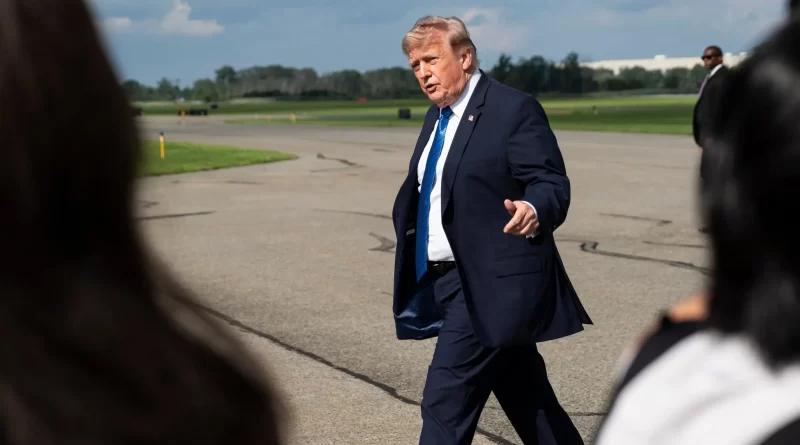
When President Trump appeared to back down once again from a threatened military escalation against Tehran, he offered fresh fodder to the narrative Iranian officials are eager to promote: They are not the ones who fear war — Mr. Trump is.
Iran’s leadership believes it has found the world’s Achilles’ heel. With the help of regional militia allies, Tehran spent the past week underscoring its ability to threaten several of the world’s most critical energy facilities and waterways.
It has continued to up the ante in its face-off with Washington over when and how to stop their renewed hostilities and return to a short-lived deal to start peace negotiations, which fell apart last month.
When Mr. Trump signaled in recent days that a major escalation was imminent if no concessions were made, two former Iranian officials said Tehran’s leadership told him to go right ahead.
“They are ready for the war, and they won’t back down,” said Amir al-Mousawi, a former Iranian diplomat, who said he had met over the weekend with the team surrounding Iran’s head negotiator and speaker of Parliament, Mohammad Bagher Ghalibaf. Mr. al-Mousawi described an exchange of messages between U.S. and Iranian officials sent over the weekend through Pakistani and Qatari officials, in which he said Mr. Trump vowed a severe attack on civilian infrastructure like power plants if the Iranians did not restart negotiations.

The Iranians refused, he said, unless Washington returned to the previously agreed “memorandum of understanding,” which many experts say was in Iran’s favor.
“‘We have no problem with war at all, and we are ready for the big confrontation,’” Mr. al-Mousawi said the Iranians told the Americans. “Trump told the Iranians: ‘I will hit the power in Iran.’ So, the Iranians said: ‘If you strike, we strike.’”
Iranian officials have spotted a pattern in Mr. Trump’s attempts to shape negotiations, said Sasan Karimi, a former senior Iranian government official and a professor of Iranian studies at the University of Tehran.
“Whenever their messages are exchanged, Mr. Trump starts to pressurize the situation by threatening Iran, so he can try to get further concessions,” he said. “But Iran is not so easily manipulated.”
On Sunday, Mr. Trump said he had relented from his planned escalation after Iran and other Middle Eastern countries requested a delay because the “perimeters of a deal” had been agreed to.
Yet, there are no outward signs of any return to U.S.-Iranian negotiations. What does appear to have happened is that Saudi Arabia and Qatar expressed concerns over their ability to adequately defend their oil and gas facilities, according to two regional diplomats.
The official Saudi news channel said on Sunday that Crown Prince Mohammed bin Salman, the de facto ruler of Saudi Arabia, had recently spoken with Mr. Trump to stress “the necessity of prioritizing dialogue to de-escalate tensions” and “prevent a wider conflict.”
Recent strikes in the region reflect the severity of those concerns.
Two weeks ago, the Houthis, an Iran-aligned militia force in Yemen, blockaded Riyadh’s use of the Bab al-Mandab waterway in the Red Sea. The Saudis had been piping oil to their west coast port on the Red Sea in order to circumvent Iran’s stranglehold on global shipping through the Strait of Hormuz, the primary route for oil shipments out of the Persian Gulf.
Then last week, drones struck two major oil facilities in Saudi Arabia, in an attack Riyadh attributed to Iran-backed militias in Iraq. A day later, two ships caught fire in Damietta Port in Egypt, in what the Egyptian authorities said appeared to have been a drone attack and was widely seen by regional analysts as yet another strike by Iran or its proxies.

At its heart, the current struggle “is about redesigning the regional security architecture,” said H.A. Hellyer, a senior associate fellow at the Royal United Services Institute in London.
The core of that struggle is the issue of who controls the Strait of Hormuz, he said. “The Iranians are very, very serious about not giving up control, and they’re willing to bomb things to make sure that’s the case.”
Beyond that dynamic, there was also the startling July 17 attack on U.S. military sites in Jordan that killed three American soldiers.
“The strike in Jordan was the game changer,” said Ali Vaez, Iran project director for the International Crisis Group. It not only showed that Iran’s missile arsenal remained well stocked, he said, but also that Tehran’s intelligence capabilities were higher than previously believed.
The attack also stirred rare dissent within Jordan, a crucial U.S. security ally in the region, as hundreds of prominent Jordanians, among them politicians and lawyers, challenged their country’s limits on free speech to demand the withdrawal of American forces.
“The entire Iranian strategy in this period has been aimed at making the United States understand that if there is another round of escalation, the scope and scale of Iranian response would be so much more devastating for the region and the global economy,” Mr. Vaez said.
Mr. Trump, he added, has never fully grasped the motivations of the Iranians, how they refuse to be bullied or cowed. Throughout both his current and previous term, Mr. Trump “is reluctant to learn the lesson” that aggressive tactics toward Iran have only hardened its position, Mr. Vaez said.
“It’s already eight years of his maximum pressure” with economic sanctions, he said, now combined with military pressure “that has never produced what he has sought.”
At the same time, Washington is grappling with depleted stores of munitions. Some military officials say their abilities to fight future conflicts — such as a so-called great-power war against China — could be hobbled by shortages that might take years to reverse, particularly of defensive weapons like Patriot missiles.
“The U.S. military options aren’t great, and it’s not simply reported munitions shortages,” said Farzan Sabet, an Iran analyst at the Geneva Graduate Institute in Switzerland.
“One, it’s not clear that the limited and time-bound military escalation Trump is willing to undertake at this point will be enough to change Iran’s calculus,” he said. “Two, it’s hard to imagine these options can degrade Iran’s missile and drone capacity, such that it cannot effectively close the Strait of Hormuz or further damage the Gulf’s critical and energy infrastructure.”
Emboldened, some well-known Iranian hard-liners mocked the dilemma the Trump administration seems to find itself in.

Ebrahim Rezaei, the spokesman of the Iranian Parliament’s national security and foreign policy committee, echoed an earlier threat by Mr. Trump in April that he would bomb Iran “back to the Stone Age.”
When Mr. Trump said he was postponing an escalation, a prominent hard-line commentator, Seyed Mohammad Marandi, posted a picture of chicken tacos on his X account. It was a reference to a sarcastic acronym used by Mr. Trump’s critics: TACO, or “Trump Always Chickens Out.”
“Iran has not budged,” he wrote above it.
Far from being closer to talks, some regional experts feel the two sides are further away than ever.
Mr. Karimi, the former Iranian official, said Iran should ready itself for another phase of war in the coming weeks.
As long as both Tehran and Washington remain convinced they are the ones whose demands should be met, he said, the talks will not be meaningful.
“To reach a deal, both sides must be politically humble and agree that their maximalist ambitions will not work,” he said, adding that, for now, “those dynamics are not on the table.”
============================================
Falih Hassan, Aaron Boxerman and Sanam Mahoozi contributed reporting.
is The Times’s bureau chief for Iran and Iraq.