
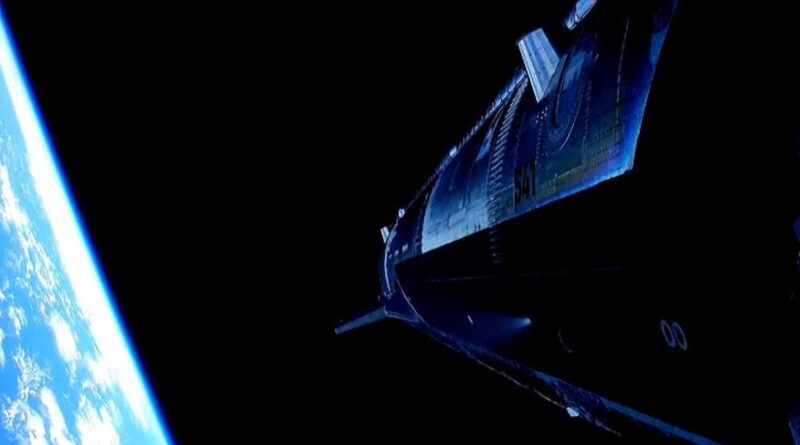
SpaceX’s Starship Makes It to Orbit for the First Time, but Returns to Earth Early

The 14th test flight marks a crucial milestone toward the company’s ambitions of sending people to the moon and Mars, but it was not a complete success.

SpaceX’s Starship on Monday finally circled Earth, a key milestone toward Elon Musk’s dreams of eventually sending people to Mars, as well as NASA’s plans to send astronauts back to the moon.
But Starship had to return from space early, after less than two orbits instead of the planned six, because of engine problems that occurred during liftoff.
The Starship spacecraft splashed down in the North Pacific near Hawaii just before noon, ending its journey with a fiery explosion when, not unexpectedly, leftover methane fuel ignited.
Some gasps of disappointment arose at SpaceX headquarters, heard during video coverage of the flight. After the previous flight, Starship had toppled over gently enough to remain intact, floating in the water.
“As you saw, not quite a soft, extra-soft splashdown like we had on the last one,” Dan Huot, one of the SpaceX commentators, said during the webcast.
Mr. Huot said the test flight, the 14th for this rocket, remained a success. “Most importantly, Starship made it to orbit,” he said.
SpaceX launched Starship at 8:48 a.m. Eastern on Monday from its Starbase site outside Brownsville, Texas.

The mission did not go perfectly. One of the 33 engines in the booster failed during the upward flight.
A second engine failed to reignite during the maneuver to turn it around for a simulated landing in the Gulf of Mexico. However, the other engines were able to compensate, and the simulated landing appeared gentle.
The upper-stage Ship continued to space. Because one of the six engines failed, the other five fired longer than planned. During the webcast, Mr. Huot initially announced that Starship would not enter orbit but then reversed himself, saying engineers continued to evaluate the situation.
Several minutes of tense waiting followed as Ship continued to coast upward. The team ultimately decided to fire one engine for 19 seconds to put the spacecraft in a circular orbit about 171 miles above Earth’s surface.
“We kept the drama up a little bit,” Mr. Huot said.
A few minutes later, the spacecraft started deploying 26 next-generation Starlink satellites, which will become operational parts of SpaceX’s internet communications network.
Starship was to have made about six orbits of Earth before re-entering for a splashdown in the Pacific off the coast of Chile. But SpaceX had also prepared for the possibility of an earlier return, sending recovery teams to both sites.
Just after 11 a.m., Starship fired one engine to provide enough of a nudge to send it falling back toward Earth.
Starship is the largest and most powerful rocket ever built. It is 407 feet tall and consists of an upper-stage spacecraft, also called Starship and often shortened to Ship, and a powerful booster stage with 33 engines known as the Super Heavy.
The design aims to be fully reusable; eventually both stages will return to the launch site to be caught by giant mechanical arms.
If SpaceX pulls off this vision, Starship would revolutionize the space industry, enabling launches of bigger, heavier satellites and other cargo at lower costs.
“It’s designed for not just full reusability but also rapid reusability, like an aircraft,” Mr. Musk, the founder and chief executive of SpaceX, said this month during the All-In Summit, a business and technology conference.

Although this test flight was not for NASA, it is important for the space agency, which has hired SpaceX to provide a version of Starship to take its astronauts from lunar orbit to the surface of the moon. But work on Starship has taken longer than Mr. Musk and SpaceX originally promised.
For the moon mission, SpaceX needs to demonstrate several technological firsts. That includes conducting multiple Starship launches over a short period of time, because the lunar lander version of Starship will need to have its propellant tanks refilled by another spacecraft before leaving low-Earth orbit.
Transferring ultracold liquid methane and liquid oxygen between two spacecraft in the weightlessness of space has also not yet been demonstrated.
Those more ambitious goals cannot be pursued until SpaceX shows it can reliably launch Starship into orbit. With the continuing engine problems, SpaceX may decide it needs to first repeat the objectives of this flight.
How the mixed success affects the confidence of investors remains to be seen.
SpaceX debuted on the stock market in June in the largest initial public offering ever. Its stock price shot upward, then plummeted. In recent weeks, it has moved upward again to about $150, modestly higher than the $135 initial offering price.
==============================================================
Kenneth Chang, a science reporter at The Times, covers NASA and the solar system, and research closer to Earth.