
How Do Cuttlefish Hide?

Cephalopods are masters of camouflage. Scientists want to decipher how the process works in the brain.

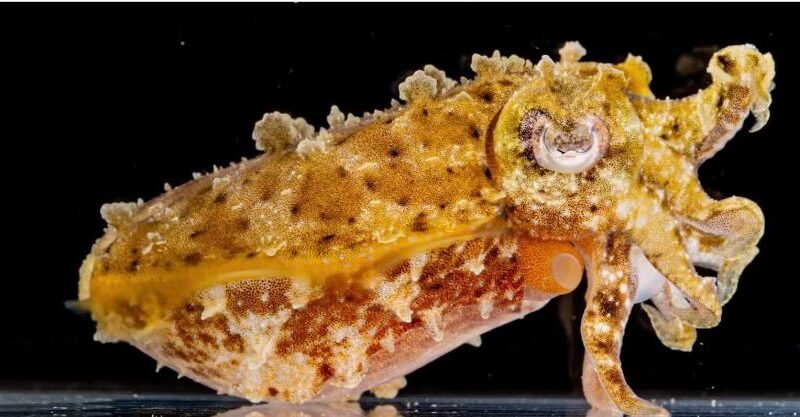
One afternoon in late August, Tessa Montague, a postdoc in neuroscience at Columbia University, stood in a windowless lab at the Zuckerman Institute several floors below street level peering at a dwarf cuttlefish, an octopus relative about the size of a human palm. The cuttlefish swam in a saltwater tank scattered with fake algae and rocks, its skirtlike fins fluttering, as dark and light bands rippled along its body like shifting shadows.
For a moment, the undulating bands stopped moving across its skin. “We don’t know what they mean or why they do it,” Dr. Montague said, as the bands began rippling again. “But they’re kind of amazing.”
Around her, more than 100 similar tanks, housing over 200 dwarf cuttlefish, filled the room with the hum of water pumps and the smell of brine. In one tank, a cuttlefish had darkened to conceal itself amid a clump of fake algae. In another, the resident had white spots running down its body. A third cuttlefish had turned its skin pale as it hovered near the top of its tank, as if waiting for a meal.
Coleoid cephalopods, the group that encompasses cuttlefish, octopus and squid, have mystified scientists for centuries. Endowed with large brains that evolved entirely independently of vertebrates’, they can solve problems, form memories and engage in social behavior. Aristotle, who observed cuttlefish in a bay on the Greek island of Lesbos, called them “the most cunning” of soft-bodied animals.
Some cephalopods, including cuttlefish, can camouflage themselves with stunning precision, changing the pattern, color and texture of their skin to match coral reefs and sandy seabeds. Scientists have long wanted to understand the neural basis for that otherworldly transformation. How does the cuttlefish — which studies suggest is colorblind — take in the visual world and project it on its skin in as little as a second?

“It’s showing you its perception of the world,” Dr. Montague said. “No other animal can show you what it sees or tell you what it sees except a human.”
Dr. Montague and her colleagues have taken a significant step toward being able to understand the phenomenon. In September they announced that they had created the first transgenic cuttlefish by successfully inserting foreign genes into its DNA, which were passed on to subsequent generations.
Their goal is to engineer a cuttlefish whose neurons flash each time they’re active, allowing researchers to map how camouflage is generated in the brain. “If we can look inside the brain during camouflage,” Dr. Montague said, “we can see how the brain is representing the visual world.”
‘Like grabbing a cloud’

Cuttlefish skin.Credit...Thomas Barlow
Cuttlefish change color by manipulating millions of pigment cells, called chromatophores, which act like color pixels in a television display. Each chromatophore holds a single pigment, and the cells are arranged in layers: yellow or orange on top, red in the middle, and brown or black at the bottom.
Tiny muscles, controlled by motor neurons, cause the chromatophore to expand or shrink, displaying more or less pigment. The layering of pigment cells produces additional hues, and the animal has other specialized cells that can create iridescence, or shimmer.
Some species can produce a wider range of colors and patterns than others, helping them to evade predators, hunt and communicate. The flamboyant cuttlefish, a species native to the waters of the Indo-Pacific, can produce a kaleidoscope of vibrant red, yellow and purple on its skin.
The cuttlefish’s ability to match its environment occurs so quickly that it seems like a reflex, said Cliff Ragsdale, a neurobiologist at the University of Chicago. Yet it’s so complex and variable that it suggests a higher level of cognitive processing — “like, for us, the production of languages,” he said. “There are so many puzzles to it.”


Iridophores and chromatophores of a cuttlefish arm tip; flexing chromatophores; a microscopic view of chromatophores and radial muscles.Credit…Thomas Barlow
To camouflage, a cuttlefish must first take in the scene, select an appropriate pattern and then enlist hundreds of thousands of chromatophores to produce it. Past studies suggest that the animal doesn’t copy the scene pixel by pixel. Instead, it seems to mostly rely on texture.
Imagine looking at a patch of sand on the seabed, then closing your eyes. You probably would not be able to picture the precise location of every individual grain of sand. But you could probably still remember the way the seabed looked — the coarseness of the grains, say, or how packed they were. You could still envision and describe those properties without knowing where each grain of sand was. That is texture.
The cuttlefish brain may be compressing the texture of the visual world — such as sand or rocks — into a set of numbers, then decompressing those back into a recreation of that world on the skin, said Erica Shook, a Ph.D. candidate at Columbia working with Dr. Montague.
Scientists want to understand the whole loop: how the cuttlefish encodes the information and then outputs the pattern. Visual statistics may help them identify which features of the environment the cuttlefish is trying to match. Then, by studying the flashing neurons in its brain, they may be able to trace how the brain turns that information into a pattern on the animal’s skin.
But the phenomenon also depends on perception, Ms. Shook said: Good camouflage is whatever manages to fool the observer. “Anytime you’re having to deal with perception, things get very, very hard,” she added.
Roger Hanlon, a marine biologist at the Marine Biological Laboratory in Woods Hole, Mass., who has studied camouflage for more than five decades, said that measuring camouflage was “kind of like grabbing a cloud.”
“You see a cloud, you know what it is, you grab it, but you don’t get anything in your hand,” he said. “Camouflage is like that. You know that it’s doing something visually, but trying to put numbers to it is very difficult.”
Caring for cephalopods


A clutch of cuttlefish eggs; Connor Gibbons, the lab’s cephalopod manager; a hatchling in a transfer tube.Credit…Thomas Barlow
To better understand how the cuttlefish performs its magic, Dr. Montague first needed to choose the right species to study. Past studies had used the European cuttlefish — the same species Aristotle studied in the Aegean Sea over 2,000 years ago. Dr. Montague chose the dwarf cuttlefish instead, a smaller species native to the tropical waters of the central Indo-Pacific that develops faster and lives as long as a year.
Caring for and breeding cephalopods is notoriously difficult. They are sensitive to water quality and temperature. Some species are cannibalistic; others grow too large to be easily maintained in a lab. And almost all octopuses lay just one clutch of eggs in their lifetime.
At Columbia, the research team mixes its own saltwater for the tanks and orders grass shrimp overnight from Florida by FedEx Priority. “The animals demand perfection,” said Connor Gibbons, the lab’s cephalopod manager. (Mr. Gibbons wears a gold wedding ring that was cast in a mold made of cuttlebone, the cuttlefish’s internal shell.)
Creating a transgenic cuttlefish required an understanding of the species’ behavior, genetics and development, and Dr. Montague, with funding from the Howard Hughes Medical Institute, has spent the better part of a decade building her knowledge of all three. “But transgenesis is by far the most difficult,” she said.

How to make a cuttlefish glow
For the Columbia team, a transgenic cuttlefish would serve as an animal model: an organism specially designed for laboratory studies, with neurons that light up to identify where and how camouflage works in the brain.
With collaborating scientists, they began by sequencing the dwarf cuttlefish genome — itself a first, as cephalopod genomes were sequenced for the first time only a decade earlier. Then the team worked on identifying the exact stage at which to inject a cuttlefish embryo with additional genes. (This had to be done at the one-cell stage, they learned, with specialized quartz needles, as normal needles were not sharp enough to pierce the embryo.) They started modestly, injecting a fluorescent gene that would make the cuttlefish body glow, just to see if transgenesis was possible in the animal.
It was. The first transgenic cuttlefish, a female, reached adulthood — but never laid eggs. The researchers created another, this time a skittish male. He was placed in a tank with non-transgenic females, and he was so small and nervous that scientists doubted he would ever mate with them. But a few weeks later they found three embryos in the tank.

A transgenic cuttlefish embryo and hatchling.Credit…Thomas Barlow
As products of a transgenic male and a non-transgenic female, the embryos had only a 50 percent chance of carrying the fluorescent gene. Dr. Montague placed the first embryo under the microscope; its cells did not glow. “It’s all over,” she recalled thinking. But when the next one did — a fiery orange under the microscope — she burst into tears. “Somehow this little guy did it,” she said.
The skittish male now has grandchildren. Transgenic cuttlefish have since bred with others, passing the gene on to the next generation, which fill the stacks of tanks below Columbia. “These are mostly all transgenic,” Dr. Montague said as she looked around the room in late August.
“It’s miraculous,” said Caroline Albertin, a developmental biologist at Harvard University and a co-author on the new study. “She’s done a tremendous, herculean job making her model system work.”
A love for questions


Cuttlefish nerve tracts of the optic lobe, with Dr. Montague and Mr. Gibbons screening for fluorescent embryos.Credit…Thomas Barlow
The Columbia team’s ultimate goal is to create a line of cuttlefish whose neurons carry a gene for a protein that glows green when it binds to calcium. When a neuron fires, calcium rushes into the cell; and so, in a transgenic cuttlefish, every neuron would flash when active, and scientists could see which brain cells are enlisted during camouflage.
To capture those flashes, Dr. Montague and her colleagues will need to monitor and record a transgenic cuttlefish’s brain in real time while the animal is camouflaging. They have a detailed map of the cuttlefish’s brain and are working on implanting a small microscope over the region that controls camouflage.
“This is such a beautiful and elegant system to study visually guided behavior,” said Thomas Barlow, a Ph.D. candidate at Columbia who does some of the brain-imaging experiments with the cuttlefish. “I fell in love with these creatures and the kinds of scientific questions they give us access to.”
One question is how a brain so different from ours goes about representing the visual world. And perhaps, in answering that, we might learn something about our own, Dr. Montague said.
“We have so much deep respect for these animals,” she said, surveying the many cuttlefish the lab has raised. As she walked along the rows of tanks, the cuttlefish could be seen shifting through displays, from white spots to pale and dark hues. A few drifted toward the fronts of the tanks. “I love it when they do this,” she said.
One had drifted apart from the rest and nestled among the shadows at the back corner of its tank. A deeper shade blossomed across its skin, and in an instant the animal had cloaked itself in darkness.