
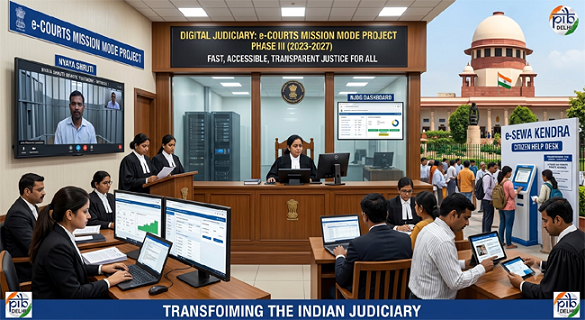
The Digital Transformation of the Indian Judiciary: e-Courts Mission Mode Project

-A PIB FEATURE EDITED BY USHA RAWAT-
India’s judiciary, which serves over a billion citizens, has historically relied on paper records and traditional brick-and-mortar court infrastructure. This legacy system created substantial bottlenecks, forcing citizens to incur significant travel and administrative expenses to access basic judicial documents and proceedings, making justice slow, cumbersome, and costly. To address these systemic challenges, the Government of India launched the e-Courts Mission Mode Project in 2007. The initiative aims to systematically accelerate court proceedings through comprehensive digitization while making the legal process affordable, accessible, and transparent for lawyers, judges, and litigants alike.
Now in its third phase, the e-Courts project has fundamentally modernized the national legal framework. Phase I (2011–2015) laid the structural foundation by computerizing over 14,000 courts and setting up basic network infrastructure. Phase II (2015–2023) built upon this base by introducing citizen-centric digital platforms—such as the National Judicial Data Grid (NJDG), e-Filing systems, and physical e-Sewa Kendras—while expanding video conferencing capabilities across judicial establishments more than fivefold. Currently active, Phase III (2023–2027) operates on an allocated budget of ₹7,210 crore to transition Indian courts into paperless, intelligent ecosystems. This phase emphasizes large-scale record digitization, paperless courtroom hardware, seamless institutional interoperability, and the integration of emerging technologies like Artificial Intelligence (AI), Machine Learning (ML), and Optical Character Recognition (OCR).
Physical infrastructure deployment under Phase III has already yielded significant scale. Across the country, 7,553 establishments—including courts, prisons, and hospitals—are equipped with video conferencing systems. Furthermore, 4,519 courts support online e-filing, 1,806 e-Sewa Kendras operate across court complexes to assist digitally underserved citizens, 1,626 court complexes are outfitted with solar power systems for uninterrupted operation, and 474 courts are fully equipped with paperless courtroom hardware. Additional achievements include the integration of 6,895 courts with the National Service and Tracking of Electronic Processes (NSTEP) for GPS-tracked service of summons, the migration of 734 judicial websites to the secure S3WaaS platform, and full implementation of the Inter-operable Criminal Justice System (ICJS) across all High Courts.
The benefits of court digitization extend across all levels of the legal system. Transparency has been significantly enhanced through the National Judicial Data Grid (NJDG), an online public dashboard offering real-time visibility into pending and disposed cases across the Supreme Court, High Courts, and District Courts. By categorizing cases by stage, type, and specific reasons for delay (such as pending documents or court stays), the NJDG assists judicial leadership in remote administrative planning and workload management. Meanwhile, the e-Filing platform eliminates the need for physical submissions by enabling lawyers and litigants to submit pleadings, make court fee payments, record video oaths, and manage cases online in English and regional languages. Since its inception, over 1.25 crore cases have been filed via e-Filing, and the e-payment platform has processed ₹1,404 crore in court fees alongside ₹75 crore in fines.
Access to justice has further broadened through remote hearings and digital case tracking. Over 4.18 crore virtual hearings have taken place nationwide, livestreaming is operational in 11 High Courts, and 31 Virtual Courts dedicated to traffic challans have processed 11.33 crore cases totaling ₹1,135.79 crore in settlements. To preserve historical records and enable instant retrieval, more than 753 crore pages of legacy court files are being digitized. Litigants and legal professionals monitor daily proceedings via multilingual mobile tools like the e-Courts Services App (3.84 crore downloads), while judges utilize the dedicated JustIS app (22,594 downloads) to organize their dockets. Furthermore, automated communication systems transmit over 4 lakh SMS messages and 6 lakh emails daily to deliver real-time case updates.
At an institutional level, digitization now connects the entire criminal justice ecosystem through the Inter-operable Criminal Justice System (ICJS). By linking platforms such as CCTNS for police FIRs and charge-sheets, ITSSO for monitoring sexual offence investigations, e-Sakshya for digital evidence chain-of-custody, e-Prisons for inmate management, e-Forensics, MedLEaPR for postmortem reports, NAFIS for biometric fingerprint matching, and Nyaya Shruti for virtual testimony by police and witnesses, the legal system enables real-time data sharing between police, prosecution, forensic labs, courts, and correctional facilities.
Looking toward 2027, Phase III is deploying dedicated AI and ML tools (backed by a ₹53.57 crore sub-allocation) to streamline judicial workflows. Key pilots include AI-driven real-time argument transcription for Supreme Court Constitutional Benches, the LegRAA research assistant, the Digital Courts 2.1 paperless management platform with built-in voice-to-text (ASR-SHRUTI) and translation tools (PANINI), and automated petition defect-screening built in collaboration with IIT Madras. Through the eSCR portal, AI tools have already translated over 83,000 judgments into 18 regional Indian languages, including over 36,000 into Hindi. Through these cumulative reforms, India’s judiciary is converting legacy paper-heavy workflows into a transparent, efficient, and technology-driven justice delivery system.