
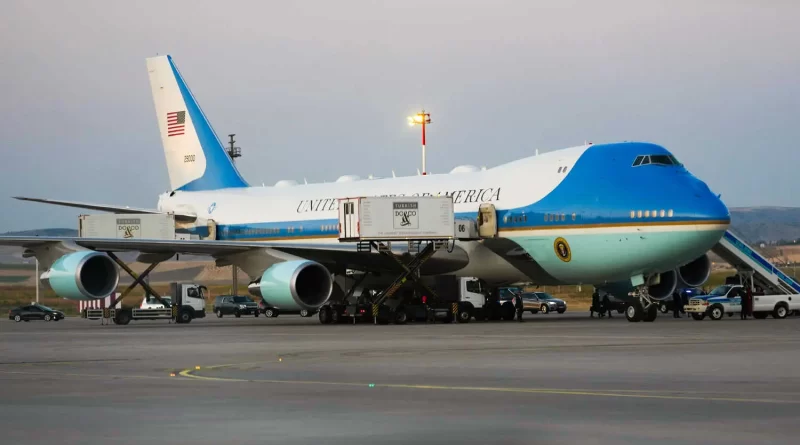
Trump Said to Have Secretly Used Military Jet to Leave Turkey Amid Threats

President Trump hid in an airport catering container and was taken to a military jet for a secret flight out of country after the NATO summit last month.


Top administration officials engaged in an elaborate deception to spirit President Trump out of Turkey during the NATO summit there last month, transporting him in a catering container to a military jet because of a threat against him and Air Force One from Iran, two senior U.S. officials said on Monday.
Mr. Trump and other officials had said publicly that he would be leaving Turkey on July 8 aboard one of the older versions of Air Force One rather than a luxury 747-8 donated by Qatar that he had flown in on. Mr. Trump told reporters at the time that he was making the switch for “old time’s sake.”
Mr. Trump boarded the older plane from the left-side door in view of cameras, and news organizations, including The New York Times, reported that he had traveled on it to Britain, where he switched back to the newer plane. The Times reported at the time that the decision was driven in part by concern about the security of the new plane donated by Qatar, which had not been equipped with all of the defensive capabilities of older versions.
But instead of flying out aboard that older, powder blue, modified 747, Mr. Trump was whisked off that plane via a catering container that had been lifted to the opposite side of the plane from where the journalists traveling with him boarded, one of the U.S. officials said. The president was then taken to a third plane, which he flew in secret to Britain, the official with knowledge of the matter said.
Reporters on the older plane were not told that Mr. Trump had not flown with them from Turkey to an air base in Britain, making them unwitting participants in the ruse and leaving them, along with some White House staff members, to serve as unknowing decoys.
After Mr. Trump arrived in Britain, he was secretly moved back to the older version of Air Force One. He then disembarked in view of reporters and walked across the tarmac to the plane donated by Qatar, which he flew to Washington.
The elaborate plan appears to have been developed in a matter of hours after officials determined that a threat against Mr. Trump from Iran was credible. It came after years of threats against Mr. Trump from Iran and amid the war he launched against that country. And it was an unusual instance of the public being deceived about a president’s whereabouts.
Officials have not previously acknowledged that Mr. Trump was not where they claimed he was. The furtive operation was reported earlier by the Washington Post, which identified the plane that carried the president to Britain from Turkey as a C-32A, a military variant of a Boeing 757.

It is rare for presidents to travel without the reporters who comprise the press pool designated to be with them, or in their vicinity, without some general awareness of the commander in chief’s whereabouts.
President George W. Bush kept a slimmed-down press pool with him as he flew first to a military base and then back to Washington in the chaotic hours after the Sept. 11, 2001, terrorist attacks. And presidents — including Mr. Trump — have traveled to war zones with reporters alongside them.
Donald Mihalek, a former Secret Service agent who worked in the protective details for Mr. Bush and President Barack Obama, said the Secret Service has used decoy motorcades and flights in the past to move presidents secretly.
“Anytime the president is in a theater where there’s potential combat danger, the Secret Service has employed protective counter measures including the use of a decoy,” Mr. Mihalek said.
He added that the agency has long prioritized the security of the president over transparency with the public.
“The agency is not the agency of public affairs,” he said. “The agency is the agency of the Secret Service. Their number one job is to keep the president safe.”
In this case, the threat led the White House to purposely mislead reporters assigned to cover Mr. Trump, leaving journalists to report that he was traveling on board a plane that was being used as a decoy.
After The Times reported last month on the security shortcomings of the Qatari-donated jet amid the concerns about the threat from Iran, Steven Cheung, the White House communications director, seemed to hint that subterfuge might have been involved in Mr. Trump’s departure from Turkey.
“As the president has said recently, there are many enemies of America who have their sights on him, and we use every tool at our disposal — including distraction and misdirection — to address those threats,” he said at the time.
The threat from Iran was not specific to the Qatari-donated jet, people familiar with the sequence of events said. Instead, Mr. Trump was being targeted on whatever airplane he was traveling on, as The Times has previously reported.
Mr. Trump was briefed on the threat while in Turkey, and a plan was soon put in place, with a small group of top government officials involved, including Gen. Dan Caine, the chairman of the Joint Chiefs, and Defense Secretary Pete Hegseth, the official with knowledge of the deception plan said.
The Defense Department and a spokesman for General Caine referred all questions to the White House on Monday. The White House reissued Mr. Cheung’s statement from the week of the NATO summit, only without the clause mentioning “distraction and misdirection.” The U.S. officials with knowledge of the deception plan spoke on the condition of anonymity to discuss sensitive security issues.
When Mr. Trump arrived at the airport to leave Turkey, a camera that had been positioned beforehand captured him getting on the old Air Force One, and journalists traveling with him, rushing to board the plane through lower steps in the back, had only a glimpse of him. A pool report noted as the plane took off, “We have been advised to keep our window shades in the press cabin closed.”
The older Air Force One landed at 10:16 p.m. at the Mildenhall military base in England, a pool report said, with Mr. Trump stepping off it 40 minutes later. Before that, unbeknown to reporters, Mr. Trump was brought by vehicle from the third plane that he had arrived on to the older Air Force One, boarded it through a different entrance and strode down the step from the upper left-side door as he would typically do, according to the U.S. official.
He walked from there to the Qatari jet, as the small group of reporters who had traveled aboard the older jet watched. The president and the press pool then boarded the new plane to fly back to Washington.
When asked by reporters during that flight back to the United States about why they had flown on the old Air Force One to England, Mr. Trump claimed he had wanted the troops stationed at the U.K. base to see the new plane. When pressed on why the window blinds had been directed to be shut on the flight from Turkey, Mr. Trump said that he knew of no specific threat, but described himself as under constant siege from Iran.
“I’m number one on their list, before you,” he told the reporters. “But if I go, you go. Right?
Mr. Trump and a number of his advisers have faced threats from Iran for years, especially after Mr. Trump, during his first term, ordered the killing of a powerful Iranian commander, Maj. Gen. Qassim Suleimani.
Mr. Trump’s advisers during the 2024 campaign privately told allies that they were given intelligence that Iran still hoped to harm Mr. Trump. That led to the occasional use of decoy planes during the campaign. His staff at times put the candidate aboard a secret jet, without alerting the media, while his staff flew his private plane. The Biden administration increased security for Mr. Trump that summer after new intelligence about plots to kill Mr. Trump; a short time later, he faced an unrelated assassination attempt in Butler, Pennsylvania at an outdoor rally. There was a second unrelated attempt in September 2024.
The collective threats, which ranged from a prosecuted murder-for-hire plot by an Iranian proxy to the hacking of Trump campaign officials’ email and social media accounts, created a siege climate for the candidate and his aides. It led to fear, insularity and, at times, paranoia, that shaped how officials interacted with the Biden administration, which was responsible for allocating Secret Service resources, as well as with the media, and with other government officials.
After the Times reported about the security concerns in Turkey, and the fact that the Qatari jet lacked the same defensive capabilities as the older presidential aircraft, Mr. Trump was enraged by the leaks. The Justice Department issued subpoenas for grand jury testimony to the reporters who had been on the bylines of the stories, as well as some of their family members. Those subpoenas were withdrawn after a federal judge admonished federal prosecutors for the process involved.
Mr. Trump has continued to rage about information coming from his government that contradicts what he is telling the public, particularly about the war in Iran that he began on Feb. 28, according to multiple officials.
=====================================================================================
Katie Rogers, Erica L. Green and Doug Mills contributed reporting.
is a White House correspondent for The Times, reporting on President Trump.
is a national security correspondent for The Times. He has reported on U.S. military affairs and counterterrorism for more than three decades. Contact him securely on Signal: @ericschmitt.36.
is a White House correspondent for The Times, covering President Trump and his administration.