
10-Minute Challenge: Angel Oak

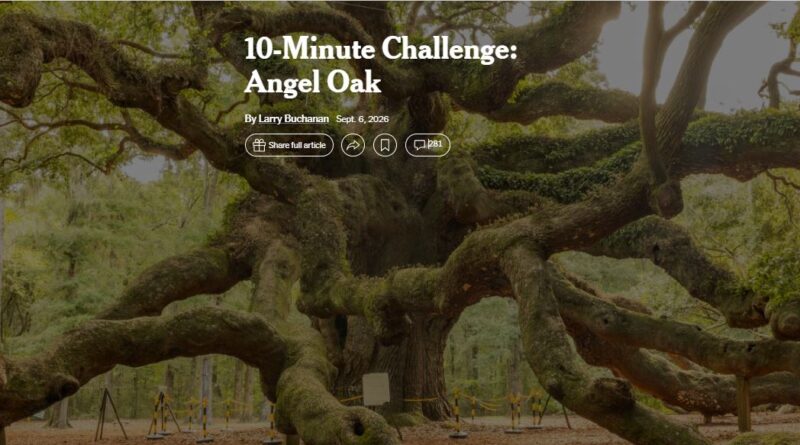
On a marshy island a dozen miles southwest of Charleston, Angel Oak has, for the last 400 years or so, slowly spread its weighty wings. And do they ever spread.
This Southern live oak rises more than six stories. Its branches plunge down, snaking along the ground, and arc back up again, in gnarly twists and turns that a roller-coaster designer might take inspiration from. The longest limbs stretch nearly 100 feet from the massive trunk (31 feet around).

“It’s a powerful tree,” said Barbara Taylor, the longtime manager of Angel Oak Park.
Blankets of resurrection fern live in harmony with the tree, growing over the branches. The fern shrivels up during the dry times, and springs back to green after rain, reawakened.

In all, this giant produces a carpet of shade covering more than 17,000 square feet.
Some 400,000 people visit each year. The site was added to the National Register of Historic Places in May.
“It’s a place where you can come and feel what the world has to offer you,” Ms. Taylor said.

A few months ago, my colleague Margaret Roach wrote about a freshman seminar at Harvard called, simply, “Tree.”
Students pick one of the 16,000 trees in the university arboretum and lavish dedicated attention on it, visiting it week after week, observing it, drawing it, writing about it, photographing it, for the whole semester.
The syllabus gives some suggestions on how to observe — particularly relevant to us in the 10-Minute Challenge:
-
Show up, and let the tree guide you.
-
Record and reflect on your thoughts.
-
Allow yourself to obsess.
-
As time goes on, you will become a “better, keener observer.”
By the end, some students report knowing the tree better than some of their friends.
“There’s just nothing that will shake me of this complete confidence that nature and our connection with it can make us a better set of humans,” said William Friedman, an evolutionary biologist who teaches the Harvard course and is director of the Arnold Arboretum. His syllabus states: “The goal of this freshman seminar will be to initiate a personal and lifelong connection with the ‘other,’ the vast and variant organisms with which we share the planet.”For most of this series, we’ve tried to reclaim attention by looking at art. But what about the nature that surrounds us?
Trees are ubiquitous; it’s easy to let them become wallpaper to your life as you walk by. But zoom in and that bark can envelop you:

Ms. Taylor, the Angel Oak manager, isn’t a natural outdoor person. As a child, she sat on the porch and watched her siblings and cousins play in the dirt. But when she started at the park more than two decades ago, the tree converted her.
“The energy just gravitates to you,” she said.
When I called, she didn’t have much time. On any given day, she’s dealing with hundreds of visitors. But in the mornings before anyone else arrives, she gets some time with the tree herself.
She uses it to fill her tank for the whole day.
When she gets a rare visitor with a “negative vibe,” she pulls from that reserve.
“With the energy from that tree that I receive in the morning, I am able to help de-escalate and turn that one person into a positive.
These images of Angel Oak, taken last week by the Charleston photographer Hunter McRae, have primed my eyes to better see the trees around me in the last few weeks of summer.
You know that feeling when you learn a new word and start noticing it everywhere? It’s called the Baader-Meinhof phenomenon, or the frequency illusion, and it happens to me every time I finish an installment of our series. After spending so much time with Seurat last month, I couldn’t help but notice complementary color pairs everywhere. Lois Dodd focused me on the simple drama of light through windows. It’s not that these things are occurring more frequently; it’s just that I hadn’t been giving them my attention.
It’s happening now with trees.
I slowed down to look at the London planes in the park by my house. They are full and thriving. I’ve paid closer attention to a skinny peach tree that my wife and I planted in a large pot in our tiny backyard. It’s no Angel Oak, but I tended it with string and supports as the branches drooped, heavy with the weight of new fruit. I watched those peaches ripen and picked them when the color seemed just right.
Now the internet is telling me to prune the tree heavily for better growth. I am having a hard time with this.
As for Angel Oak, Ms. Taylor said its growth is slowing a bit now that it’s in middle age: The life expectancy of an oak like this is around 800 to 900 years. But it still has much to give to those who visit it.
“As you get older, you become wiser,” she said. “You become the wisdom that you get from being around it.”
