
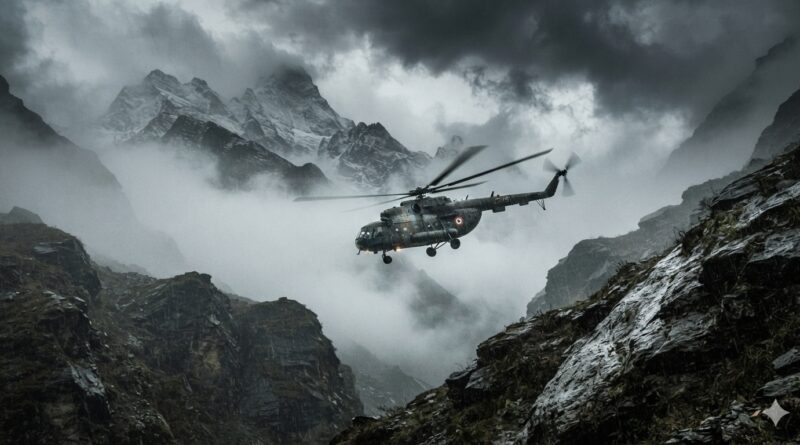
Helicopters Turning into Flying Coffins in Uttarakhand

In this article, Jay Singh Rawat highlights the alarming rise in fatal helicopter crashes in Uttarakhand, pointing specifically to the October 2026 tragedy near Joshimath. Rawat argues that these disasters can no longer be blamed solely on unpredictable Himalayan weather. Instead, they expose severe systemic failures, including ignored meteorological warnings, overlooked safety audits of fleet operators, and regulatory friction between state and national aviation authorities. He urgently calls for transparent compliance reporting, the mandating of advanced safety avionics, and strict accountability to prevent further loss of life in the region.

By Jay Singh Rawat
The recurring helicopter accidents in Uttarakhand can no longer be dismissed as the inevitable cost of navigating unpredictable Himalayan weather or treacherous mountain terrain. They have escalated into a grave national concern—one that exposes systemic flaws in aviation safety, regulatory oversight, and accountability for human lives. The latest tragedy on October 30, 2026, saw a helicopter operated by Trans Bharat Aviation crash near Joshimath while en route from Badrinath to Dehradun. The crash claimed all six lives on board, including the pilot, marking yet another grim entry in the state’s expanding ledger of aviation disasters.
What makes this latest tragedy particularly disturbing is that the India Meteorological Department (IMD) had issued explicit heavy rainfall warnings for five districts in Uttarakhand, including Chamoli. Crucially, an orange alert had been placed directly over the Badrinath and Hemkund Sahib belts. The decision to clear and operate a flight in such an ecologically and meteorologically sensitive mountain zone despite advance warnings raises fundamental questions about the efficacy of standard aviation safety protocols.
According to preliminary flight data, the aircraft departed Badrinath at approximately 1:12 p.m., bound for the Sahastradhara helipad in Dehradun. Air traffic control lost contact within minutes, and search teams subsequently discovered the charred wreckage in the rugged terrain near Joshimath. The crucial question that demands an answer is whether prevailing weather conditions, visibility metrics, and flight-path risks were rigorously evaluated prior to takeoff. While an orange weather alert does not automatically ground all aviation operations, it mandates heightened caution and stringent risk assessment. If these vital precautions were bypassed, the implications point toward a failure that extends far beyond a single pilot’s split-second decision in the cockpit.
Uttarakhand Leads the Nation in Helicopter Accidents
Official data underscores the frightening disproportion of these incidents. In July 2025, Minister of State for Civil Aviation Murlidhar Mohol informed Parliament that Uttarakhand recorded the highest number of helicopter accidents nationwide during the reporting period. A subsequent Lok Sabha reply on August 6, 2026, revealed an even more alarming statistic: all six helicopter accidents reported across the entire Himalayan state region between 2023 and 2025 took place within Uttarakhand. While a comprehensive aeronautical risk assessment requires evaluating total flight sorties and air-hours across states, this dense concentration of fatal crashes points to a localized crisis.
The year 2025 was exceptionally tragic for air travel in the state. On May 8, six people perished in a helicopter crash in Uttarkashi district. On June 15, another helicopter returning from Kedarnath went down near Gaurikund, killing seven. These followed an October 2022 crash near Kedarnath that claimed seven lives, mostly pilgrims. Following the June 2025 disaster, authorities temporarily suspended operations in the Kedarnath Valley, grounded operator Aryan Aviation, and suspended the licenses of two Trans Bharat Aviation pilots for six months for flying in unsafe conditions. Yet, as the October 2026 crash proves, temporary suspensions have failed to establish a durable safety enforcement mechanism.
Serious Deficiencies Uncovered in Audit of Eight Operators
Perhaps the most troubling revelation is that regulatory authorities were fully aware of systemic operational vulnerabilities long before the latest crash. In response to Lok Sabha Unstarred Question No. 3039 on August 6, 2026, the Ministry of Civil Aviation disclosed that the Directorate General of Civil Aviation (DGCA) had conducted special safety audits of eight active operators in 2025.
The audited fleet operators included Trans Bharat Aviation, Himalayan Heli Services, Arrow Aircraft Sales and Charters, Aryan Aviation, Thumby Aviation, Kestrel Aviation, Pawan Hans, and Global Vectra Helicorp. The audit findings exposed wide-ranging procedural lapses: failures in tracking pilot Flight and Duty Time Limitations (FDTL), non-compliance with Standard Operating Procedures (SOPs), lax maintenance certifications, uncalibrated equipment, and inconsistent reporting of internal safety audits.Ground infrastructure and operational oversight showed equal neglect. Auditors noted incomplete emergency response setups at Guptkashi, irregularities in flight-slot management, and repeated failures to analyze mandatory airborne image-recording data. At Sahastradhara heliport, the primary gateway for charter flights, even basic mandatory facilities—such as equipment for conducting pre-flight pilot breathalyzer tests—were absent.
These revelations were not mere rumors; they were official audit findings presented to Parliament by the Ministry. However, the parliamentary annexure refrained from mapping specific deficiencies to individual operators. While it would be unfair to attribute every listed failure directly to Trans Bharat Aviation, its presence on the audited list prompts urgent questions: What specific shortcomings were identified in Trans Bharat Aviation’s audit, what corrective directives were issued, and did the DGCA ever verify compliance before granting flight clearances? The government must immediately publish operator-specific audit findings and compliance reports.
Unheeded Warnings from Parliamentary Committee
The regulatory breakdown comes as no surprise to parliamentary monitors. In its 380th Report presented on August 20, 2025, the Department-related Parliamentary Standing Committee on Transport, Tourism, and Culture voiced deep concern over Uttarakhand’s aviation regulatory framework. The committee highlighted the hazardous interplay of high-altitude mountain terrain, unpredictable weather shifts, and dense, uncoordinated helicopter traffic.More crucially, the committee flagged a dangerous friction point: the division of regulatory duties between the DGCA and the local Uttarakhand Civil Aviation Development Authority (UCADA). While UCADA manages commercial aspects—such as operator selection, ticketing, and flight scheduling—the DGCA retains exclusive responsibility for airworthiness, safety protocols, and regulatory oversight. The report highlighted severe deficiencies in mountain-flying training, lack of specialized certifications, and a chronic shortage of trained personnel to monitor high-volume seasonal operations. It recommended establishing a unified regulatory framework, mandatory specialized mountain-flight certifications, and a dedicated, permanent DGCA oversight cell in the region. The latest crash demonstrates how slowly these recommendations have moved from paper to policy.
Technology, Weather Monitoring, and Technological Mandates
In recent years, the government has touted technological upgrades, including satellite tracking, automated weather stations, live webcams, and designated GPS flight corridors. In its August 2026 parliamentary update, the Civil Aviation Ministry highlighted stricter pre-flight checks, load restrictions at high-altitude helipads, and daily sortie caps.However, critical safety technologies such as Terrain Awareness and Warning Systems (TAWS) and Health and Usage Monitoring Systems (HUMS) remain unmandated for mountain operators. The regulatory justification—that these fleets consist primarily of single-engine aircraft flying under Visual Flight Rules (VFR)—requires immediate technical re-evaluation. In the Himalayas, cloud cover can seal off a valley in minutes, severely degrading visibility and trapping aircraft in narrow mountain passes where maneuvering room is zero. Advanced warning avionics cannot alter the weather, but they provide pilots with critical seconds to avoid terrain collisions.
The October 30 crash also raises serious questions regarding real-time weather dissemination. The IMD’s orange alert warned of thunderstorms, lightning, hail, and wind gusts reaching 40–50 km/h in Chamoli, alongside rain and snow along the Badrinath–Joshimath corridor. The ongoing investigation must clearly establish what meteorological data was provided to the pilot prior to departure, whether the flight breached VFR thresholds, and who authorized the final clearance.
Accountability Must Precede the Tragedy
Helicopter aviation is an indispensable lifeline for Uttarakhand. It connects remote mountain shrines, enables critical medical evacuations, and provides vital support during natural disasters. However, economic reliance and emergency utility can never justify compromising basic flight safety.The Ministry of Civil Aviation must immediately make public the 2025 operator audit findings, the compliance actions taken, and the current status of the Parliamentary Standing Committee’s recommendations. The investigation into the Joshimath crash must fearlessly examine meteorological warnings, pre-flight clearance procedures, mechanical integrity, and regulatory oversight without shielding any entity.
Himalayan weather will always be unpredictable; that reality is precisely why stringent regulations, mandatory specialized training, and unyielding oversight exist. When clear warnings of dangerous weather are issued in advance, blaming the mountains for human loss is no longer an acceptable defense. Uttarakhand does not need another cycle of official condolences, high-level probes, and empty assurances. It demands a transparent, enforceable, and accountable aviation safety system that protects human life before the next helicopter takes off into the clouds.
—————— ——————————————————————————
Jay Singh Rawat is a veteran journalist, author and researcher, with nearly five decades of experience in journalism. He has authored eight research-based books, including works on Uttarakhand’s history, politics and tribal communities. He is a recipient of the prestigious K. C. Kulish International Award for Excellence in Print Journalism and several other honours.