
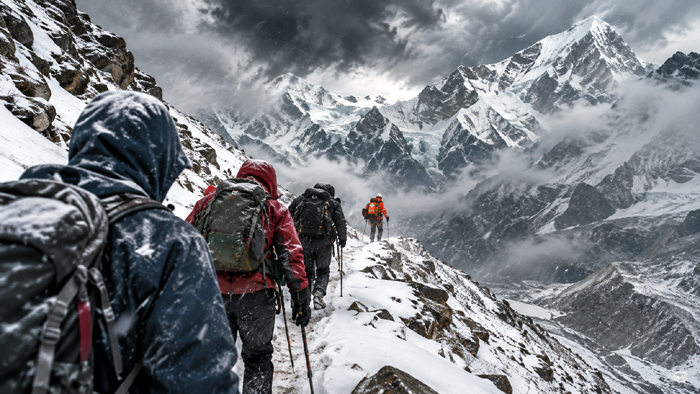
Adventure in the Himalaya: When the Call of the Mountains Turns Deadly

The Kedartal trekking tragedy has renewed urgent questions about safety in Himalayan adventure tourism. Repeated accidents across Uttarakhand, Himachal Pradesh, Sikkim and Nepal show how avalanches, blizzards, altitude and rapidly changing weather can turn expeditions fatal. These events have varied causes, and climate change should not be blamed for any specific incident without scientific evidence. Yet natural hazards do not remove the need for stronger safeguards. Risk-based route planning, trained guides, reliable communication, weather-based restrictions, equipped rescue teams and protection for local workers are essential. Trekking need not be banned, but its growth must be matched by preparation, accountability and effective safety systems.

— Jay Singh Rawat —
A recent trekking accident at Kedartal in Uttarakhand has once again raised serious questions about the safety of adventure tourism in the Himalaya. Snow-covered peaks, glaciers and remote valleys draw thousands of adventure travellers every year. But the search for excitement amid nature can sometimes become a final journey. The Kedartal tragedy is not an isolated case. Similar incidents have occurred in recent years from Uttarakhand and Himachal Pradesh to Sikkim and Nepal. It is not enough to dismiss them as natural disasters. We must also ask whether safety arrangements, weather forecasting, trained personnel and emergency rescue capacity have kept pace with the growth of adventure tourism. Trekking teams undertake these journeys at their own risk, but when they become stranded or meet with an accident, local authorities also come under scrutiny.
The recent Kedartal tragedy is not the first time that people have lost their lives in the Himalaya. Many mountaineers and adventure seekers have perished while confronting the region’s formidable challenges—its remote peaks, icy passes and glaciers. Some bodies have been recovered; others have disappeared forever in the Himalaya’s remote, frozen wilderness.
On October 27, a trekking team that had set out for the Kedartal area of Uttarkashi district was caught in severe difficulty because of adverse weather and an avalanche. The team was due to return by October 29. By November 4, four bodies had been recovered, while the search for four others was still under way. Looking back, in October 2021, seven members of a trekking team were killed after being stranded in bad weather at Lamkhaga Pass in Uttarkashi district. That same month, five trekkers died in the Sunderdhunga glacier region of Bageshwar. In October 2022, an avalanche during an expedition to Draupadi Ka Danda II killed 27 trainees and instructors from the Nehru Institute of Mountaineering; two others remained missing. In June 2024, a blizzard at Sahastratal claimed the lives of nine trekkers. Some of them were experienced. Clearly, experience can reduce risk, but it cannot eliminate it.
The tragedy is not confined to Uttarakhand. In October 2014, a sudden snowstorm and avalanche in Nepal’s Annapurna region killed more than 40 people. In April that year, an avalanche on Mount Everest’s Khumbu Icefall killed 16 Nepali mountain guides. In April 2015, avalanches at Everest Base Camp, triggered by Nepal’s devastating earthquake, also killed many climbers and support workers. In the high-altitude regions of Kinnaur and Lahaul-Spiti in Himachal Pradesh, trekking groups have met with accidents because of heavy snowfall, avalanches and losing their way. In October 2021, three trekkers died in the Buruwa Pass area of Kinnaur. In April 2023, an avalanche on the Nathu La route in Sikkim killed seven tourists. Though this was an incident involving ordinary tourists, it underscores the breadth of Himalayan risks.
These incidents differ in nature: some involve avalanches, others blizzards, earthquakes or the dangers of extreme altitude. It would therefore be scientifically unsound to attribute them all to a single cause. Uttarakhand, in particular, has a long record of accidents in the Himalaya.
Geologically, the Himalaya is a young and active mountain system. Its unstable rocks, steep slopes, crevasses in glaciers and rapidly changing weather pose natural hazards. At high altitudes, the reduced partial pressure of oxygen affects the body’s ability to function. Without adequate acclimatisation, people may develop acute mountain sickness and other serious health problems.
Climate change has added new concerns about the Himalaya’s vulnerability. Shrinking glaciers, changes in the snowline and shifts in temperature and rainfall patterns are affecting the mountain environment. However, scientific investigation is needed before any particular avalanche can be directly attributed to climate change. Weather records, snow conditions and the geographical circumstances of each incident should be studied.
At the same time, social media and commercial promotion have turned remote locations into popular tourist destinations. The risks hidden behind beautiful photographs are often not adequately explained. It is also worrying that the distinction between an ordinary tourist and a trained mountaineer is increasingly blurred.
After the Sahastratal accident, there was an initiative in Uttarakhand to frame standard operating procedures for trekking. It emphasised trained guides, communication equipment, weather information and traveller safety. But framing rules and ensuring that they are followed are separate challenges. Before granting permission for a trek, how thoroughly is the risk assessed? Does every group have reliable emergency communication? Is an automatic alert issued if a group fails to return by its scheduled time? When a severe weather warning is issued, is it clear who has the authority and responsibility to stop an expedition?
These questions deserve an impartial investigation in the wake of the Kedartal accident. It would be wrong to presume in advance that any agency or official was negligent. But it is equally unacceptable to ignore gaps in safety arrangements by calling the incident a natural disaster.
Discussion of adventure tourism often focuses on the safety of tourists, even though local guides, porters and other support workers also bear the risks. Everest accidents in Nepal have highlighted this inequality. These workers operate in dangerous conditions to make other people’s adventures possible. They must receive proper training and equipment, accident insurance, medical support and fair wages. Combining local mountain knowledge with scientific training can strengthen safety.
In Himalayan states, adventure tourism is an important source of employment and livelihood. The answer to accidents is not to ban trekking, but to manage it safely. Every route should have a risk-based classification, with clear standards for group size, experience, health checks and equipment. Sensitive areas need weather-based restrictions, trained rescue teams, emergency shelters and satellite communication. Coordination among the departments concerned is essential.
From Kedartal to Annapurna, these accidents are a warning: tourism must not expand faster than the capacity to keep people safe. The question remains: despite known hazards, why are trekkers sent out without adequate preparation?
=================================================================
About the Author
Jay Singh Rawat is a senior journalist, author and editorial consultant with more than four decades of experience. His work focuses on Uttarakhand’s history, society, politics and the Himalaya.
Disclaimer: The views and arguments expressed in this article are those of the author. The portal’s admin does not necessarily share or endorse them.