
Caught in the Act: Astronomers Witness the Rebirth of a Cosmic Maverick

By- Jyoti Rawat
In the vast cosmic ballroom of open star clusters, stars are usually expected to follow a predictable routine. Born together from the same collapsing cloud of interstellar gas, stellar siblings age in lockstep. The most massive stars burn through their nuclear fuel rapidly, swelling into red giants and dying off, while smaller stars age slowly over billions of years.
Yet, for decades, astronomers have been puzzled by a group of rebellious outliers known as Blue Stragglers. These peculiar stars appear impossibly young, hot, bright, and massive, defying the fundamental rules of stellar aging. They seem to have found a cosmic Fountain of Youth, resetting their nuclear clocks to outlive their peers.
While scientists have long hypothesized that these “stragglers” rejuvenate by stealing material from a companion or merging with another star, direct evidence of this process has remained extremely rare. Now, an international team led by Indian astronomers has captured a Blue Straggler Star (BSS) actively feeding on its partner—providing an unprecedented, front-row seat to stellar rejuvenation in real time.
Unmasking TIC 327546480
The breakthrough came from examining TIC 327546480, a remarkable binary star system located roughly 9,500 light-years away in the ancient open star cluster Collinder 261. Estimated to be around 7 billion years old, Collinder 261 should no longer host stars as massive and blue as TIC 327546480’s primary component.
To unravel the system’s secrets, researchers from the Indian Institute of Astrophysics (IIA), Gauhati University, Inter-University Centre for Astronomy and Astrophysics (IUCAA) Pune, and international institutions combined high-precision light curves from NASA’s Transiting Exoplanet Survey Satellite (TESS) with high-resolution radial velocity measurements from the Very Large Telescope (VLT) operated by the European Southern Observatory in Chile.
Combined modeling of the light curve (LC) and radial velocity (RV) data using the astrophysical modeling code PHOEBE yielded a short orbital period of $P_{\text{orb}} = 2.112\text{ days}$. Crucially, the modeling revealed a low mass ratio of $q = 0.19$, indicating a strongly unequal-mass binary system:
-
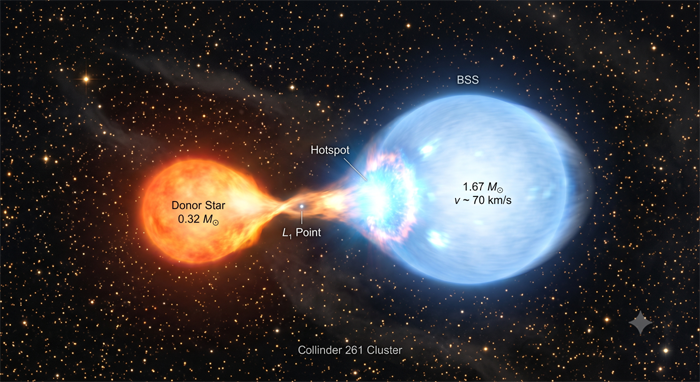
The Accretor (The Blue Straggler Primary): A massive star weighing $1.67\text{ solar masses}$ ($1.67\,M_\odot$).
-
The Donor Companion: A low-mass star containing just $0.32\text{ solar masses}$ ($0.32\,M_\odot$).
This extreme mass disparity sets the stage for a dramatic gravitational tug-of-war that is reshaping both stars.
A Cosmic Crime: Roche-Lobe Overflow in Action
The observational analysis confirms that TIC 327546480 is a semidetached binary system, meaning the lighter donor star has expanded enough to completely fill its Roche lobe—the gravitational boundary defining a star’s territory. Unable to contain its outer hydrogen envelope, the low-mass donor is actively spilling material onto the Blue Straggler primary through the inner Lagrangian point ($L_1$).
     [ Donor Star ]                   [ Blue Straggler Primary ]
   (0.32 Solar Masses)  ======>         (1.67 Solar Masses)
  Fills Roche Lobe       Stream          Accretes Matter & Spins Up
Because of the geometry of the binary, material transferred through the $L_1$ point directly impacts the surface of the Blue Straggler rather than forming a wide disk. This direct-impact accretion produces two distinct, observable astrophysical smoking guns:
-
Accretion Shock X-Rays: The cascading gas stream slams directly into the Blue Straggler’s surface, generating powerful shockwaves that heat the plasma to X-ray-emitting temperatures. Additional coronal X-ray activity from the magnetically active donor star contributes a secondary component, naturally explaining the system’s intense X-ray profile.
-
Light Curve Hotspot: Photometric modeling reveals a prominent hotspot on the accretor’s surface near the impact site, creating the pronounced light curve asymmetries observed by TESS.
Spinning Up the Engine of Rejuvenation
As gas flows onto the Blue Straggler, it transfers not just mass, but a significant amount of orbital angular momentum. Spectroscopic measurements reveal an observed projected rotational velocity of $v \sin i \approx 69.55\text{ km s}^{-1}$ to $73\text{ km s}^{-1}$ at an inclination angle of $i \sim 72^\circ$.
This closely matches the expected rotational velocity of the Blue Straggler ($v_{\text{rot}} \approx 65\text{ km s}^{-1}$), demonstrating that the primary star is rotating near synchronous velocity. To test whether this spin is caused by mass transfer, the research team calculated a characteristic spin-up timescale of $t_{\text{spin}} \sim 0.1\text{ Gyr}$.
Because this spin-up timescale is significantly shorter than the total mass-transfer timescale of $t_{\text{MT}} \sim 1.6\text{ Gyr}$ ($t_{\text{spin}} \ll t_{\text{MT}}$), the accretor can be efficiently spun up during the early stages of mass accretion. This provides clear physical proof that the Blue Straggler’s near-synchronous rapid rotation is a direct consequence of ongoing accretion.
Reconstructing 5.4 Billion Years of History
To trace the evolutionary history of TIC 327546480, researchers ran detailed computational simulations using MESA (Modules for Experiments in Stellar Astrophysics). The models show that the binary started as a standard detached system with an initial $1.12\,M_\odot$ donor and a $0.92\,M_\odot$ accretor on a tight $0.83\text{-day}$ orbit.
                  Evolutionary Timeline of TIC 327546480
┌────────────────────────────────────────────────────────────────────────┐
│ Initial System (1.12 M☉ Donor + 0.92 M☉ Accretor | Period: 0.83 days)  │
└───────────────────────────────────┬────────────────────────────────────┘
                                    ▼ ~5.46 Gyr (Core H Exhaustion)
┌────────────────────────────────────────────────────────────────────────┐
│ Roche Lobe Overflow Begins → Mass-Ratio Reversal & Orbital Expansion   │
└───────────────────────────────────┬────────────────────────────────────┘
                                    ▼ ~1.6 Gyr of Mass Transfer
┌────────────────────────────────────────────────────────────────────────┐
│ Present Configuration: 1.67 M☉ BSS + 0.32 M☉ Donor (Period: 2.11 days) │
└────────────────────────────────────────────────────────────────────────┘
Roche lobe overflow began approximately 5.46 billion years ago following central hydrogen exhaustion in the original donor star. As matter poured from the primary onto the secondary, the mass ratio reversed, causing the orbit to expand to its current $2.112\text{-day}$ period.
At the cluster’s current age of ~7 billion years, the system undergoes stable mass transfer at a rate of $\dot{M} \sim 2 \times 10^{-10}\,M_\odot\text{ yr}^{-1}$. Over the past 1.6 billion years of mass transfer, the Blue Straggler has gained roughly $0.75\,M_\odot$, fully accounting for its current rejuvenation and inflated mass. Assuming nearly conservative mass transfer and weak magnetic braking, the system undergoes stable, nuclear-timescale evolution.
What Lies Ahead: The Ultimate Fate of the System
The ongoing mass transfer is expected to continue until the donor star loses most of its hydrogen-rich envelope and detaches from its Roche lobe. It will leave behind a low-mass proto-helium white dwarf ($\sim 0.29\,M_\odot$), while the accretor remains as a rejuvenated Blue Straggler. At this stage, the system will temporarily resemble the short-period BSS–helium white dwarf binaries observed elsewhere in open clusters.
Eventually, the Blue Straggler will consume its acquired fuel and evolve off the main sequence toward the red giant phase. As it swells, it will fill its own Roche lobe, triggering a second phase of mass transfer. However, because the mass ratio at this stage will be extremely inverted, this second mass-transfer phase will become dynamically unstable, plunging the system into a Common Envelope (CE) phase where both stars share a single outer atmosphere:
                     Future Evolutionary Pathways

                       [ Blue Straggler + He WD ]
                                   │
                                   ▼ (BSS Swells into Red Giant)
                       [ Common Envelope Phase ]
                                   │
             ┌─────────────────────┴─────────────────────┐
             ▼                                           ▼
   [ Successful Ejection ]                      [ Inefficient Ejection ]
  • Orbital shrinkage                          • Cores merge
  • Extremely close binary                     • Single overmassive giant star
    (Subdwarf/He WD + He WD)
If the common envelope is successfully ejected, orbital drag will pull the cores close together, leaving a tight binary consisting of the stripped core of the BSS (a subdwarf or helium white dwarf) and the original helium white dwarf. If envelope ejection fails, the two cores will merge into a single overmassive giant star.
Solving a Decades-Old Cosmic Mystery
“This discovery provides one of the strongest pieces of direct observational evidence yet for the formation of BSSs through mass transfer in binary systems, helping to resolve a decades-old mystery in stellar astrophysics,” explains Ram Sagar, faculty member at IIA and co-author of the study.
The combined weight of evidence—a Roche-lobe-filling donor, direct-impact accretion geometry, hotspot-induced light curve asymmetry, and accretion-shock X-ray emissions—proves that TIC 327546480 is a Blue Straggler caught in the act of creation. Published in The Astrophysical Journal Letters by lead author Ali Hasan Sheikh and an international collaboration, this discovery offers an unprecedented natural laboratory for studying the fundamental physics of interacting stars across the cosmos.
=================================
Publication Link: https://iopscience.iop.org/article/10.3847/2041-8213/ae6270