
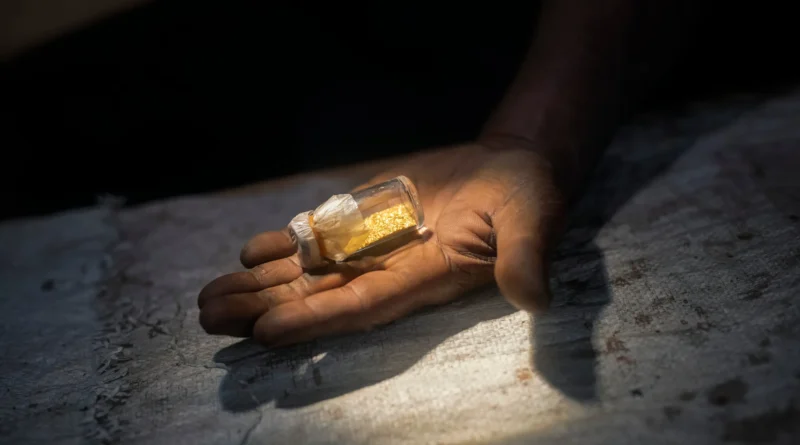
Gold Price Boom Is Fueling Deadly Disease Outbreaks

Surging gold prices, driven by investors seeking stability since the Covid-19 pandemic, have fueled a global boom in unregulated, illegal gold mining across developing nations. A New York Times investigation across Papua New Guinea, Madagascar, and Guyana reveals that these crowded, makeshift mines have become lethal hot spots for infectious diseases—especially tuberculosis, alongside malaria, Ebola, and flesh-eating bacteria. Driven by silica dust, deforestation, child labor, and nonexistent healthcare, miners contract illnesses and carry them home to their communities. Meanwhile, mainstream refineries purchase this illicit gold, linking global financial markets directly to irreversible public health and environmental devastation.



Lynsey AddarioArlette BashiziAdam Ferguson and Federico Rios
Justin Scheck spent more than a year traveling to illegal mines that have sprung up or expanded to meet the world’s demand for gold.
When Covid-19 struck, wealthy investors bought gold, seeking protection from the economic instability created by a deadly infectious disease.
Their continued hoarding has caused gold prices to nearly triple, which, perversely, has fueled further waves of illness and death across the globe, a New York Times investigation has found. We visited far-flung mining towns on three continents that ballooned to meet the record-breaking demand for gold.
They became hot spots for infectious disease.
“There’s a TB boom as well as a gold boom,” said Chris Kuksa, a nurse in a Papua New Guinea region where gold mining has exploded. By the time the miners arrive at his hospital, he said, many have already infected their family and neighbors with tuberculosis, the world’s deadliest infectious disease.
The illness emanating from gold mines is an example of how investors, seeking shelter from destabilizing forces, inadvertently sow the kind of instability they are hedging against.
The Times this year also revealed how, as gold prices climbed ever higher, the industry’s guardrails collapsed. The White House, the U.S. and Canadian mints and major gold refiners have helped to embolden or enrich gangsters, child exploiters and drug cartel members. Gold fuels one of the world’s deadliest continuing wars, in Sudan. Gold can be more profitable to drug dealers than cocaine and more attractive to money launderers than cryptocurrency.
Recent outbreaks of Ebola, Mpox and the Marburg virus have spread from crowded African gold mines, killing thousands. One recent study in the Amazon found that 76 percent of miners tested had suffered flesh-eating bacterial infections. In Guyana, researchers have found that surging gold prices led to even bigger increases in malaria cases.
But tuberculosis is the disease most closely linked to gold mining. Infection rates are falling in most of the world, but not in Madagascar and Papua New Guinea, two countries in the thrall of chaotic gold rushes.


The idea that mining causes illness may not be intuitive, but scholars made the connection centuries ago. The German metallurgist Georgius Agricola noted the tuberculosis link in the mid-16th century. Researchers tracked cholera and tuberculosis during the California gold rush, typhoid in the Klondike decades later, and dysentery and bat-to-human infections in gold mines across Africa and Asia in the years since.
Modern medicine tamed many of those diseases. Today’s gold boom is bringing them back, and making them worse. Recent prices — a record $5,602 an ounce this year — have made it profitable to mine in remote areas with inefficient, destructive methods. Miners level old-growth forests, barge excavators far up remote rivers, and devastate towns and farmland. They pile into dusty, overcrowded mines without basic health protections. Disease follows.
Little data is available on outbreaks in hard-to-reach areas with few doctors and fewer researchers. The only way to see how gold prices drive disease in these places is to be there.
This fall, I drove four hours north from Papua New Guinea’s capital, Port Moresby, on the region’s only paved road, and parked by the winding Tauri River. A dinghy with an outboard motor took me upriver, into dense tropical forest.
Six hours later, I reached the path to Hells Gate.

Gold, Fire and Violence
Hells Gate is a jumble of rudimentary mines and shanties hacked out of the forest. Flocks of huge cockatoos squawk overhead by day, and even larger bats fill the skies at dusk. Fires, set by the miners to clear brush, smolder in all directions.
“This is all gold,” a miner named Tony Feoviri explained, sweeping his arm across the landscape. “Even the road we’re walking on,” he said. “It’s gold.”
Until recently, though, it made little financial sense for anyone other than locals to mine there. Extracting gold from Hells Gate’s soil is particularly hard work. The land is flecked with tiny grains of gold, like ground pepper mixed with tons of gravel and dirt. The huge cost of lugging equipment so deep into the forest turned most people away.
A few years ago, gold surpassed $2,000 an ounce and the economics changed. People flocked to mine gold in Hells Gate — illegally, because they did not have licenses, did not own the mining rights and sometimes used child labor.

When gold surpassed $4,000 an ounce last year, it became worth the cost of barging excavators and trucks upriver. A company that owned the mining rights opened a legal mine in the middle of the lawlessness.
Violence is common outside the company’s security fence. Members of two rival communities attack each other and the company with bows and arrows or handmade guns.
Illness is as common as conflict in Hells Gate.
Poor living conditions and diets of canned food and bush meat put people at risk of disease. I met a man carrying a fruit bat — a species that transmits viruses to people — to eat for breakfast.
Research shows the act of mining itself is a major risk factor.
Mining creates silica dust that damages the lungs and the immune system, said Rodney Ehrlich, a South African researcher who has studied the link for decades. The resulting condition, silicosis, greatly increases the chance of developing tuberculosis.
Most research focused on big industrial mines. But in 2015, a San Francisco occupational health expert named Perry Gottesfeld found that workers in small-scale mines had even greater exposure to airborne silica and “incredibly high rates” of tuberculosis.
Then this year, Patrick Howlett, a physician and researcher at Imperial College London, delivered a new finding. He reported elevated risk for silicosis not just among miners who crush rock, but also among those who sift leftover mining gravel — similar to the method used at Hells Gate.
“People are sick here,” said Andrew Tie, 29, a graduate student who has been paying tuition by mining with his family at Hells Gate since before the gold boom.


Tuberculosis is generally treatable with antibiotics, but there are no doctors at Hells Gate. During my visit, one woman was too sick to leave the hut she shared with others. A man, unable to walk, beckoned us over, hoping that all the talk about illness meant that doctors had arrived.
Geographically, Hells Gate is a world apart from Europe’s financial capitals. But in the gold industry, it is one step away. A man who said he was mining Hells Gate illegally said he had been selling to the same customer for a long time. He handed me a receipt showing a sale to Italpreziosi South Pacific, a buyer affiliated with the major Italian gold refinery Italpreziosi. Italpreziosi’s gold bars sit in vaults at banks like JPMorgan, held by funds traded on stock exchanges — one example of how illegal gold slides into the mainstream market.
Roberto Tanganelli, an Italpreziosi executive, said that the company was “entirely unaware” of illegal mining in its supply chain. He said that Italpreziosi South Pacific was a distinct legal entity. He said that, after receiving my email, the company “took immediate actions.”
Recent research estimated that about 18 million informal gold miners worldwide faced heightened tuberculosis risk. But that was based on 2023 data, and experts say that the number has most likely increased as more people rush into mines.
No estimate exists at all for Hells Gate. The nearest place to get tested is a six-hour boat ride away.
More Than Just a Dangerous Job
In the town of Bulolo, across the spine of mountains bisecting Papua New Guinea, the rural hospital runs a tuberculosis-testing laboratory from a hillside cabin.
Cases have surged since about 2024, medical workers say, when rising gold prices brought a wave of miners.
One of those miners, Mark Justin, waited on the laboratory’s porch for his test results. He had been sick for a year — fatigued, coughing and wasting away. (Hence tuberculosis’s old name, “consumption.”) He made the exhausting daylong trip to the hospital only after his 2-year-old daughter started coughing blood.
“I’m too sick,” said Mr. Justin, 27. “I’m confused. I’m worried.”
This is what separates gold mining from other dangerous jobs like logging or deep-sea fishing. When a tuna fisher gets pulled overboard, his whole family does not drown with him.
When miners catch tuberculosis in a gold mine, they bring it home.
As Mr. Justin received his positive test result, his daughter was in a hospital ward, surrounded by doctors. She was sicker than he was, and doctors began treatment even before they could collect her phlegm for a test.


Quantifying the precise effects of gold mining on Papua New Guinea’s public health is next to impossible. There is little money to study it, especially in rural areas. But everyone I talked to said the trend was clear.
Until about a decade ago, Papua New Guinea’s tuberculosis rate was falling, World Health Organization data show. Urbanization, poverty, overcrowding and poor health care drove up infection rates, said Ann Clarke, who runs a Port Moresby nonprofit group, Businesses for Health, that works on tuberculosis and H.I.V. prevention.
Now, the gold boom draws people from cities to the mines, where conditions accelerate the spread. “There is an increase in migration to the areas because the gold price has increased,” said Pilly Mapira, who overseas disease control and surveillance for the country’s health department.
Tuberculosis testing has increased in recent years, Dr. Mapira said, but the government has not studied the spread in mining populations. She said the government aimed to do so in coming years.
Sex work and sexually transmitted diseases also proliferate around gold mines, and conditions like H.I.V. make people more susceptible to tuberculosis.
The global gold run-up hits poor countries hardest not because they may have more gold. Rather, weak and unstable governments allow illegal mining to flourish. Thousands of people would never be allowed to ravage a huge tract of uninhabited American land to turn it into a gold mine overnight.
But that is what is happening in less prosperous countries, with unexpected public health consequences. In the South American country of Guyana, for example, researchers have documented how another disease flourished around mines.
“When the gold prices go up, the malaria cases go up,” a Harvard University epidemiologist, Caroline Buckee, told members of a remote Indigenous community in Guyana last year.

She and her colleagues reported in 2021 that a 1 percent increase in the gold price was followed by a 2 percent rise in malaria infections in the country.
Thousands have rushed to the area in recent years, clearing trees and building ponds where mosquitoes breed.
“Everyone gets malaria,” said Bruna Mello, a manager at a nearby illegal mine.
There’s No Going Back
If the stream of miners arriving for tuberculosis tests in Bulolo showed an outbreak in action, what I saw this summer at an open-air hospital near gold mines in eastern Madagascar showed the fallout.
“As soon as I began to vomit blood, my family brought me here,” said Norbert Phillippe, a miner who was being treated at a tuberculosis ward in the hospital.
Mr. Phillippe mined by breaking rocks, a technique that is particularly bad for the lungs. Two of his fellow miners died of tuberculosis in 2024, he said. His sister and his brother also got sick.
Sitting on a bed nearby was a 7-year-old boy, Vanina. He contracted tuberculosis working in a gold mine with his mother and brother. “All the babies like him work in panning,” said his mother, Blandine (neither she nor Vanina uses a last name).


Gold booms do not make the spread of disease inevitable. Big corporate gold mines do not generally see the same tuberculosis rates. Because of decades of research into the risks, large, legal operators in rich and poor countries alike are more likely to require basic safety equipment.
One reason that chaotic, illegal operations can keep growing, employing children like Vanina and spreading disease, is that mainstream refineries are willing to buy from them.
After hitting a record high this year, the gold price has wobbled. The commodity currently hovers around $4,000 an ounce.
At these prices, scientists say it will take years to fully understand the effects. Pablo Martinez de Salazar, one of the scientists who studied malaria in Guyana, is now working in the Amazon, studying how diseases like yellow fever and dengue spread along the roads into mining areas.
Even if gold prices were to see an extended decline, damage from the gold run-up is irreversible. Once tuberculosis takes hold in a community, it does not leave when mining stops. People can carry and spread the disease for years.
In villages like Leklu, near the Bulolo hospital, residents struggle every day with the consequences of the gold boom.
A few locals had always mined the area. Then, about two years ago, outsiders arrived with excavators and other heavy equipment. They destroyed much of the ground, leaving a wasteland of rubble, save for a single pillar of earth that holds the grave of the village patriarch.
Farmers became miners, said Gima Anugu, a community leader. Diets changed from local crops to canned fish.
There is no comprehensive data available on tuberculosis in Leklu. But one villager after another recounted their experiences with the disease. Most either worked in gold mines or were related to people who did.
“Because of gold, there’s a lot of sickness,” said Chris Dange, a miner who estimates that he is at least 50 years old. He got tuberculosis last year, then his wife fell ill, too. Things were better before the gold rush, he said.
There is no easy way back for Leklu. Much of the village’s cropland has already been destroyed and mined for gold.

Justin Scheck is a London-based reporter for The Times.
Lynsey Addario has been a contributor to The Times since 2001. She has photographed many of the biggest conflicts and humanitarian crises of her generation.