
Students Rally in France for Second Day of Mass Protests in a Week

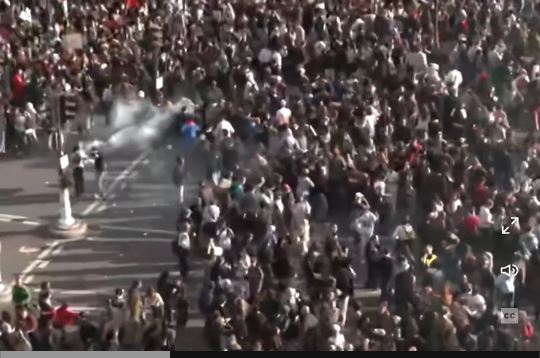
An enormous crowd gathered at Bastille square in Paris on Thursday afternoon, as France’s education minister met with three major student groups.
Protesters angry about the conditions in public schools packed into one of the main squares in Paris on Thursday, as French officials looked for ways to ease a crisis that has threatened to swell into a nationwide wave of grievance.
Just over 150 high schools were closed around France as of midday on Thursday, according to the French education ministry. That was down sharply from Tuesday, when the ministry said that nearly 900 schools were shuttered because of the student protests. The main demonstration got underway later Thursday afternoon in Paris, where an enormous crowd of mostly young people gathered at Bastille square amid a heavy police presence.
There were signs that French officials were listening to the students’ grievances. France’s education minister, Édouard Geffray, invited three major student groups to meet him on Thursday afternoon. Mr. Geffray pledged there would be no job cuts at schools, addressing one of the students’ complaints — a shortage of teachers. But the government won’t unveil its new education budget until Nov. 12, which has left many students frustrated.
The big question confronting French officials is whether other groups will now join the protests, which could alter their character and make them even more disruptive. So far, they have largely been contained to high school campuses and focused on student grievances — except for marches across France on Tuesday, when union activists rallied with the students, drawing an estimated 250,000 people, according to the Interior Ministry. Unions have called for a third day of nationwide protests next week.
The protests come at a fraught moment for France. The country faces a presidential election in April in which a far-right candidate, Marine Le Pen, has a plausible path to victory. And France is in the throes of a financial crisis and fears about public debt caused yields on French bonds to spike to nearly 5 percent on Wednesday.
The students are protesting against overcrowded classrooms, a shortage of teachers and decrepit facilities. But with parlous public finances, the French government can offer students little remedy beyond continuing to suspend most classes so they can air their complaints.
“Young people’s anger doesn’t come out of nowhere,” Prime Minister Sébastien Lecornu said in a speech to the nation on Wednesday. But he pleaded with the students to “choose their path and look to the future with confidence.”
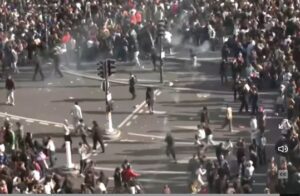
The police are now trying to disperse the protesters at Bastille square. An officer on a megaphone is directing people to take a specific route, and from the end of the square I could see that a police water cannon was used at one point. Some people are starting to disperse but a huge crowd remains.
Here’s what else to know:
-
Solidarity from university students: The crowd of demonstrators in Bastille square included many university students who said they were moved to join the protests because of police violence against high schoolers that they had seen online. “We are used to seeing police in France beat people but they are normally adults,” said Kerra Underwood, 20, who is studying psychology. “These are kids.”
-
Paris protest: One of the wellsprings of the protests is the Paul Éluard high school, where crumbling buildings and staff shortages propelled student anger and led some of them to pull down a fence and set fires outside the campus.
-
A key suburb: Though the protests have affected schools across the country, they have been particularly intense in Seine-St.-Denis, a suburb north of Paris where there are unusually high levels of unemployment, poverty, immigration and teacher absenteeism.
-
Far-left in focus: The protest movement has been a double-edged sword for France Unbowed, France’s main far-left party, and its leader, Jean-Luc Mélenchon, who is one of the most serious contenders for next year’s presidential election. Some of the party’s lawmakers joined blockades early on and were quickly accused by the center and right-wing parties, as well as the government, of stirring up tensions. The party has denied the accusations and criticized the government for adopting what it considered to be a heavy-handed police response.