
This Trap Wants Ants to Take a Bite

Named for an ancient Roman crossbow-like weapon, the newly found “ballista” spider uses a springy snare to catch prey.
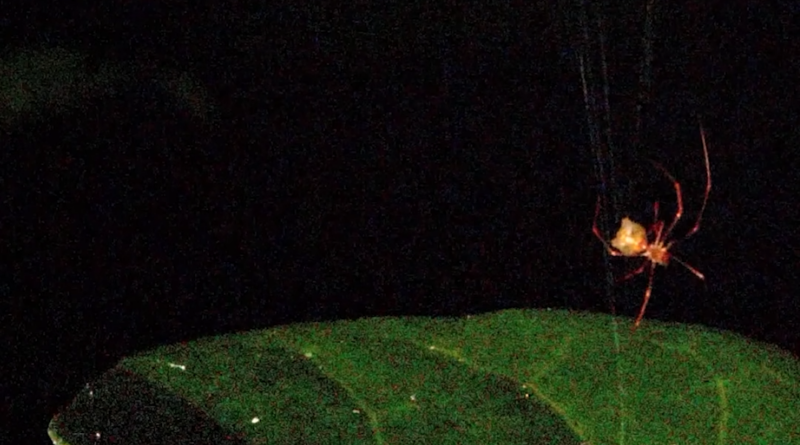
In the dead of night, a predator lays its traps in the rainforests of Queensland, Australia. It spins silky, spring-loaded webs, appears to coat them with a tantalizing, yet enraging scent, and then waits.
Its prey comes along. The victim rushes that way, becomes aggressive and bites the offending web. The trap snaps, and the prey catapults through the air — right to where its hunter has been waiting.
This hunter is a newly discovered spider, and scientists are for now calling it the ballista spider, after a crossbow-like weapon from ancient Rome. Its prey is an ant. And the unusual springy snare? It is perhaps the first known example of a spider setting a trap whose mechanism is triggered by the prey itself, as described in a study from the journal Current Biology.
The discovery process began several years ago, when Gregory Anderson, an author of the study, happened upon the spider’s cone-shaped webs. He shared the find with a small group of researchers, who “immediately thought this was absolutely bizarre and needed investigation,” said Ajay Narendra, a sensory biologist at Macquarie University in Australia who was part of that group.
The team trekked into the remote rainforests of the Cape York Peninsula in Australia to watch the spiders with high-speed cameras and infrared lights, and to collect samples of the springy silk. In total, they recorded five of the fast-moving traps on film.
“We spent several nights watching and filming these spiders build their webs and hunt green ants,” Dr. Narendra said. “We had to film at 5,000 frames per second to visualize” the hunting strategy, he added. (After calculations, they found that the trap launched ants faster than 1,300 meters per second squared.)
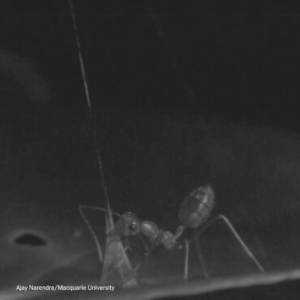
They observed several other things, too: The spiders were hunting one specific ant, the green tree ant, which is highly territorial and aggressive. The spiders closely mimicked the ant’s appearance, with a large green abdomen and segmented body. And the spiders seemed to be using the ant’s aggression against itself. Researchers think they might be coating their web traps with pheromones that attracted the ant and elicited its aggressive biting response.
The biting, the scientists saw, is what sets off the trap and launches the victim into the air toward the ballista spider.
Many spiders use pheromones to lure prey. The bolus spider, for example, creates a sticky blob-shaped web that it swings at moths who are drawn closer by the false scent of females. However, the new species’ use of a negative stimulus to elicit a response is unique.
“In this paper there’s also olfactory mimicry that is mimicking the sense of something that the ant doesn’t like,” said Andrew Gordus, a biologist at Johns Hopkins University who was not involved in the research. “I’ve never heard of that before.”
Also unique is this spider’s web. Some species rely on their webs’ elastic tension to catapult prey, but not in quite the same way as the ballista spider. The “triangle” and “slingshot” webs of these other species rely on the spider to release the tension and launch their prey, said Jessica Garb, an evolutionary biologist at the University of Massachusetts Lowell who was not involved in the new study. However, the ballista spider’s cone-shaped web relies on the prey setting off the trap.
“There are just so many different spider species” that researchers still haven’t had a chance to study, Garb said. “This is a really fabulous example of an interesting web that wasn’t really described before.”
K. R. Callaway is a science reporter and a member of the 2026-27 Times Fellowship, a program for journalists early in their careers.