
U.S. Is Negotiating an Iran Deal That Would Buy Time, Again
The United States proposed a 20-year “suspension” of all nuclear activity, even as President Trump demands assurances that Iran can never build a nuclear weapon.


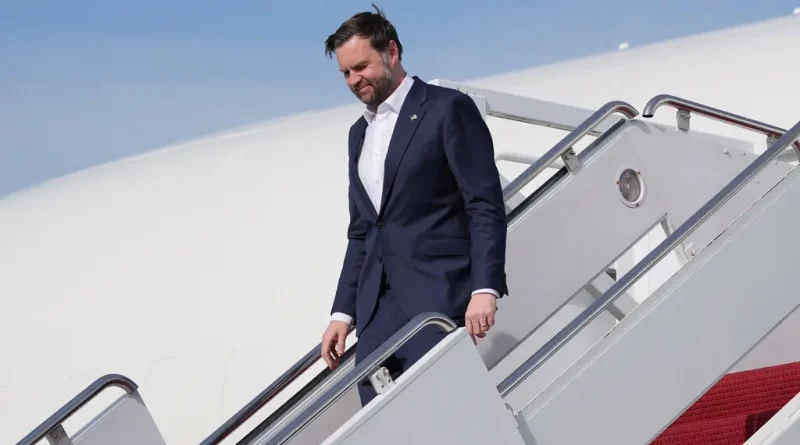
Just before Vice President JD Vance left Islamabad early Sunday morning, he described Iran and the United States as worlds apart, chiefly on the question of assurances that Iran can never build a nuclear weapon — “not just now, not just two years from now, but for the long term.”
It turns out that the Trump administration’s idea of the long term is 20 years.
As details of Mr. Vance’s 21-hour visit to Pakistan spilled out on Monday, people familiar with the negotiations said the U.S. position was not a permanent ban on nuclear enrichment by Iran. Instead, the United States proposed a 20-year “suspension” of all nuclear activity. That would allow the Iranians to claim they had not permanently given up their right, under the Nuclear Nonproliferation Treaty, to produce their own nuclear fuel.
In response, Iran renewed a proposal that it suspend nuclear activity for up to five years, according to two senior Iranian officials and one U.S. official. The Iranians had made a very similar proposal in February during a failed set of negotiations in Geneva that convinced President Trump it was time to go to war. Days later, he ordered the attack on Iran.
There are several other issues looming over the negotiations, including restoring free passage in the Strait of Hormuz and ending Iran’s support for proxy groups like Hamas and Hezbollah. But Iran’s refusal to end its nuclear ambitions, dismantle its huge atomic infrastructure and ship its stockpile of fuel out of the country has always been the central dispute.
So the revelation that the two sides are now arguing over the time period for suspending nuclear activity suggests that there may well be room for a deal, and there were indications on Monday that negotiators may meet again in the coming days. White House officials said no meetings had been finalized, but another round of in-person negotiations was being discussed.
But for Mr. Trump and his aides there is also the risk that any agreement that emerges may resemble the 2015 nuclear accord, which the president exited three years later and called a “horrible, one-sided deal that should have never, ever been made.”

At the core of Mr. Trump’s complaint about the Obama accord, formally called the Joint Comprehensive Plan of Action, was that it contained “sunsets.” And it did: The Iranians were allowed gradually more enrichment activity until 2030, when all restrictions would evaporate. (Iran’s commitments under the nonproliferation treaty would still ban it from building a bomb.)
But the Obama deal did not involve a full suspension of nuclear activity, which would buy at least a few years of zero nuclear activity — past Mr. Trump’s term in office.
“If they could get Iran to suspend for even a few years, that is superior to what we got in the J.C.P.O.A.,” said Rob Malley, who was on the negotiating team in 2015 for the Obama administration and then led an ultimately fruitless effort during President Joseph R. Biden Jr.’s administration to restore some kind of agreement.
In fact, the history of America’s interactions with Iran is littered with efforts to buy more time. Sometimes that has come by sabotaging the program, as the United States and Israel did by using cyberweapons to make nuclear centrifuges self-destruct. Sometimes it involved sanctions, and at other times diplomatic agreements.
But the result has been that it has taken Iran longer to get to a bomb than almost any other country that has seriously sought to build one — longer than North Korea, India, Pakistan or Israel, all of which now have nuclear arsenals.
The status of the current negotiations was described by officials and experts who declined to speak on the record because of the sensitivity of the talks. Like the Obama administration, the Trump White House is trying to preserve the secrecy of the negotiating room, so that it has maximum room to cut a deal. And like the Obama administration, it is discovering that both sides engage in strategic leaking.
Mr. Vance said on Monday evening that there were “some good conversations” with Iran in Pakistan, and the ball is now in Tehran’s court.
“The big question from here on out is whether Iranians will have enough flexibility,” he said on Fox News.
Mr. Vance said Iran showed some flexibility but “didn’t move far enough.” As to whether there would be additional talks, he said the question would be “best put to the Iranians.”
At the White House, Karoline Leavitt, the press secretary, said that “President Trump, Vice President Vance and the negotiating team have made the U.S. red lines very clear.”
“The Iranians’ desperation for a deal will only increase with President Trump’s highly effective naval blockade now in effect,” she said in a statement, “which is sending oil tankers towards the big, beautiful Gulf of America.”
Another sticking point centers on the U.S. demand that Iran remove 970 pounds of near-bomb-grade uranium from the country, to ensure it could never be diverted to a bomb project. Trump has weighed sending in ground troops to Isfahan to secure the bulk of the highly enriched uranium, which is stored deep underground in what look like large scuba-diving tanks.
The Iranians have insisted the fuel must stay inside Iran. But they have offered, as they did in Geneva, to dilute it significantly so that it could not be used to produce a nuclear weapon.
That, too, would extend the timeline to a bomb. The risk, of course, is that the Iranians would still have possession of the fuel and in the future might be able to re-enrich it to its current state of about 60 percent purity, just below the 90 percent needed to make a weapon.
As the talks move to their next stage, one thing to watch is whether Iran gets back money it believes it was owed.
Mr. Trump has complained for years, and repeated in recent weeks, that the Obama administration released “planeloads” of cash to Iran — a reference to returning $1.4 billion in Iranian assets long frozen by the United States, plus $300 million in accumulated interest. (Some of it did go in pallets of cash aboard an airplane, because Western banks were prohibited from doing business with Iranian entities.)
It is too early to know how it will turn out, but part of the negotiations underway now involve Iran’s demand that the West unfreeze roughly $6 billion in funds from oil sales, which have been tied up in Qatar because of sanctions that date to Mr. Trump’s first term.( NYT)
==================================================================================================
Farnaz Fassihi and Ephrat Livni contributed reporting.
David E. Sanger covers the Trump administration and a range of national security issues. He has been a Times journalist for more than four decades and has written four books on foreign policy and national security challenges.
Tyler Pager is a White House correspondent for The Times, covering President Trump and his administration.
Farnaz Fassihi is the United Nations bureau chief for The Times, leading coverage of the organization. She also covers Iran and has written about conflict in the Middle East for 15 years.