
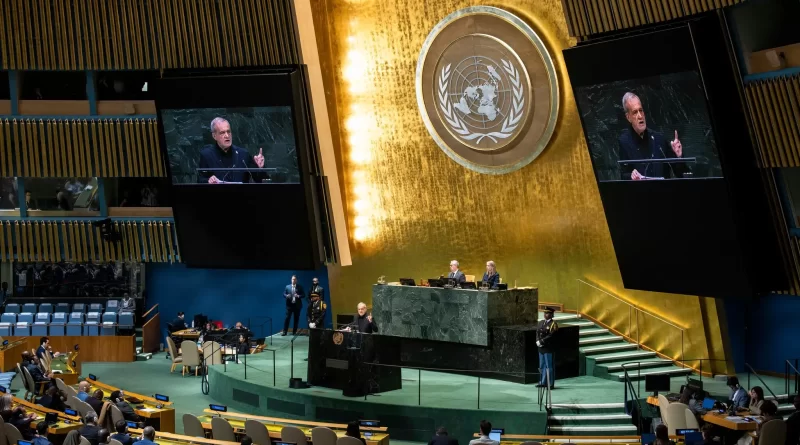
Iran’s President Accuses U.S. and Israel of Lawless Attacks on Nonmilitary Targets
Masoud Pezeshkian became the first leader whose country is at war with the United States to address the General Assembly in New York. He spoke of peace efforts but said Iran would never accept limits on its civilian nuclear program.


A day after President Trump used the stage of the United Nations General Assembly to threaten to “annihilate” Iran, the Islamic Republic’s president, Masoud Pezeshkian, stood at the same lectern and gave a defiant speech, brandishing pictures of those killed by American and Israeli strikes on his country.
Mr. Pezeshkian vowed that his country could “not be made to surrender” and accused the United States and Israel of going “against international law” by targeting civilian infrastructure in its strikes on Iran. “Yes they did hit us,” he said, “but we did not bend the knee.”
It was the first time in the world body’s 81-year history that the president of a country that is actively at war with the United States has set foot in New York to address the Assembly.
Just seven months ago, Mr. Pezeshkian was running his country from an underground bunker, trying to stay alive as U.S. and Israeli airstrikes rained down.
Now, Mr. Pezeshkian is being protected by the Secret Service, as per protocol, and he has been cruising through Manhattan in convoys of S.U.V.s as well as holding a marathon of diplomatic meetings.
Among the other leaders scheduled to address the Assembly on Wednesday are Ukraine’s president, Volodymyr Zelensky, President Javier Milei of Argentina and Delcy Rodríguez, who has led Venezuela’s government since the United States deposed Nicolás Maduro in January.
President Ahmed al-Sharaa of Syria gave the first speech on Wednesday, using his time to highlight the many ways his country has been folded back into the international community after more than a decade of civil war.
In Mr. Trump’s address on Tuesday, his focus turned to Iran. He said that he faced a choice: to strike a deal with Iran and help it become economically prosperous, or to “annihilate” it.
The United Nations provides Iran a stage it cannot afford to ignore. The country has been attacked by the United States and Israel, its top leaders have been assassinated, its schoolchildren killed by American bombs and its population subjected to severe economic hardships. The mere act of showing up in New York, analysts said, signaled to the world that Iran remained defiant.
In an unexpected development on Tuesday, American and Iranian representatives met through mediators for the first time since a peace agreement fell apart in July. Iran’s foreign minister, Abbas Araghchi, communicated through Qatari mediators with the U.S. special envoy, Steve Witkoff, and Jared Kushner, a son-in-law of Mr. Trump’s, on the sidelines of the General Assembly.
According to two Iranian officials, they discussed how Tehran and Washington could resume peace talks. Esmail Baghaei, the spokesman for Iran’s foreign ministry, said the Iranians had demanded a halt to the war and the lifting of the naval blockade on ports, state media reported.
Gen. Yahya Rahim Safavi, the top military adviser to Iran’s supreme leader, Ayatollah Mojtaba Khamenei, told Iranian state television on Tuesday that the supreme leader had “right now decided to give the government an open hand to negotiate.”
Here is what else to expect:
-
A.I.: The U.N. Security Council will convene a session of foreign ministers on the threat posed by artificial intelligence, specifically the use of A.I. weapons in conflicts. The event has gained more urgency after recent warnings by some A.I. developers that without significant oversight, the technology could pose a threat to humanity. In many parts of the world, however, most people feel positive about A.I., according to a new Gallup poll.
-
Climate change: A summit hosted by António Guterres, the U.N. secretary-general, will take place in the afternoon, bringing together leaders of governments from countries most vulnerable to climate upheaval, as well as major energy producers and consumers.